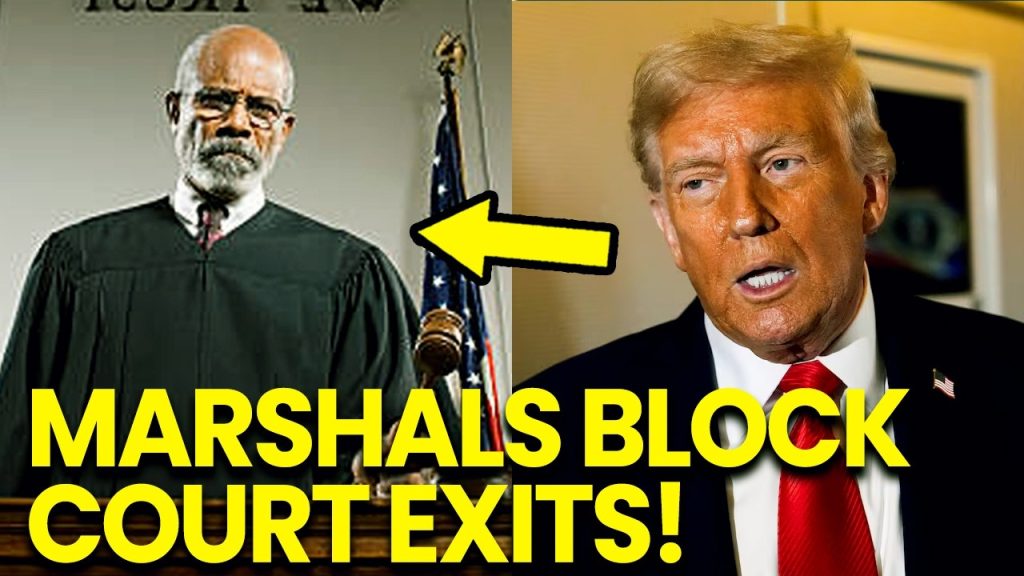
When a courtroom becomes a stage for national politics, even the smallest gesture can reverberate far beyond its walls.
This week, renewed attention fell on Donald Trump after footage and reporting resurfaced from his New York civil fraud trial — including the moment he abruptly exited the courtroom following an adverse ruling. While some online commentators dramatized the possibility of judges “blocking all exits,” the legal reality is more structured, and more restrained, than viral headlines suggest.
The underlying case, brought by New York’s attorney general in 2022, accused Mr. Trump and his company of inflating asset valuations to secure favorable loans and insurance terms. In 2023, a judge found Mr. Trump liable for fraud. Recently, a state appeals court narrowed the financial penalty — throwing out roughly $500 million in sanctions on constitutional grounds — while leaving the liability finding intact. The decision was described by Mr. Trump and his allies as a victory, though the core fraud determination remains in place.
It was against that backdrop that an earlier courtroom episode regained attention: Mr. Trump rising from his seat, expressing frustration after a ruling, and leaving the room while proceedings continued. Because the matter was a civil bench trial — not a criminal jury proceeding — his presence was not legally required. The trial did not halt. The judge continued. No marshals were dispatched to seal doors.
Still, the optics lingered. 📸

In American courtrooms, decorum is not ornamental; it is foundational. Judges possess broad authority to maintain order, including the power to cite individuals for contempt, impose fines or, in rare circumstances, order detention. In criminal trials especially, defendants are typically required to remain present unless formally excused. A willful departure in such a context could carry consequences.
But the idea that a judge would routinely “lock down” a courtroom in response to frustration over a ruling is, legal scholars say, an exaggeration. Court security officers and U.S. marshals answer to judicial authority, yet their interventions are guided by procedural necessity, not political theater. Blocking exits would be an extraordinary measure, reserved for safety or immediate disruption — not symbolic enforcement.
What makes the Trump cases unusual is not the mechanics of judicial power but the defendant’s profile. A former president retains lifetime Secret Service protection. That detail introduces logistical complexity whenever he appears in court. Security coordination between federal protective agents and court officers requires planning and deference to clearly defined roles. The Secret Service protects; the judge presides.
In the New York civil trial, Mr. Trump’s departure was brief. He returned later. The proceeding itself was unaffected. Still, commentators have speculated about what might occur in one of his pending criminal cases if tensions escalate. In a criminal trial, a judge could instruct a defendant to remain seated and warn of contempt if he attempted to leave. The court could continue in the defendant’s absence under limited circumstances, though such scenarios are uncommon and legally sensitive.
The deeper question is not whether exits can be blocked, but whether institutional authority can be exercised without spectacle. ⚖️
Mr. Trump has repeatedly criticized judges overseeing his cases, characterizing proceedings as politically motivated. His attorneys have pursued aggressive appeals and procedural challenges, a standard legal strategy in high-stakes litigation. Judges, for their part, have responded with written orders, fines for violations of gag restrictions, and structured courtroom management — not dramatic showdowns.

Legal historians note that American courts derive their legitimacy less from force than from consistency. Authority is maintained through precedent, written rulings and adherence to established process. Even in moments of visible tension, the judiciary’s instinct is toward continuity, not confrontation.
The appeals court’s recent decision illustrates that point. While it vacated the financial penalty as excessive under constitutional standards, it did not absolve Mr. Trump of liability. The appellate ruling emphasized proportionality, not exoneration. Such distinctions can be easily blurred in political messaging but remain central in legal analysis.
In that sense, the narrative of “blocking all exits” may say more about the current media ecosystem than about courtroom practice. Online discourse often amplifies hypothetical extremes. Yet actual judicial conduct tends toward measured escalation: warnings before sanctions, sanctions before contempt, and written opinions before public pronouncements.
For Mr. Trump, whose public persona is built on defiance and counterattack, courtroom settings present a different dynamic. The judge sets the tempo. Speaking time is regulated. Reactions are recorded in transcripts rather than rallies. The forum itself imposes discipline.
Whether future hearings will produce sharper conflict remains uncertain. Multiple criminal and civil proceedings continue in various jurisdictions. Each courtroom has its own rules, its own judge, its own procedural posture. But the structural principle is stable: courts do not operate by spectacle. They operate by order.
The image of a former president standing abruptly in a courtroom captures attention. It invites speculation about power, control and institutional limits. Yet the enduring story is less dramatic. It is about process — appeals filed, penalties recalculated, findings reviewed.
In American jurisprudence, exits are rarely blocked. Proceedings, however, continue.






