The high-stakes world of political communications is often compared to a tightrope walk, but what we witnessed this week was more akin to a catastrophic fall without a safety net. Karoline Leavitt, the White House Press Secretary, stepped onto the set of Fox News with a singular mission: to extinguish a growing firestorm surrounding a racially charged video posted on Donald Trump’s Truth Social account.
What followed was not the smooth, polished deflection the public has come to expect from the Trump administration. Instead, it was a fragmented, incoherent, and ultimately desperate attempt to rationalize the irrational, leaving both the interviewer and the audience wondering if anyone is actually at the helm of the White House messaging machine.
The controversy began when a video depicting Barack and Michelle Obama with an “ape motif” was posted to the President’s primary social media account. The backlash was instantaneous and bipartisan, with Senator Tim Scott notably remarking that he prayed the post was a fake because it represented some of the most offensive content he had ever seen associated with the White House.
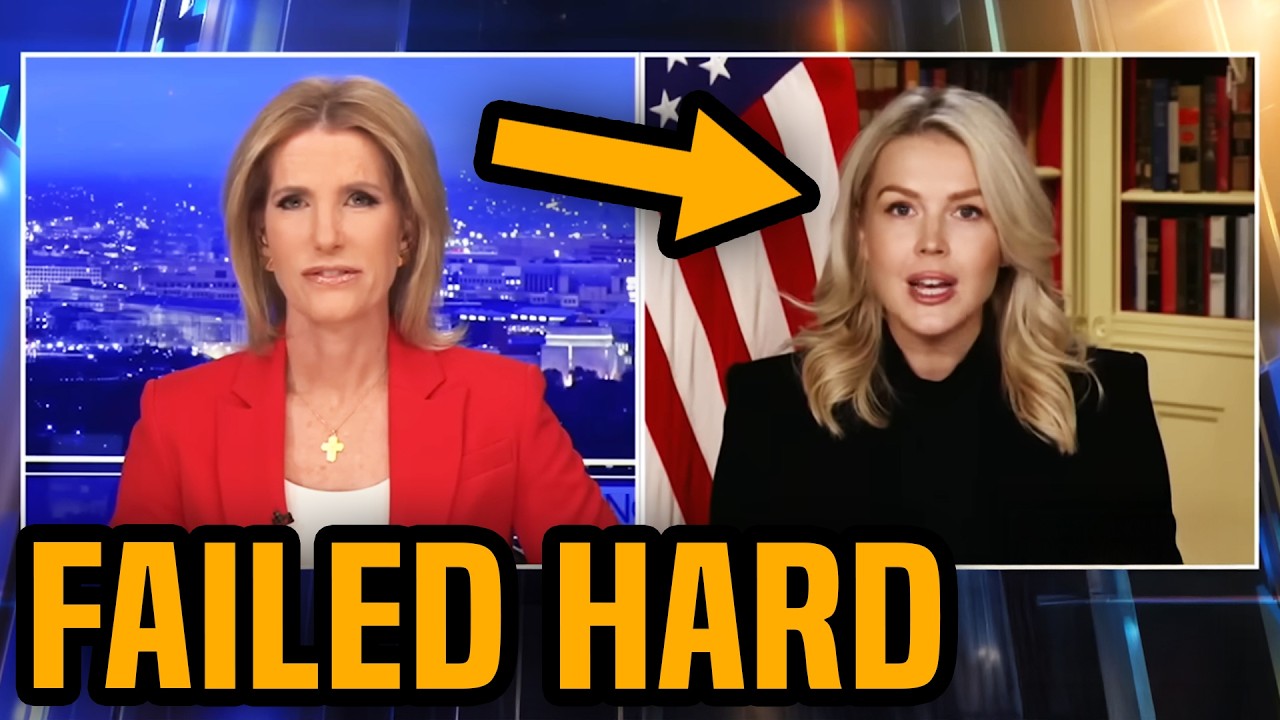
When Leavitt appeared on Laura Ingraham’s show, the setting was intended to be friendly territory. Ingraham, rarely a hostile presence for the administration, offered Leavitt a “gift” of a question, essentially asking if a staffer was to blame for the post. It was a clear exit ramp—a way to distance the President from the content while maintaining a semblance of accountability.
However, Leavitt’s response was a masterclass in how not to handle a crisis. She began by confirming it was a “meme” posted by a staffer but then veered into a bizarre explanation involving Disney’s The Lion King. According to Leavitt, the video was simply a parody where different Democrats were portrayed as different animals.
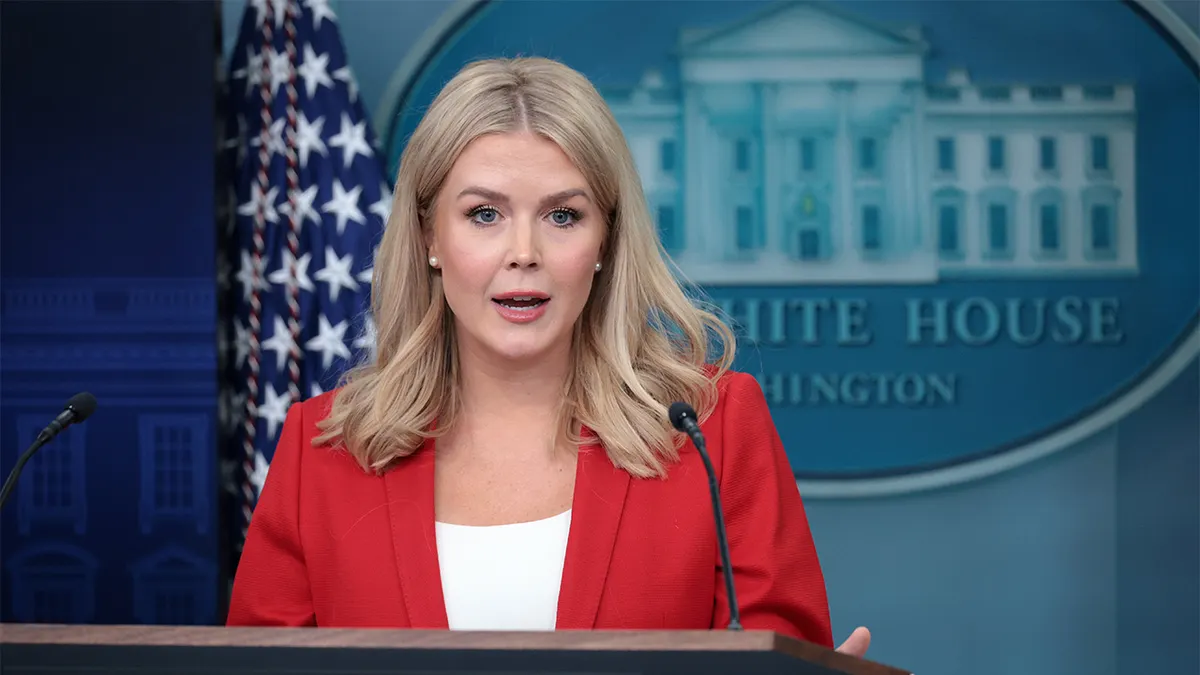
The logic, if it can be called that, was that because Kamala Harris was depicted as a turtle, the portrayal of the Obamas as apes was somehow neutralized of its historical and racist connotations. This defense didn’t just fail; it backfired spectacularly, as critics were quick to point out that The Lion King doesn’t actually feature the types of animals depicted in the meme in the way Leavitt suggested.
The shifting nature of the story—moving from “it’s no big deal” to “it was a staffer” to “it’s actually a Disney-themed joke”—revealed a deeper level of chaos within the administration. When a Press Secretary changes the narrative four times in a single interview, it signals to the world that there is no coherent strategy, only a frantic attempt to survive the current news cycle.
This lack of discipline is more than just a PR headache; it is a direct threat to the Republican Party’s prospects in the upcoming midterm elections. While Leavitt tried to pivot the conversation to the Dow Jones breaking 50,000 points, the political reality is that candidates in swing districts cannot talk about the economy when they are constantly forced to answer for the President’s social media behavior.
Reports from Capitol Hill suggest that Republican incumbents are in a state of “private freakout.” They are aware that for the next nine months, they will be haunted by these “monkey memes” and forced to choose between alienating Trump’s base or alienating the general electorate by defending the indefensible.
The strategy of the Trump administration has always been to minimize, deflect, and blame the media. But as this interview showed, that strategy is reaching a point of diminishing returns. When the defense is so disconnected from reality that it involves mischaracterizing a 30-year-old animated movie, the credibility of the spokesperson—and the administration they represent—evaporates.
For the American voter, these moments are clarifying. They peel back the curtain on an administration that seems more focused on managing the fallout of its own impulses than on governed by a disciplined, clear message. The “Lion King” defense didn’t just fall flat; it exposed a White House that is increasingly scrambling to keep up with its own leader.
As we move closer to the midterms, the question isn’t just whether the GOP can hold the House or the Senate, but whether they can survive nine more months of a communications strategy that is constantly being blown up by a single post. If the Leavitt interview is any indication, the road ahead is going to be incredibly rocky for anyone carrying the Republican banner.
The danger for the GOP is that these “memes” and the failed attempts to defend them become the defining narrative of the election. It is an uphill battle for any party to maintain discipline when the head of the ticket is perceived as “crumbling and declining” in his judgment and digital behavior.
Ultimately, Karoline Leavitt’s appearance on Fox News will likely be remembered as a turning point—the night the spin finally died and was replaced by a transparent, panicked scramble for relevance. Whether the electorate will forgive or forget this level of dysfunction remains to be seen, but for now, the Republican panic is very real.
The disconnect between the White House and the reality of the American public’s reaction to such content is growing wider. It is no longer enough to simply scream “fake news” when the evidence is posted in plain sight on the President’s own account.
As the political landscape continues to shift, the administration’s inability to provide a coherent, honest, and respectful response to controversy will continue to be its greatest liability. The midterms are coming, and as Leavitt’s interview proved, the White House is far from ready for the scrutiny that is about to follow.