🔥 BREAKING: A CONTROVERSIAL POST SHIFTS THE TONE AS Donald Trump SHARES A VIDEO FEATURING Barack Obama — THE REACTION QUICKLY IGNITES ONLINE BUZZ ⚡
Former President Donald Trump ignited a new political controversy this week after sharing on social media a video widely condemned as racist for depicting former President Barack Obama and former First Lady Michelle Obama as apes.
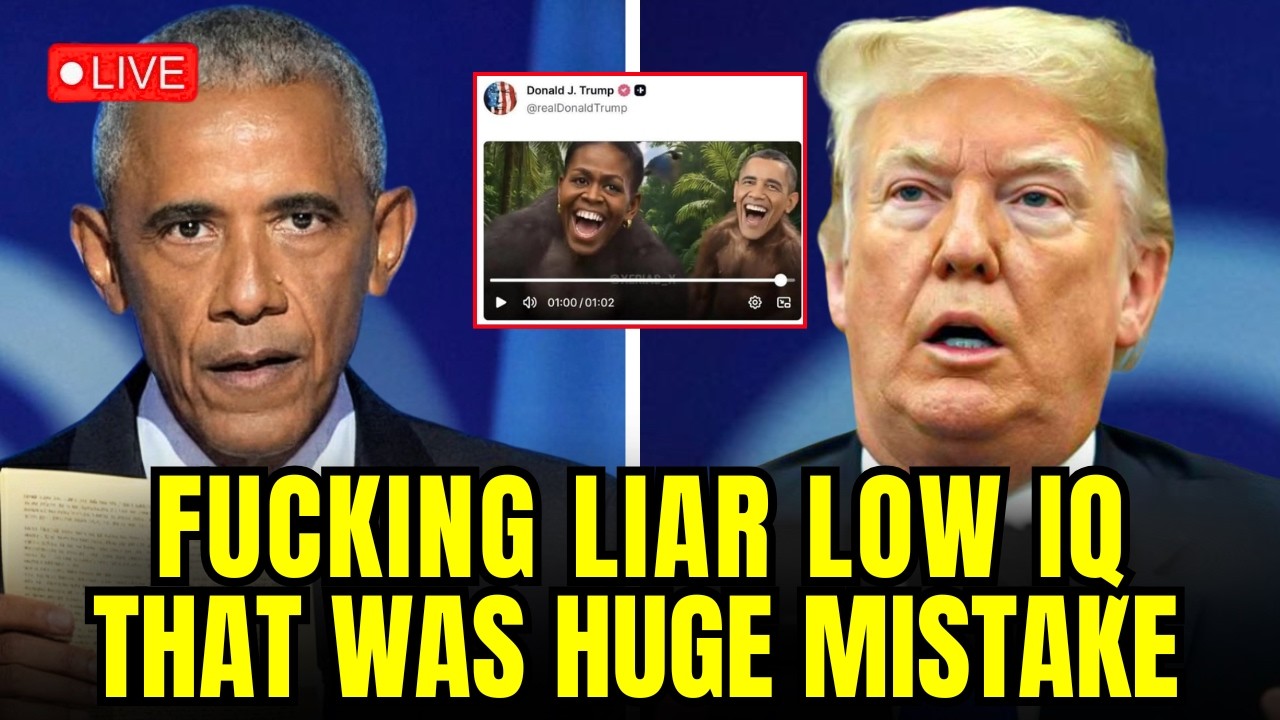
The post, published late in the news cycle, drew swift criticism from civil rights advocates, Democratic lawmakers and media commentators, many of whom described it as beneath the dignity of a former president. The White House later removed the video. As of this writing, Mr. Trump has not issued a public apology.
Mr. Obama addressed the broader climate without referencing the video directly. Speaking at a public event, he said that “the majority of the American people find this behavior deeply troubling,” and lamented what he characterized as a “clown show” unfolding across social media and television. He also noted that norms of decorum and respect for public office appear to have eroded in recent years.
The episode unfolded against the backdrop of renewed attention to court documents related to Jeffrey Epstein, whose network of wealthy and politically connected associates has remained the subject of public scrutiny. In recent weeks, additional filings have been unsealed, prompting another wave of online speculation and media analysis about the names referenced within them.
Some commentators suggested that Mr. Trump’s post was designed to redirect attention from that coverage. The former president has repeatedly denied wrongdoing in connection with Epstein and has described their past social interactions as limited and ultimately severed. The unsealed documents have not resulted in new charges against him. Nonetheless, the continuing release of records has sustained public interest in the case.
The political calculation — if one existed — appeared to hinge on provocation. Historically, controversies involving race have quickly dominated cable news panels and social media timelines. Yet in this instance, the anticipated escalation did not materialize in the expected form.
Mr. Obama did not respond directly on social media. He did not convene a press conference or issue a statement devoted solely to the video. Instead, he continued with scheduled public appearances, including a school visit, offering no extended commentary on the matter beyond his broader remarks about civic norms.
The restraint was striking in an era when political disputes often unfold in real time across digital platforms. Some observers interpreted the silence as strategic — a refusal to amplify content deemed offensive and unworthy of extended engagement. Others argued that silence risks allowing inflammatory rhetoric to circulate without adequate rebuttal.

Civil rights organizations were less equivocal. Several groups condemned the imagery as a continuation of racist tropes historically used to dehumanize Black Americans. They emphasized that such depictions have long carried violent and discriminatory undertones.
The controversy also highlights a recurring feature of contemporary politics: the interplay between distraction and disclosure. Major document releases — particularly those tied to criminal investigations — frequently coincide with unrelated but high-volume controversies. Whether by coincidence or design, the effect can be to fragment public attention.
Legal analysts caution against drawing conclusions about motive without evidence. While the Epstein filings have generated intense public debate, they comprise a complex body of depositions, correspondence and legal arguments accumulated over years of litigation. References to public figures vary in context and significance, and legal responsibility is determined by far more than the mere appearance of a name in court records.
Still, the optics of timing fueled speculation. In the hours after Mr. Trump’s post, television networks and online outlets debated both the content of the video and the continuing revelations in the Epstein case. The dual narratives — one centered on race and rhetoric, the other on legal documents and accountability — competed for prominence.
Political historians note that presidents and former presidents have long sought to shape media cycles to their advantage. What distinguishes the current moment is the speed and scale at which content spreads. A single post can dominate discourse within minutes, yet it can also be overshadowed just as quickly if other developments command sustained attention.
Mr. Obama’s measured response — or lack of a direct one — may have contributed to that dynamic. Without a prolonged back-and-forth between the two men, the controversy did not evolve into an extended public feud. Instead, coverage returned to the broader political and legal questions already in motion.
For many Americans, the episode underscored a larger tension in public life: how to respond to rhetoric that many consider inflammatory without allowing it to eclipse substantive issues. In choosing not to engage directly, Mr. Obama signaled a belief that not every provocation requires a counterpunch.
Whether that approach will influence future political exchanges remains to be seen. What is clear is that the incident added another chapter to a rivalry that has shaped American politics for more than a decade — and illustrated, once again, how swiftly the national conversation can pivot between spectacle and scrutiny.






