🔥 BREAKING: A SHARP COMEDY MOMENT SHIFTS THE TONE AS Jimmy Kimmel TAKES AIM AT Donald Trump Jr. LIVE ON TV — THE REACTION QUICKLY IGNITES ONLINE BUZZ ⚡
On a recent episode of “Jimmy Kimmel Live,” the host Jimmy Kimmel turned his attention once again to Donald Trump Jr., delivering a string of barbs that quickly ricocheted across social media.
The segment was framed around Mr. Trump Jr.’s public appearances and online commentary in defense of his father, former President Donald Trump. But as has often been the case in recent years, Mr. Kimmel used the younger Mr. Trump as a proxy in a broader critique of the Trump family’s political brand — a mixture, he suggested, of grievance, spectacle and privilege.
In one monologue, Mr. Kimmel referred to Mr. Trump Jr. as “Trump’s most disappointing son,” a line that drew sustained laughter from the studio audience and later trended online. In another, he mocked Mr. Trump Jr.’s attempt to position himself as an everyman commentator on American culture, joking that he was a “New York prep school nepo baby” feigning outrage over changes to a restaurant chain’s logo “as if he’s ever been to a Cracker Barrel.”
The humor was pointed, but it was not new. For years, late-night hosts have made the Trump family a recurring feature of their political satire. Mr. Kimmel, in particular, has repeatedly singled out the former president’s eldest son, portraying him as eager for relevance and frequently overmatched in public debate.
The latest exchange followed a flurry of political and cultural controversies. Mr. Trump had delivered remarks at a White House Hanukkah celebration in which he boasted about plans for a $400 million ballroom and recited what he described as a list of pro-Israel accomplishments. The speech, which included meandering asides and repeated self-congratulation, became fodder for late-night commentary.
Mr. Kimmel juxtaposed clips of the ballroom remarks with economic data showing rising unemployment and a slowdown in manufacturing, suggesting a disconnect between political messaging and material concerns. He then pivoted to Mr. Trump Jr., who had been active on social media defending his father’s record and attacking critics.
In one segment, Mr. Kimmel played footage of Mr. Trump Jr. speaking outside a courthouse, where protesters could be heard chanting “crime family” — a reference to ongoing civil and criminal cases involving the Trump Organization. The host likened the family to a “very dumb crime family,” drawing on the language of mob dramas to underscore his point.
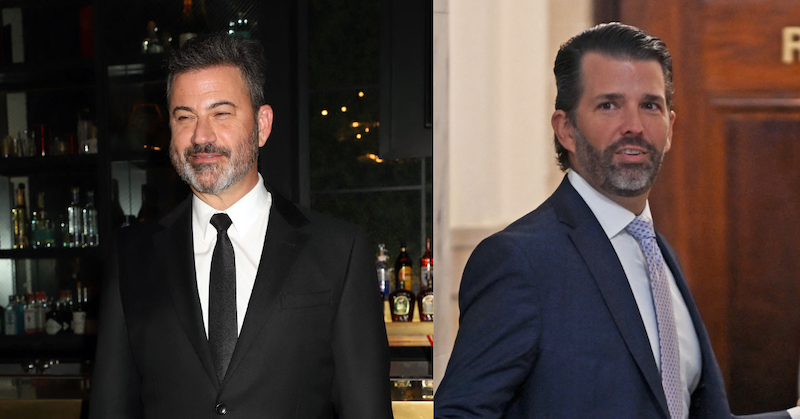
The monologue blended insult with cultural commentary. Mr. Kimmel mocked Mr. Trump Jr.’s gesticulations during interviews — “His hands move faster than his brain,” he quipped — and lampooned a promotional venture branded as “Don Jr. Gold,” suggesting that the younger Mr. Trump’s business efforts were inseparable from his political persona.
Such jabs are consistent with the evolution of late-night television over the past decade. What was once largely apolitical entertainment has become a nightly forum for partisan critique. Hosts like Mr. Kimmel have embraced a more openly ideological stance, particularly in response to Mr. Trump’s presidency and continued influence within the Republican Party.
Mr. Trump Jr., for his part, has leaned into confrontation. A fixture at campaign rallies and conservative conferences, he has positioned himself as a combative defender of his father and a critic of what he calls “elite hypocrisy.” He frequently accuses Democrats and media figures of projecting their own faults onto others — a charge he reiterated in recent interviews.
The dynamic between Mr. Kimmel and Mr. Trump Jr. reflects a broader pattern in American political culture, where cable news, social media and late-night television form a feedback loop. A comment made at a rally becomes a viral clip; a viral clip becomes a monologue; the monologue becomes a new target for partisan outrage.
There are risks and rewards on both sides. For Mr. Kimmel, the sharp humor energizes viewers who see satire as a form of accountability. For Mr. Trump Jr., being targeted by a high-profile host can reinforce his image as a disruptor opposed by cultural elites — a narrative that resonates with parts of the Republican base.
The exchange also illustrates the increasingly familial nature of American politics. The children of political figures, once largely shielded from direct attack, now operate as public surrogates and media personalities in their own right. In that role, they become fair game for the same scrutiny and satire as elected officials.
Whether such segments meaningfully influence voters is difficult to measure. But their reach is undeniable. Clips from “Jimmy Kimmel Live” regularly draw millions of views online, extending the audience far beyond late-night television.
In the end, the monologue was less about a single joke than about an ongoing cultural struggle over authenticity and power. Mr. Kimmel cast Mr. Trump Jr. as a symbol of inherited privilege wrapped in populist rhetoric. Mr. Trump Jr. continues to cast himself as a truth-teller pushing back against a hostile establishment.
Between them lies a media landscape in which politics is performance and performance is politics — and where the punch line can carry as much weight as a policy speech.






