🔥 BREAKING: A BOMBSHELL REVELATION SHIFTS THE NATIONAL CONVERSATION AS NEW DETAILS EMERGE AROUND Jeffrey Epstein — THE REACTION QUICKLY IGNITES ONLINE BUZZ ⚡
As court documents related to the late financier Jeffrey Epstein continue to be unsealed, the disclosures have reignited a familiar public question: Why have so few additional prosecutions followed?
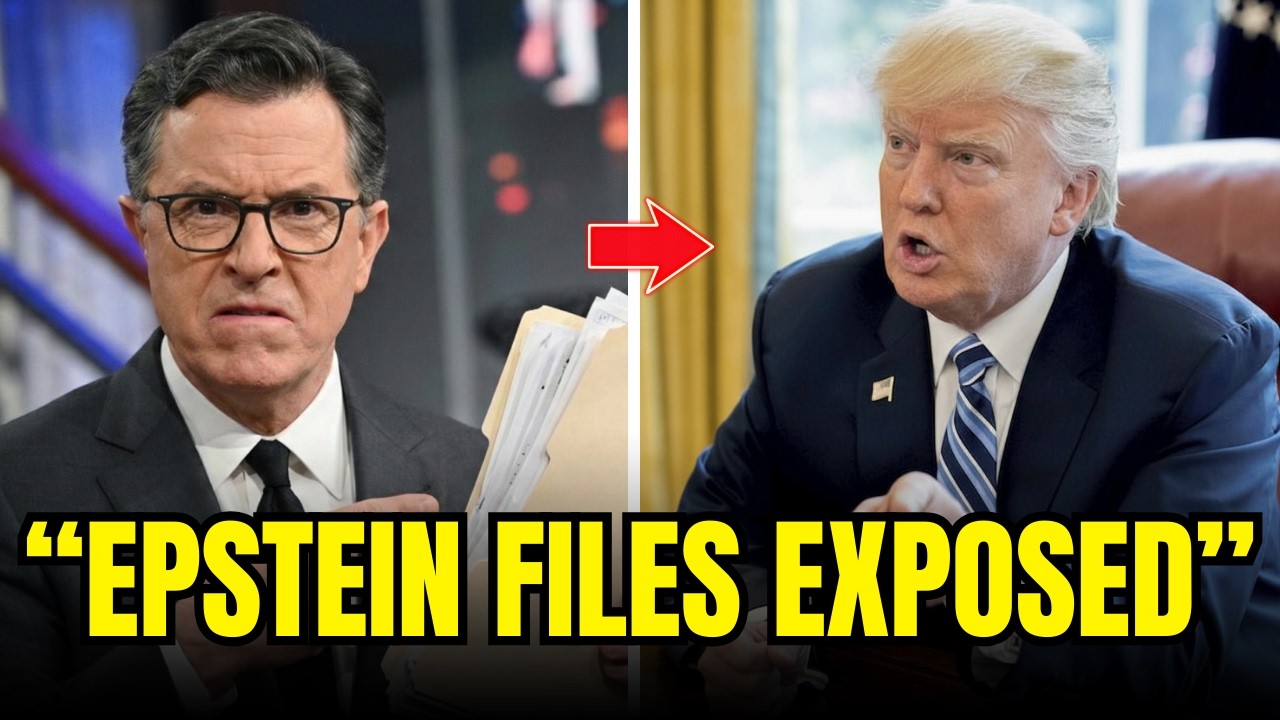
The records — comprising flight logs, depositions and internal correspondence — have surfaced in phases over recent months, naming business leaders, academics and politicians who at various points crossed paths with Epstein. While inclusion in the documents does not imply criminal conduct, the steady flow of revelations has renewed scrutiny of the justice system’s response to one of the most notorious sex-trafficking cases in recent history.
On a recent broadcast of “The Late Show,” Stephen Colbert devoted a segment to the issue, shifting from satire to sober inquiry. Rather than leveling accusations, he framed his remarks as a series of questions about institutional accountability. Why, he asked, had the publication of thousands of pages of material not been followed by visible legal action against additional figures? And what does that silence signal to the public?
The renewed debate comes amid heightened political tensions. Former President Donald Trump, who has previously acknowledged knowing Epstein socially before a falling out, has publicly denied wrongdoing and distanced himself from the financier. In campaign-style remarks, Mr. Trump has said he severed ties with Epstein years before his 2019 arrest and has pointed to other prominent individuals — including former President Bill Clinton and former Treasury Secretary Larry Summers — as having had documented contact with Epstein. Both men have said they regret any association and deny knowledge of Epstein’s criminal conduct.
Epstein was arrested in July 2019 on federal sex-trafficking charges and died the following month in a Manhattan jail cell in what authorities ruled a suicide. His longtime associate, Ghislaine Maxwell, was later convicted of sex trafficking and related offenses and is serving a 20-year sentence. Beyond Maxwell’s conviction, however, the broader web of powerful acquaintances referenced in civil filings has largely not resulted in criminal cases.
Legal experts caution that public frustration, while understandable, may oversimplify the standards required for prosecution. Being named in a deposition or appearing in a flight log does not establish criminal liability. Prosecutors must prove specific criminal acts beyond a reasonable doubt — a threshold that may not be met by circumstantial references or uncorroborated testimony. Moreover, some conduct described in older records may fall outside statutes of limitation.
Still, the absence of high-profile indictments has fueled skepticism across the political spectrum. In his segment, Mr. Colbert described the disparity between the volume of released material and the visible pace of prosecutions as “the silence that speaks volumes.” He stopped short of alleging misconduct by the Justice Department, instead focusing on the perception that powerful individuals often appear insulated from consequences.

The Justice Department has not publicly indicated that it is pursuing new criminal cases related to the recently unsealed documents. Officials have repeatedly said that prosecutorial decisions depend on admissible evidence, not public pressure. Former federal prosecutors note that investigations of complex trafficking networks can take years and often proceed out of public view.
Complicating matters is the politicized climate in which the conversation now unfolds. Critics of Mr. Trump have questioned whether his choices for senior law-enforcement positions would influence the department’s priorities should he return to office. Supporters argue that such claims are speculative and that prosecutorial independence is safeguarded by career officials and established procedures.
The broader debate touches on a deeper issue: public trust. The Epstein case has become emblematic of concerns that wealth and influence can distort accountability. For victims who have spoken publicly about abuse, the incremental release of documents can feel like a reopening of wounds without the resolution of courtroom proceedings.
Scholars of criminal justice say that high-profile cases often expose the tension between transparency and due process. While the release of records satisfies demands for openness, it does not automatically produce evidence sufficient for criminal charges. The legal system, they argue, is designed to move deliberately — sometimes frustratingly so.
At the same time, advocates for survivors contend that visible action is essential to restoring confidence. They point out that the Justice Department routinely devotes significant resources to cases it deems priorities and argue that trafficking networks tied to influential figures should receive similar attention.
Whether additional prosecutions will emerge remains uncertain. What is clear is that the Epstein case continues to reverberate years after his death, shaping conversations about power, privilege and the reach of American law.
As late-night commentary and political rhetoric amplify the issue, the underlying question persists: When voluminous records enter the public domain, what, if anything, follows? For many Americans, the answer will shape not only their view of a single case, but their faith in the principle that justice applies equally — even to the well connected.






