🔥 BREAKING: TRUMP TAKES AIM AT STEPHEN COLBERT — THEN A LIVE-TV MOMENT SHIFTS THE ENERGY INSTANTLY ⚡
Late-night television has long thrived on confrontation, but rarely does it attempt to stage something resembling a courtroom drama. That was the atmosphere described in a widely circulated online video this week, which portrayed a tense exchange between former President Donald Trump and the CBS host Stephen Colbert.
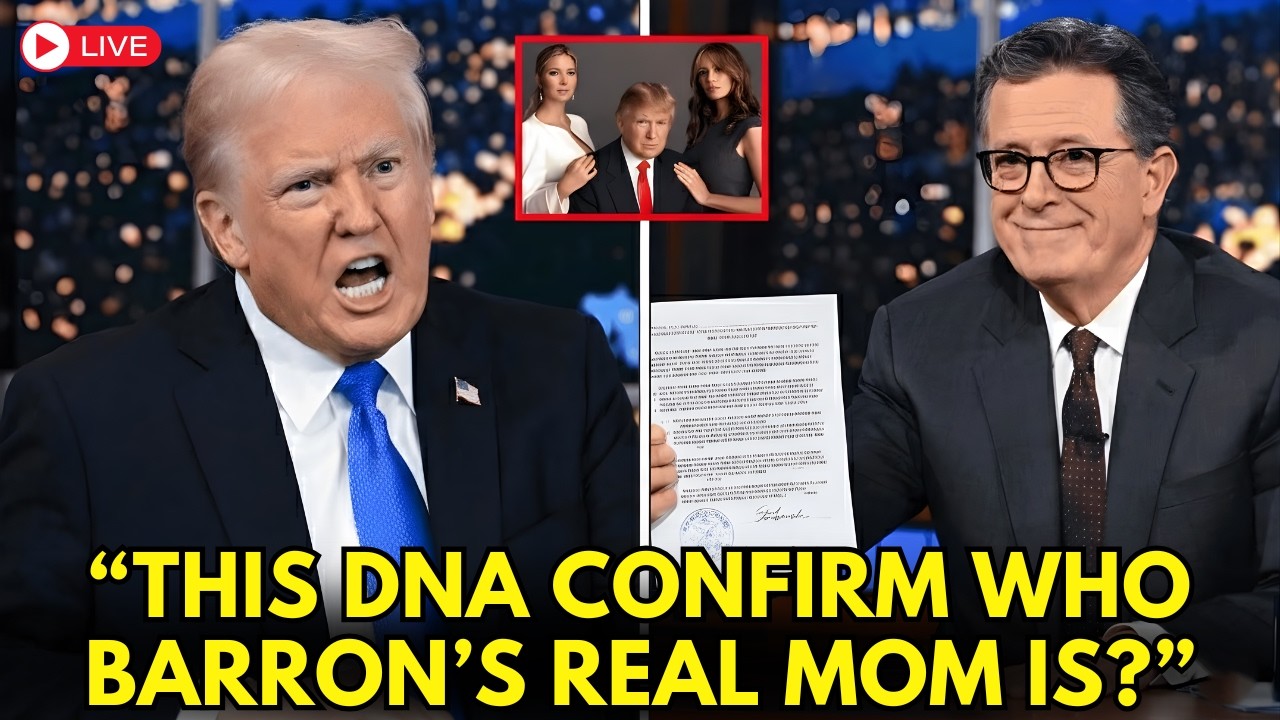
The video, framed as a dramatic showdown, opens with Mr. Trump entering the studio confidently, teasing Mr. Colbert about ratings and suggesting that controversy, not comedy, was the real draw. The host, known for his measured cadence and pointed satire, responds calmly. What follows, according to the clip’s narrative, is a gradual shift in tone: from banter to accusation, from laughter to silence.
But as with many viral political-media moments in recent years, the most striking element may not be the confrontation itself, but the way it has been packaged and shared.
The nearly 30-minute segment circulating on YouTube presents what appears to be a live, uninterrupted exchange culminating in Mr. Colbert unveiling what he describes as a “DNA report” contradicting claims related to a family controversy. In the video’s telling, the studio falls silent as the document is revealed. Mr. Trump, once animated and combative, is depicted as momentarily stunned. The audience, initially divided, grows quiet and then erupts in applause after Mr. Colbert delivers a line about evidence outweighing applause.
Yet there is no record of such an episode airing on CBS. No official transcript, network statement or credible news account corroborates the existence of a DNA reveal on “The Late Show.” Media analysts who reviewed the footage noted stylistic inconsistencies, abrupt tonal shifts and theatrical pacing more typical of scripted online content than of live network television.
“This has the hallmarks of political fan fiction,” said one television producer who reviewed the clip and requested anonymity to speak candidly. “It’s structured like a morality play — dominance, reversal, silence, verdict.”
Indeed, the video follows a clear dramatic arc. Mr. Trump is portrayed as attempting to dominate the stage through humor and bravado. Mr. Colbert is shown countering with restraint and quiet questions. The turning point arrives with the presentation of a folder — a visual device that signals documentary authority. The climax is not an argument, but silence: a room no longer laughing, a performer unable to reclaim momentum.
The clip’s popularity underscores a broader phenomenon in the digital age. Political entertainment has increasingly blurred into narrative storytelling, where confrontations are edited, enhanced or wholly constructed to deliver emotional payoff. Audiences are drawn not only to satire but to scenes of accountability — moments when power appears to falter under scrutiny.
Mr. Trump has frequently sparred with late-night hosts, dismissing them as biased or irrelevant while simultaneously benefiting from the attention such exchanges generate. Mr. Colbert, for his part, has built much of his recent commentary around critiques of Mr. Trump’s rhetoric and conduct. The adversarial dynamic is familiar, even expected.
What is less familiar is the speed and scale at which fabricated or dramatized encounters can spread. The YouTube video presents itself with cinematic pacing, carefully timed pauses and close-up shots that heighten tension. The narrative voice-over — absent in authentic late-night segments — frames each reaction as historic, each silence as seismic.
The effect is immersive. Viewers are invited to witness not simply a disagreement but a symbolic transfer of authority: volume giving way to credibility, performance yielding to proof. Whether or not the events occurred as depicted becomes secondary to the emotional resolution the video provides.
Digital misinformation researchers note that such content often thrives because it aligns with existing perceptions. For critics of Mr. Trump, the clip confirms a belief that bluster collapses under evidence. For supporters, it may reinforce distrust of media institutions, seen here as staging ambushes.
CBS has not issued a statement regarding the specific video, and Mr. Trump has made no public reference to a DNA confrontation on “The Late Show.” In the absence of verification, the segment appears to be a work of creative editing or fabrication rather than a documented broadcast.
Still, the episode reveals something real about contemporary political culture. Late-night television, once a relatively contained space for satire, now functions as a proxy battleground for broader ideological conflicts. Studio audiences — or their digital stand-ins — become juries. Applause becomes verdict. Silence becomes judgment.
In the end, the viral clip may say less about what transpired on a soundstage than about what audiences are eager to see: powerful figures challenged not with shouting, but with documents; not with insults, but with calm insistence on facts.
Whether authentic or imagined, the story resonates because it dramatizes a tension central to modern democracy — the contest between spectacle and substance. And in the online arena, where attention is currency, even a fictional confrontation can shape the conversation long after the studio lights dim.






