A World Cup in Question as T̄R̄UMP’s America Tests FIFA’s Global Promise
When FIFA awarded the 2026 World Cup to the United States, Canada and Mexico, the decision was framed as a celebration of North American unity and logistical strength. The tournament would be the largest in history, spanning 16 host cities and 104 matches, a festival of football designed to reaffirm the sport’s global reach.
Now, less than a year before kickoff, that promise of openness is colliding with the hard edge of geopolitics.
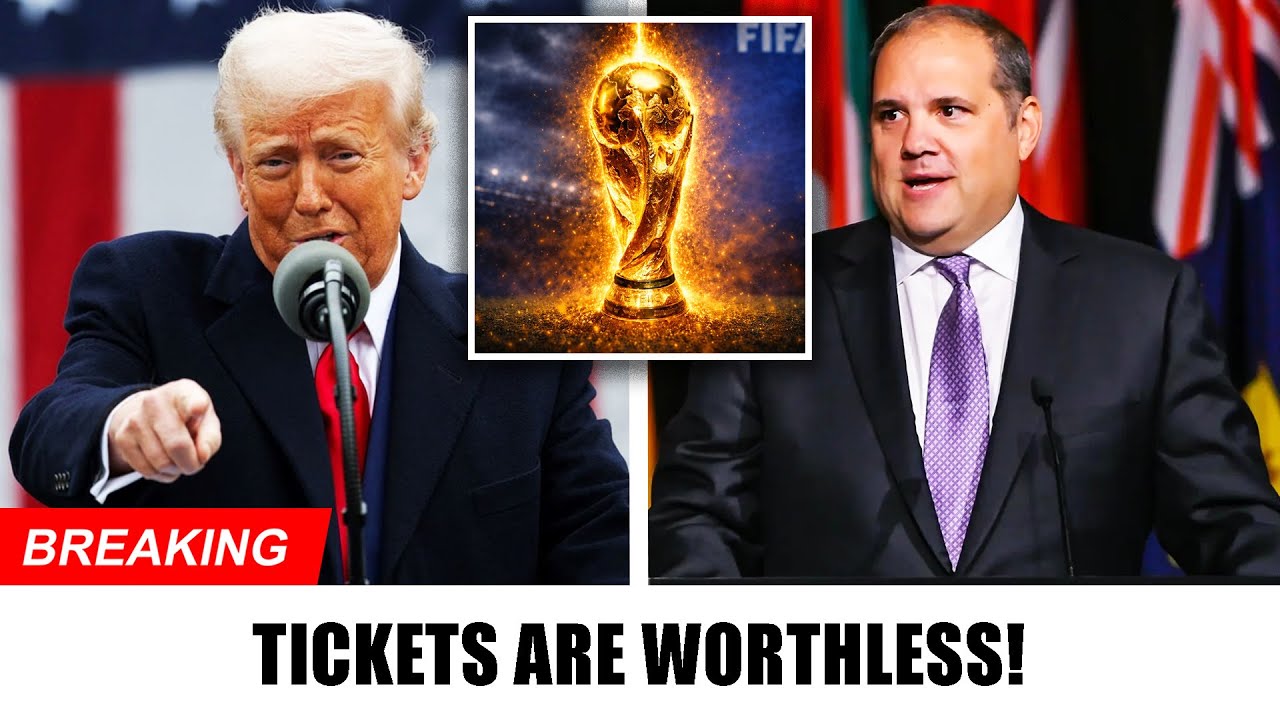
Victor Montagliani, a FIFA vice president, recently acknowledged an uncomfortable reality: purchasing a World Cup ticket does not guarantee entry into the United States. Admission to the country, he said, remains the sovereign prerogative of the host nation. For millions of international fans — many of whom will spend thousands of dollars on flights, hotels and match tickets — that statement has landed with a thud.
The remark was not a gaffe. It was a clarification. And it has intensified concerns that immigration enforcement under President T̄R̄UMP could cast a long shadow over what is meant to be the world’s most inclusive sporting event.
For critics of the administration’s aggressive immigration posture, the implications are stark. Rafal Pankowski of the Never Again Association, a Poland-based anti-racism organization, has warned that the tournament risks becoming what he calls a “propaganda event” for T̄R̄UMP and his policies. Others have raised fears about racial profiling, visa denials and heightened border scrutiny for travelers from countries deemed politically sensitive.
The idea of boycotting the tournament, once confined to activist circles, has begun to seep into mainstream European football discourse. A vice president of the German Football Association recently invoked the precedent of the 1980 Olympic boycott, signaling that participation in a U.S.-hosted World Cup is no longer viewed as politically uncomplicated.
Germany’s caution reflects a broader unease across Europe. T̄R̄UMP’s recent rhetoric on Greenland and his tariff disputes with European allies have strained diplomatic ties. In that context, the World Cup — typically a stage for soft power — risks becoming entangled in disputes over sovereignty and trade.
Sepp Blatter, the disgraced former FIFA president, once warned that awarding the World Cup to the United States could prove a high-risk gamble given the country’s volatile domestic politics and restrictive visa regime. At the time, his comments were dismissed as sour grapes. Yet Montagliani’s acknowledgment that FIFA cannot guarantee entry for ticket holders suggests that the structural tension Blatter identified was real.
Unlike past controversies — such as the human rights debate surrounding Qatar’s 2022 World Cup — the current dilemma is not solely moral. It is logistical and financial. If even a small percentage of fans are denied entry at U.S. borders, the reputational damage could be significant. If entire national federations were to withdraw, the economic consequences would be profound.
Major sponsors, including global brands that depend on European fan engagement, have invested billions in the tournament. Their business models assume full participation by football’s traditional powers and the vast traveling support that accompanies them. A partial boycott would not merely dent television ratings; it could trigger contractual disputes.
FIFA, according to industry sources, is quietly preparing contingency plans. Canada and Mexico — originally scheduled to host 26 matches combined — could absorb additional fixtures if necessary. Vancouver and Toronto, along with Mexico City and Monterrey, possess the infrastructure and experience to scale up quickly. Mexico has hosted the World Cup twice before; Canada successfully staged the Women’s World Cup in 2015.
Such a reallocation would be diplomatically delicate but commercially pragmatic. European teams might prefer playing in cities with more predictable visa regimes and shorter travel distances. A London-to-Toronto flight is considerably simpler than a cross-continental journey to Los Angeles, both in terms of time zones and recovery for players.
Mark Carney, Canada’s prime minister, has carefully positioned his country as a stable alternative — not in open opposition to Washington, but as a reassuring complement. Mexican officials, too, have signaled readiness to assume a larger role, subtly turning anti-T̄R̄UMP sentiment in parts of Europe into a strategic advantage.
Yet the tournament’s symbolic center remains the United States. For T̄R̄UMP, the World Cup represents an unparalleled opportunity to project national strength. For FIFA, it is a commercial linchpin. For fans, it is meant to be a celebration transcending borders.
The tension lies in whether those borders will, in practice, prove permeable.
To be sure, the United States has hosted major sporting events before without systemic disruption. Security screening and visa vetting are longstanding features of global travel. But the political climate matters. Perception can shape participation as surely as policy.
If a German supporter is denied entry because of a bureaucratic complication or a watch list error, the episode will reverberate far beyond a single match. In an era of instant social media amplification, isolated incidents can rapidly define a narrative.
FIFA’s central dilemma is that it cannot compel a sovereign nation to adjust its immigration rules for the sake of a tournament. It can only hope that the host’s political leadership sees alignment between openness and prestige.
The 2026 World Cup was conceived as a unifying spectacle across North America. Whether it becomes a seamless celebration or a case study in geopolitical friction may depend less on tactics on the field than on policies at the border.
For now, the ball is not at a player’s feet, but in the hands of governments.