🔥 BREAKING: Donald Trump Responds After Jimmy Kimmel Highlights Past Statements from Karoline Leavitt Live On Air — Studio Watches Closely ⚡
When former President Donald Trump has clashed with late-night television in the past, the pattern has been familiar: a joke lands, a social media rebuttal follows and the argument becomes part of the next news cycle. This week, that rhythm resurfaced after a segment on Jimmy Kimmel Live! turned its attention to White House press secretary Karoline Leavitt, prompting a sharp response from Mr. Trump and renewed debate over the role of comedy in political accountability.
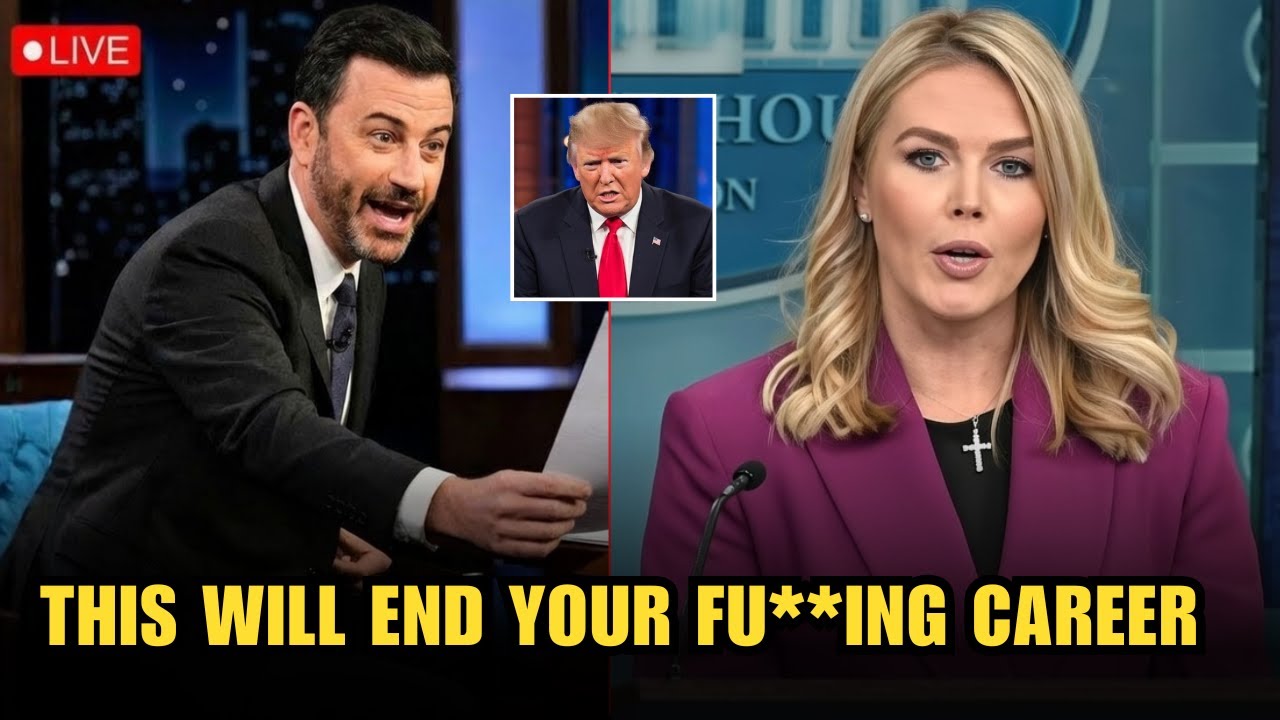
The episode began as many of Jimmy Kimmel’s recent monologues do: with a stack of notes, a montage of clips and a premise framed as straightforward. Rather than targeting Mr. Trump directly, Mr. Kimmel focused on Ms. Leavitt’s performance at the podium, arguing that the job of a press secretary is to clarify policy rather than to deflect questions.
He played excerpts from recent briefings and public statements, pausing after each to contrast what had been said with what later appeared in official records or reporting. The structure was methodical. Mr. Kimmel described it as a simple exercise viewers could replicate: compare an initial claim, the subsequent clarification and the documented facts. “If it can’t survive a replay,” he suggested, “it isn’t information — it’s marketing.”
The audience response was measured laughter that often gave way to applause. The segment’s tone, while pointed, was less a roast than a critique of communication style. Mr. Kimmel’s central observation — that labeling every question “fake” can function as a way to avoid answering any — became the line most widely shared online.
Within hours, Mr. Trump responded on social media, calling Mr. Kimmel a “propaganda clown” and praising Ms. Leavitt as effective and loyal. He characterized the segment as evidence of media hostility and suggested that comedians were amplifying partisan narratives. The posts followed a familiar template: counterattack, personalize and shift attention from the critique to the critic.
Ms. Leavitt addressed the controversy in her own remarks, describing the monologue as “Hollywood misinformation” and urging viewers not to rely on entertainers for political analysis. She reiterated that personnel decisions at networks are made by executives, not the White House, pushing back on suggestions of political influence over programming.
The exchange unfolded against a backdrop of persistent online misinformation. In recent months, fabricated stories have circulated claiming that Mr. Kimmel ejected Ms. Leavitt from his show after a confrontation — a scenario that fact-checkers have debunked. Those false narratives resurfaced as the new clip gained traction, illustrating how quickly satire, rumor and verified reporting can intermingle in the digital ecosystem.
What distinguished this episode, media analysts say, was its emphasis on verification rather than spectacle. Mr. Kimmel’s argument was not that Ms. Leavitt had committed a single dramatic misstatement but that a pattern of reframing or dismissing questions had become routine. By presenting a sequence of clips, he positioned viewers as participants in a review process rather than as spectators of a clash.

Late-night television has increasingly served as a venue for this kind of meta-commentary. Hosts blend humor with fact-checking, often occupying a space between traditional journalism and political activism. Critics argue that the format can oversimplify complex policy debates. Supporters counter that it encourages audiences to examine official statements more closely.
Mr. Trump’s reaction, in turn, underscored the feedback loop between politics and entertainment. For a figure who has long measured influence through attention, even critical coverage can reinforce relevance. Yet Mr. Kimmel’s follow-up the next evening was notably restrained. Addressing the backlash in a single sentence — “If it was meaningless, why spend all day shouting about it?” — he moved on to other topics.
The dynamic highlights a broader question about political communication in an era saturated with commentary. When elected officials and their representatives frame scrutiny as hostility, and when comedians frame deflection as evasion, audiences are left to parse competing narratives. The viral success of the clip suggests that many viewers are receptive to tools — such as replaying footage and comparing statements — that promise clarity amid noise.
Even some critics of Mr. Kimmel’s tone acknowledged that Ms. Leavitt has demonstrated restraint in certain high-profile moments, including after a tragic shooting in Minneapolis, when she avoided inflammatory language and emphasized the need for investigation. That contrast, observers noted, made the monologue feel less like a personal attack and more like an examination of strategy.
By week’s end, the takeaway was not a single punch line but a broader theme: the contest over framing. Mr. Kimmel argued that repetition and deflection can fatigue audiences into disengagement. Mr. Trump and his allies countered that media figures are engaged in partisan performance. Between those positions lies a public that must decide which claims warrant further checking.
In the age of viral clips, attention can be steered or resisted. This episode demonstrated that sometimes the most destabilizing response is not louder rhetoric but a calm insistence on replaying the tape.






