On a recent weeknight at the Ed Sullivan Theater, the home of The Late Show, the mood was less punch line than prosecutorial brief. When Stephen Colbert walked onto the stage, he did so without his customary grin, holding a tablet as if it were an exhibit. The band quieted. The audience, sensing a departure from routine, followed suit.
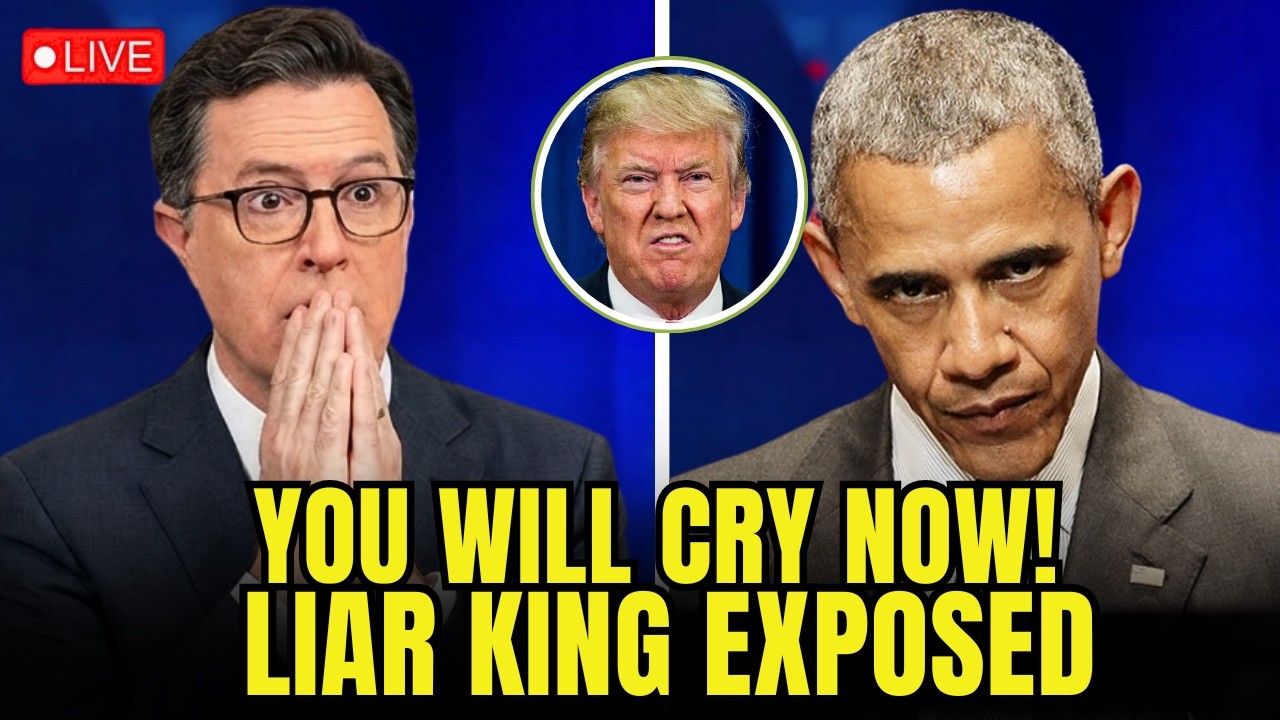
The subject was a new video posted by Donald Trump, who, when asked about continuing scrutiny related to the late financier Jeffrey Epstein, dismissed the matter as a “witch hunt” and pivoted to accuse former President Barack Obama of wrongdoing, asserting—without presenting evidence—that Mr. Obama had been caught “absolutely cold.”
Mr. Colbert played the clip in full before offering commentary. “Notice the pattern,” he said, pausing the video mid-assertion. “When the question is ‘What happened?’ the answer becomes ‘Look at me.’” The host characterized the tactic as marketing rather than information—an attempt, he suggested, to redirect attention from demands for documentation to spectacle.
The episode underscored how late-night television has evolved into a parallel forum for political argument, particularly when formal institutions move slowly or remain opaque. Mr. Colbert’s segment functioned less as satire and more as media criticism, examining the mechanics of claim and counterclaim in real time.
After airing Mr. Trump’s remarks, Mr. Colbert turned to Mr. Obama’s response. The former president, in a separate video, did not trade insults. Instead, he asked for proof. “Talk about what you did. Show what you’ve got,” Mr. Obama said, in a tone that was measured rather than indignant. The applause that followed in the theater was not explosive but sustained, reflecting recognition of the stylistic contrast.
Mr. Colbert framed that contrast as the heart of the matter. “Trump’s power isn’t the claim,” he told viewers. “It’s the chaos around the claim. If everyone is yelling, nobody is checking.” On a screen behind him appeared a simple graphic: “Speculation vs. Verification.” Mr. Colbert underscored the latter.
The Epstein case has become shorthand for institutional mistrust. Since Epstein’s 2019 arrest and subsequent death in federal custody, the public has sought clarity about the network of wealthy and powerful figures who socialized with him over decades. Court records have confirmed that Mr. Trump and Epstein moved in overlapping circles in the 1990s and early 2000s; Mr. Trump has said he severed ties well before Epstein’s arrest and has denied any knowledge of criminal activity. No court has found Mr. Trump liable in connection with Epstein’s crimes.

Yet the release of heavily redacted documents in related civil litigation has fueled ongoing suspicion. On his program, Mr. Colbert held up pages marked by thick black bars. Redactions, he acknowledged, are often legally required to protect victims and preserve due process. But the visual effect—lines obscured, names withheld—can create fertile ground for conjecture. “People start filling in blanks with their worst fears,” he said, arguing that politicians of all stripes can exploit that uncertainty.
The segment’s most pointed moment came when Mr. Colbert replayed Mr. Trump’s reaction to Mr. Obama’s call for evidence. The former president responded on social media with a flurry of denunciations but did not provide documentation to substantiate his claims. Mr. Colbert let the clip run silently for several seconds before cutting the audio. “That silence you’re hearing,” he said, “is the missing answer.”
The host then read aloud what he described as the central question raised by Mr. Obama: If there are files, facts or names that prove misconduct, what is being done with them beyond teasing their existence? The theater fell quiet. The rhetorical move shifted the conversation from allegation to accountability—less about who can dominate a news cycle and more about who can produce verifiable records.
Mr. Colbert ended not with a punch line but with a caution. When politics becomes entertainment, he said, audiences may begin to root for plot twists rather than outcomes. “If you want truth,” he added, “demand the boring part—documentation, timelines, accountability.”
The exchange illustrates a broader tension in contemporary political communication. Mr. Trump’s style, honed over years of rallies and television appearances, relies on provocation and repetition. Mr. Obama’s public interventions tend toward restraint and procedural appeals. In the compressed ecosystem of social media and cable news, both approaches can go viral. But they generate different kinds of engagement: one combustible, the other methodical.
Late-night hosts occupy an unusual position in this landscape. They are entertainers by profession, yet increasingly act as interpreters of political rhetoric. Critics argue that such commentary risks oversimplifying complex legal matters. Supporters counter that it can clarify the stakes, particularly when official statements lack specificity.
What distinguished Mr. Colbert’s segment was its insistence on paperwork over passion. Democracy, he suggested, runs on records—on filings, disclosures and sworn testimony—not on insinuation. Whether viewers share that assessment may depend on their political allegiances. But the episode demonstrated how, in an age of rapid-fire accusation, a demand for evidence can itself become a dramatic act.
As the show cut to commercial, the laughter that finally surfaced felt tentative. The jokes were there, but they were secondary. The larger message lingered: spectacle may dominate the moment, but documentation endures.