When the Image Flickers, the Narrative Fights Back
On a week when legal headlines crowded the news cycle, there was a conspicuous silence from Melania Trump. She was not in the courtroom when the verdict was read, and she did not release a statement afterward. There was no social media declaration of steadfast devotion, no carefully worded affirmation of loyalty. The absence itself might have passed without comment in another political era. In this one, it became part of a larger story about image, narrative and control.
That story took an unexpected turn on late-night television.
On a recent episode of Jimmy Kimmel Live!, Jimmy Kimmel opened his monologue not with a punchline but with a premise. “Tonight,” he said, “we’re talking about optics.” The line landed softly, but it framed what followed: a segment less about marriage than about branding, less about gossip than about political storytelling.
For years, Donald Trump has presented his public life as a polished tableau — the decisive leader, the triumphant businessman, the devoted husband standing beside a glamorous first lady. In campaign ads and official events, the image has functioned as both backdrop and argument. Strength, the visual narrative suggests, extends seamlessly from the podium to the home.
Kimmel’s critique focused not on private feelings but on public appearances. He displayed a montage of recent events: the president walking alone across tarmacs, waving from stages, posing for photographs with a noticeable space at his side. There was no speculation about why Melania Trump was absent, only a recitation of dates and events, presented with the deliberateness of a ledger.
“If everything is great,” Kimmel asked the studio audience, “why is it always missing?”
The laughter that followed was uneasy. The question was not about affection; it was about consistency. Kimmel framed the marriage as part of a broader communications strategy, arguing that when politicians elevate their personal lives into symbols of virtue and stability, those symbols become subject to scrutiny. A strong partnership, he suggested, does not require constant reinforcement. When it does, the reinforcement itself becomes part of the story.
In the language of media theory, this was a discussion about narrative maintenance. Trump has long demonstrated an acute awareness of how images travel — how a single photograph can affirm or undermine months of messaging. His critics argue that he curates those images with the precision of a brand manager. His supporters counter that the scrutiny is disproportionate and politically motivated.
The segment’s most striking moment came when Kimmel reportedly received a call placed on speaker during the broadcast. The voice on the line, identified as Trump’s, objected to the framing and accused the host of misrepresentation. What followed was less a clash of personalities than a study in rhetorical strategy.
Kimmel repeated a simple question: which date in the timeline was incorrect? The emphasis was on verifiable fact rather than interpretation. The response, according to those present, did not address the chronology directly. Instead, it shifted to broader grievances — about ratings, about media bias, about unfair treatment.
The exchange illustrated a familiar pattern in contemporary politics: when confronted with a narrowly defined claim, widen the frame. When asked about specifics, question motives. It is a strategy that can be effective in rallies and interviews, where momentum favors the most forceful voice. It is less effective against a fixed graphic on a screen.
Late-night television is not Congress, and monologues are not cross-examinations. Yet the cultural role of hosts like Kimmel has evolved. Once confined to celebrity interviews and topical humor, they now operate as commentators in a fragmented media ecosystem. Their audiences expect not only entertainment but interpretation. In that environment, satire becomes a vehicle for accountability — or at least for skepticism.
What resonated most in the clip that circulated the next morning was not an insult or a punchline. It was the unanswered question lingering in the pause between assertion and evidence. “You can’t bully a timeline,” Kimmel concluded. The line was crafted for replay, and replay it did.
For Trump, whose political identity has been intertwined with dominance — of headlines, of adversaries, of narratives — the episode underscored a vulnerability. Control over message depends in part on control over image. When the image flickers, the instinct is to steady it, sometimes forcefully.
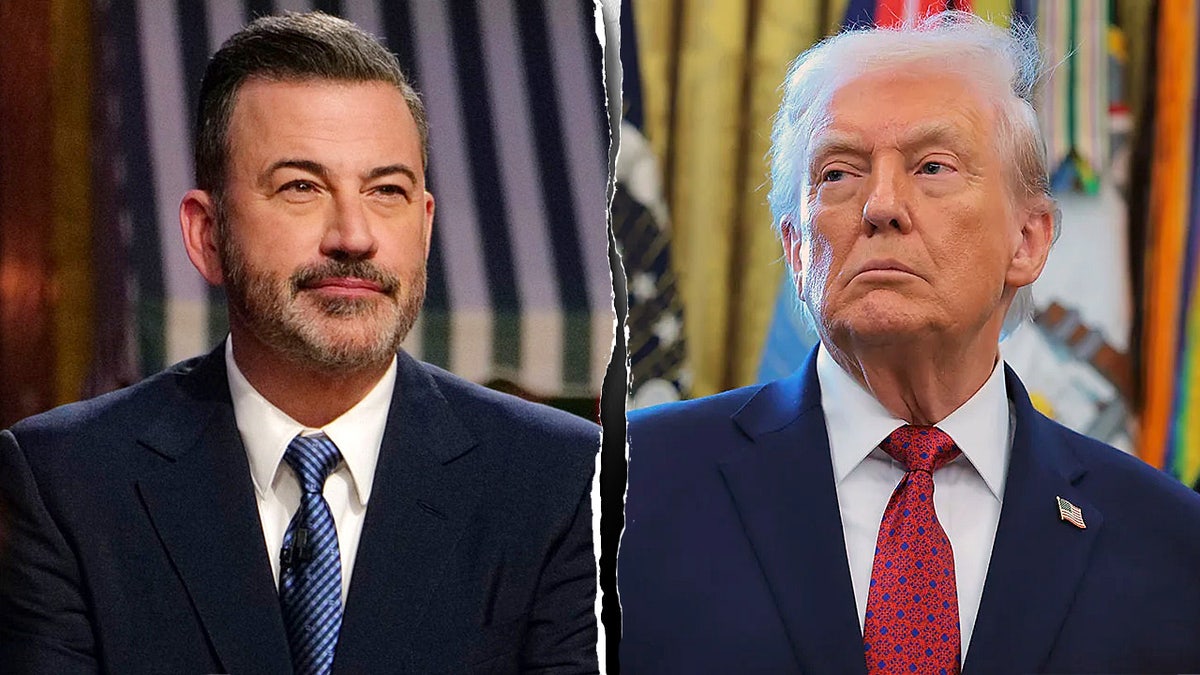
The broader implications extend beyond one marriage or one monologue. In an era when personal branding and public office intersect more than ever, the boundary between private life and political symbol grows thin. Leaders who trade on the symbolism of family must accept that symbolism invites scrutiny. Silence, too, becomes part of the tableau.
By midday, commentators were less interested in romance than in reflex. They debated whether the reaction amplified the critique, whether engagement conferred legitimacy, whether ignoring it would have been wiser. These are strategic questions, not sentimental ones.
The episode did not reveal a hidden truth about the Trumps’ relationship. It revealed something more familiar: that in modern politics, perception is currency, and currency fluctuates. When challenged, narratives either adapt or attack. On this particular night, the attack may have drawn more attention than the original challenge.
In the end, the segment served as a reminder that images, once deployed as proof of strength, can become tests of it. And in a media landscape defined by repetition, the most durable question is often the simplest one — the one that waits, unanswered, on the screen.