🔥 BREAKING: JD Vance Responds After Jimmy Kimmel Revisits His Past Remarks Live On Air ⚡
On a recent weeknight broadcast, the familiar rhythms of late-night television — monologue, applause, a few cutting jokes — gave way to something more pointed. The host, Jimmy Kimmel, devoted a significant portion of his program to scrutinizing Vice President JD Vance, revisiting the Ohio Republican’s past statements and challenging his recent rhetoric in a segment that quickly circulated far beyond its usual audience.
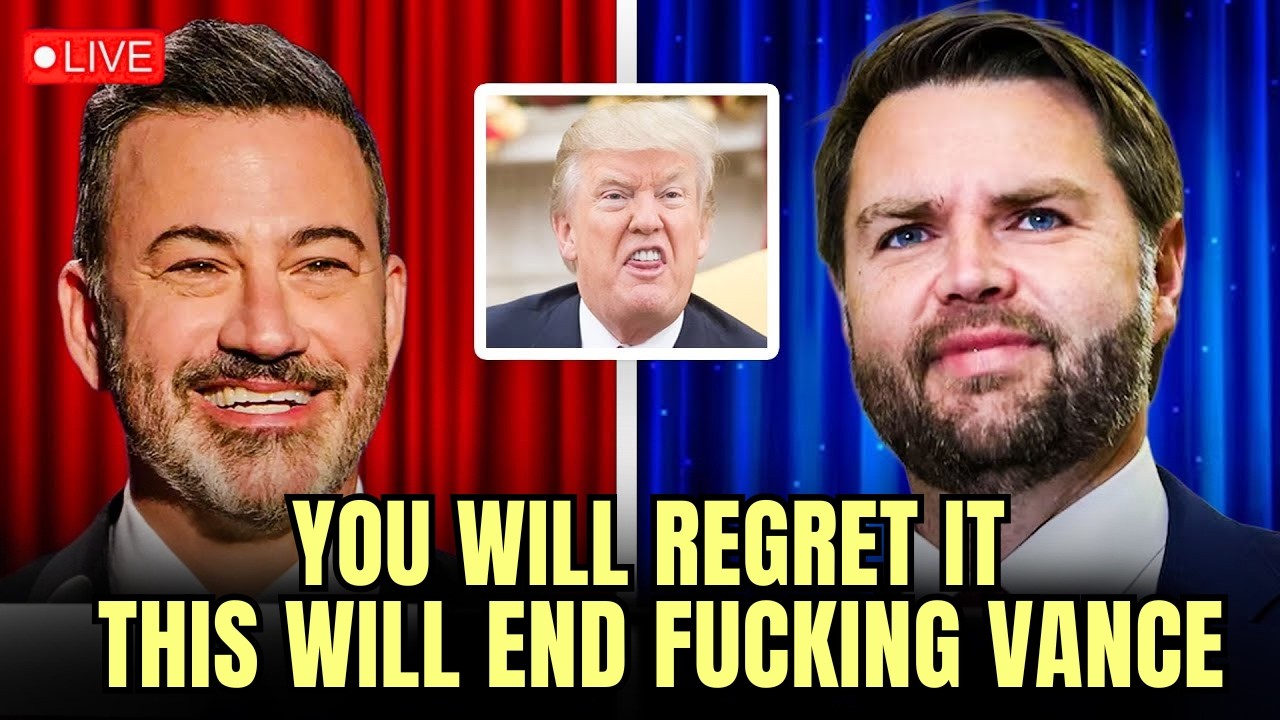
The episode unfolded against a backdrop of escalating tension between the administration of President Donald Trump and elements of the broadcast media. In prior interviews, administration allies had questioned whether major networks were serving the “public interest,” language that some critics interpreted as an implicit warning about regulatory oversight. The chairman of the Federal Communications Commission, Brendan Carr, suggested in media appearances that broadcast licenses exist contingent upon public trust — remarks that sparked debate about the boundaries between regulatory authority and political pressure.
Within that atmosphere, Mr. Kimmel returned to the air after a brief programming disruption involving affiliate stations, addressing both his ratings and the broader controversy. Nielsen data indicated that his comeback episode drew 6.3 million viewers, a figure supporters cited as evidence of sustained audience interest.
But the monologue quickly shifted from ratings to record.
Mr. Kimmel played archival clips of Mr. Vance from the period when he was promoting his memoir and speaking frequently as a political commentator. In those earlier appearances, Mr. Vance had been sharply critical of Mr. Trump, at one point questioning his temperament and suitability for office. The host juxtaposed those statements with more recent footage of Mr. Vance defending the president’s policies and rhetoric.
The contrast formed the core of the segment’s argument: that Mr. Vance’s evolution from critic to ally represented more than a change of mind. Mr. Kimmel framed it as a question of credibility, asking viewers to consider how political reinvention should be weighed against prior convictions.
Political realignments are hardly uncommon. Elected officials across parties have recalibrated positions in response to shifting constituencies or strategic realities. Mr. Vance himself has acknowledged that his views evolved as he came to see Mr. Trump’s appeal differently. Supporters argue that such reassessment reflects growth rather than opportunism. Critics, including Mr. Kimmel, see inconsistency.
The host also addressed a recent controversy involving claims about Haitian immigrants in Springfield, Ohio. Social media posts had alleged that newcomers were abducting pets — accusations that local law enforcement and state officials, including Republican Governor Mike DeWine, publicly rejected as unfounded. Mr. Vance amplified concerns about immigration and community impact during that period, though he has said he was highlighting broader anxieties rather than validating specific rumors.
In his monologue, Mr. Kimmel laid out the sequence of events, citing local reporting and official statements. He argued that repeating unverified claims can have tangible consequences, noting reports of bomb threats and school evacuations in the area during heightened online speculation. The segment blended humor with documentation, a formula that has become characteristic of politically engaged late-night programming.

Beyond specific incidents, Mr. Kimmel criticized Mr. Vance’s commentary on cultural issues, including remarks suggesting that Americans without children have less stake in the nation’s future. Mr. Vance has framed such comments as part of a broader argument about demographic decline and civic investment. Opponents contend that the rhetoric dismisses millions of citizens whose contributions to public life are unrelated to parenthood.
The vice president responded in subsequent interviews by accusing segments of the media of selective editing and partisan framing. He reiterated that his positions reflect a belief in economic nationalism and social stability, and he dismissed the monologue as entertainment rather than substantive debate.
Yet the exchange illustrates a broader shift in American political culture. Late-night hosts have increasingly assumed a quasi-analytical role, blending satire with fact-checking in ways that reach audiences who may not regularly consume traditional news broadcasts. For some viewers, this format provides accessible scrutiny. For others, it blurs the line between journalism and advocacy.
The friction also highlights enduring tensions surrounding the First Amendment and regulatory authority. While broadcast licenses are subject to federal oversight, the Supreme Court has long upheld robust protections for political speech, including satire. Suggestions that programming content could influence licensing decisions have historically drawn bipartisan concern.
Whether the episode marks a turning point or simply another skirmish in an ongoing media-political rivalry remains uncertain. Mr. Vance continues to command a loyal base, and Mr. Trump’s coalition has often thrived amid cultural confrontation. Mr. Kimmel, for his part, has built a brand around challenging powerful figures through humor sharpened by archival footage.
What distinguished this segment was not volume but documentation: clips played back-to-back, timelines reconstructed, statements compared. In an era when political memory can be fleeting, video archives have become a form of accountability.
For viewers, the moment offered a choice. It invited them to interpret political evolution as pragmatism or as contradiction, to see satire as civic engagement or partisan performance. In either case, the collision between a vice president and a late-night host underscored how entertainment platforms have become arenas where questions of credibility, consistency and public trust are contested in real time.






