When Wheat Becomes Leverage: Trade Tensions, Food Security and the Fragile Architecture of Interdependence
In a year defined by geopolitical rivalry and economic recalibration, few expected wheat to emerge as a quiet symbol of strategic tension. Yet in 2025, as trade frictions between the United States and Canada resurfaced, the conversation drifted from abstract tariff schedules to something far more tangible: bread.
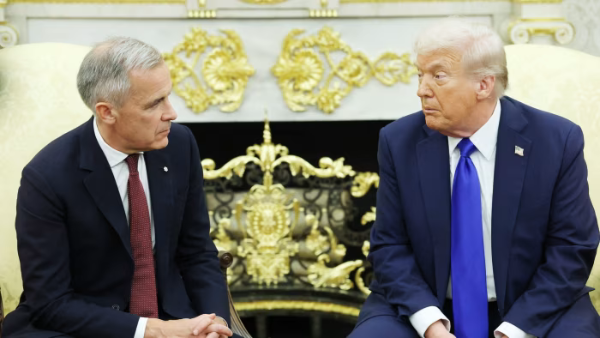
At the center of the debate were President Donald Trump, pursuing an assertive trade posture aimed at recalibrating North American agreements, and Canada’s Prime Minister Mark Carney, signaling Ottawa’s intention to safeguard export reliability while broadening global partnerships. What unfolded was not a spectacle of dramatic retaliation, but a more subtle and revealing contest over leverage, interdependence and the political boundaries of essential goods.

On paper, the United States appears comfortably positioned. It remains one of the world’s largest wheat producers, harvesting tens of millions of metric tons annually across the Plains and Pacific Northwest. The scale suggests self-sufficiency. But agriculture, like modern trade itself, is not governed by volume alone.
Wheat is not a monolith. Hard red winter wheat, soft white wheat, high-protein spring wheat and durum each serve distinct industrial purposes. Bread flour relies heavily on protein strength; pasta demands the firmness of durum; pastries require softer, lower-protein blends. For decades, American millers have imported certain Canadian spring wheat varieties prized for consistent protein levels and predictable baking performance. The integration was not born of dependency in the dramatic sense, but of efficiency. The North American grain system evolved as a finely tuned ecosystem in which climate, soil and crop genetics determined regional specialization.
When tariff threats entered policy discussions, economists were quick to clarify that the stakes were less about scarcity than about calibration. Supply chains in essential commodities operate on narrow margins. Rail logistics, futures contracts, milling blends and bakery procurement schedules are synchronized months in advance. Even modest increases in cross-border costs can ripple outward — first appearing in wholesale contracts, later in supermarket pricing.
There was no immediate panic, no empty shelves. Markets are adaptive by design. Yet the episode underscored how trade instruments — often deployed to protect strategic industries — acquire a different resonance when applied to staple foods.
Canada, for its part, signaled that diversification would remain central to its trade posture. Like many exporting nations, it has spent years expanding access to markets in Asia, Latin America and the European Union. Reliability is a currency in global agriculture. Buyers weigh not only price, but the predictability of supply amid political shifts. In a world where climate volatility already complicates harvest forecasts, policy uncertainty adds another layer of risk.
The broader question raised by the wheat dispute extends beyond North America. Should essential food commodities be treated like steel, semiconductors or automobiles — legitimate instruments of trade leverage? Or do they occupy a category that warrants insulation from high-stakes negotiation?
Advocates of assertive tariff strategy argue that leverage is indispensable in securing fair agreements. Trade, in this view, is a competitive arena; exemptions dilute bargaining power. If agricultural exporters benefit from access to the American market, they argue, reciprocal concessions are reasonable.
Critics counter that staple foods are not discretionary goods. They form the bedrock of domestic stability. While price shifts in luxury sectors may be absorbed with minimal social disruption, incremental increases in food costs accumulate quietly across households. For lower-income families, even modest changes in flour or bread prices matter.
The wheat episode also illuminated a deeper structural truth: modern economies are intricately woven systems, not isolated fortresses. The romantic notion of national self-sufficiency often dissolves under scrutiny. Climate patterns in Saskatchewan influence bakery margins in Arkansas. Rail networks in Manitoba affect supermarket pricing in Minnesota. Soil chemistry and seasonal rainfall shape urban grocery bills thousands of miles away.
Agricultural specialization, shaped by geography over generations, cannot be replicated at will. High-protein spring wheat thrives in specific latitudes and temperature bands. Durum favors particular soil conditions. Trade evolved to bridge those natural distinctions, not to erase them.
To date, the tensions have not produced systemic disruption. Negotiations continue; supply chains adjust; futures markets absorb new data. But the symbolism lingers. When everyday food enters the calculus of geopolitical strategy, it forces policymakers and the public alike to reconsider the boundaries between economic statecraft and domestic stability.
Food is more than a commodity. It is infrastructure — as essential as energy grids or transportation corridors. It anchors social order in ways that are often invisible until strained. The loaf on a kitchen counter carries within it a web of rail routes, protein ratios, weather systems and diplomatic choices.
In the end, the wheat debate may prove less about any single tariff decision and more about a renewed awareness of interdependence. Global trade’s architecture is resilient, but not frictionless. Essential goods expose its sensitivities with unusual clarity.
Whether staple foods should remain insulated from strategic maneuvering is a question that resists easy consensus. What is clear is that in an era of intensifying competition, even the most ordinary commodities can become instruments of policy — and reminders that economic sovereignty, like bread itself, is shaped by many hands.