Doug Ford Draws a Line on Trade, Framing Trump’s Tariffs as a Test of North American Partnership
TORONTO — In a press conference that carried the cadence of a policy address rather than a routine provincial update, Doug Ford signaled that Ontario is prepared to escalate if President Trump intensifies tariffs against Canada. His message was not merely defensive. It was strategic, calibrated and aimed as much at American governors and voters as at the White House.
“A tariff on Canada is a tax on Americans,” Mr. Ford said, repeating the phrase as both warning and refrain. The line distilled a larger argument: that cross-border trade between the United States and Canada is so deeply integrated that punitive measures ricochet quickly back across the border.
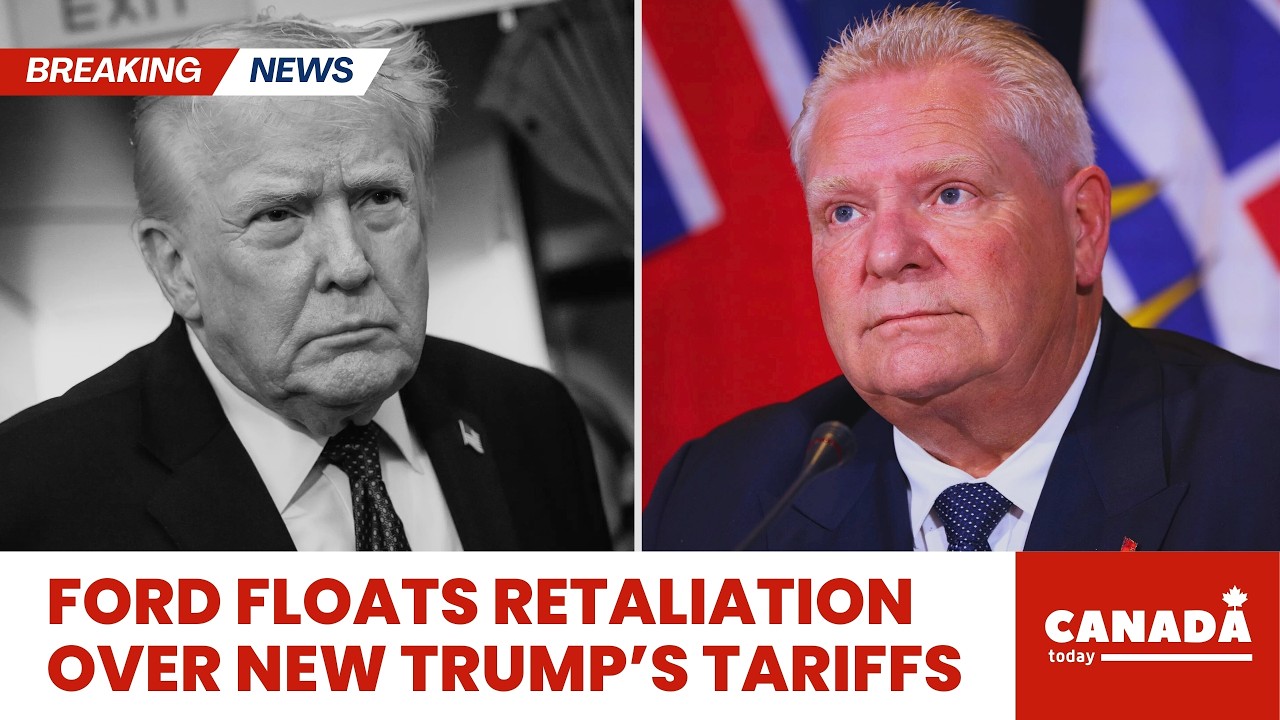
President Donald Trump, who has defended tariffs as leverage in trade negotiations, has framed them as a means of protecting domestic industry. Mr. Ford rejected that premise outright. “When you have a protectionist government,” he said, “it fails every single time.” Then he invoked Ronald Reagan, suggesting that the former Republican president — long associated with free-market orthodoxy — would recoil at the current direction of American trade policy.
The reference was deliberate. Mr. Ford did not cast his critique as Canada versus the United States. Instead, he framed it as a debate within American economic thought itself: protectionism versus integration, isolation versus interdependence. In doing so, he sought to widen his audience beyond Washington and speak directly to the American states whose economies are tightly linked to Ontario’s.
Ontario is the largest export destination for 17 U.S. states and the second largest for a dozen more. Supply chains in aerospace, automotive manufacturing and agriculture crisscross the border daily. Mr. Ford’s remarks highlighted how deeply those links run — and how vulnerable they could become in a tariff escalation.
He listed specific commodities where Canada holds significant leverage: nickel mined in northern Ontario and used extensively in aerospace and military manufacturing; aluminum from Quebec that feeds American industrial production; steel and potash critical to farming and construction. Even road salt, much of it shipped south in winter months, made the list.
The point was not merely rhetorical. Ontario produces a substantial share of the high-grade nickel used in North American aerospace manufacturing. Disruptions in that supply could ripple through factories in Michigan and beyond. In emphasizing these choke points, Mr. Ford signaled that Canada’s response would not be symbolic. It would be targeted.
“If they want to tariff us, I say we tariff them back,” he said, describing a tit-for-tat dynamic that could escalate quickly. Yet the premier balanced his warning with an appeal to cooperation. “When we work together, we create more jobs,” he added. “Attacking another country, your closest ally and friend, never ever works.”
That dual posture — readiness to retaliate paired with an invitation to collaborate — reflects a broader recalibration in Ottawa and the provinces. For years, Canadian officials have sought to shield trade relations from political turbulence in Washington. Increasingly, however, they are acknowledging that passivity may carry its own risks.
Mr. Ford’s rhetoric suggested a shift from reactive diplomacy to proactive positioning. By articulating where Ontario could apply counterpressure, he aimed to deter escalation rather than merely respond to it. His comments also underscored the asymmetry of perception: while tariffs are often framed domestically as pressure on foreign competitors, their immediate costs are borne by importers, manufacturers and consumers at home.
The premier’s warning comes at a moment when North American supply chains remain fragile after years of pandemic disruptions and geopolitical strain. Economists note that reconfiguring them is neither simple nor swift. “You can’t unscramble an egg,” Mr. Ford said, employing a homely metaphor to argue that disentangling integrated markets would impose costs on both sides. Prosperity, he suggested, depends on enlarging the economic “omelet,” not slicing it apart.
Whether Washington heeds that message remains uncertain. President Trump has long portrayed tariffs as proof of resolve, a visible assertion of national interest. For his supporters, they symbolize strength. For critics like Mr. Ford, they represent a self-inflicted wound.
What is clear is that the tone of the conversation has hardened. This was not the language of quiet negotiation. It was the language of leverage.
The stakes extend beyond nickel shipments or seasonal road salt. They touch on the durability of one of the world’s closest bilateral relationships. For decades, Canada and the United States have operated less as rivals than as partners bound by geography and commerce. A sustained tariff conflict would test that model.
Mr. Ford ended his remarks with a simple formulation: cooperation creates prosperity; escalation creates damage. Behind the aphorism lay a more complex calculation — that signaling readiness to respond may be the surest way to avoid having to do so.
As tensions simmer, businesses on both sides of the border are left to weigh the risks. The integration that has long underpinned North American growth is now, at least rhetorically, in question. Whether it proves resilient will depend not only on economic arithmetic but on political choice.