🔥 BREAKING: Jimmy Kimmel TURNS A SCHOOL IQ COMMENT INTO A VIRAL MOMENT — ONLINE REACTION BUILDS FAST ⚡
For years, President Donald J. Trump has described himself in superlative terms. He has referred to himself as a “very stable genius,” suggested his IQ ranks among the highest, and said that world leaders, including President Vladimir V. Putin of Russia, have called him a genius. The declarations have been a consistent feature of his political persona: a projection of intellectual dominance intended to reinforce his authority.
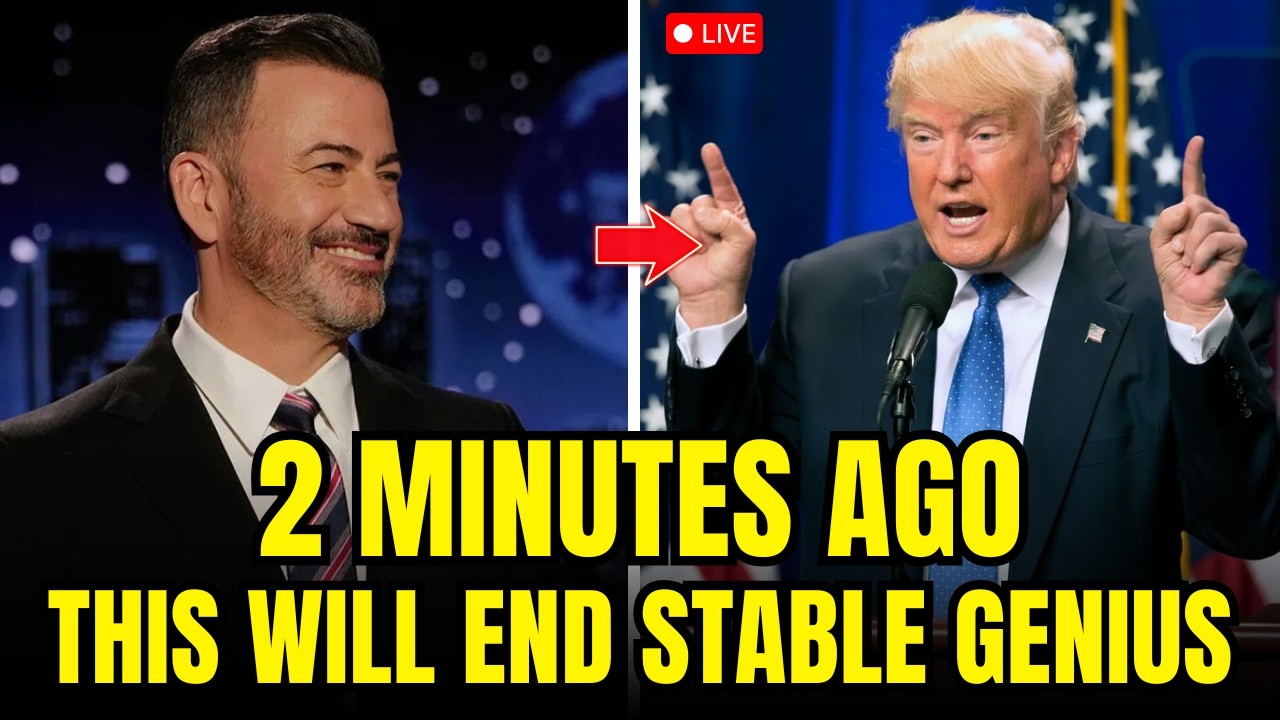
This week, the late-night host Jimmy Kimmel trained his focus on those claims, devoting a segment of his ABC show to revisiting Mr. Trump’s long-running assertions about his intelligence — and the unusual secrecy surrounding his academic record.
The segment, which quickly drew millions of views online, juxtaposed archival footage of Mr. Trump’s self-descriptions with reporting on his efforts to shield his educational history from public scrutiny. “Why would I disavow?” Mr. Trump once said in response to being called a genius. “I’m not refuting it when somebody calls me a genius. Why would I refute it?”
Kimmel’s critique centered less on the boasts themselves than on the absence of documentation. Over the years, Mr. Trump has reportedly threatened legal action against institutions he attended, including the University of Pennsylvania and the Fordham University, to prevent the release of his transcripts. Former associates have said that school officials were cautioned against sharing details of his academic performance. The records have never been made public.
For a public figure who regularly invokes intelligence as a credential — often contrasting himself with generals, scientists and political rivals — the guarded transcripts have long been a point of curiosity among critics. Kimmel framed the issue as a simple question: If one’s academic history confirms exceptional ability, why go to extraordinary lengths to keep it sealed?
The segment struck a nerve. Within hours, clips circulated widely across social media platforms. Supporters of Mr. Trump defended his intellectual bona fides by pointing to his career in real estate, his tenure as host of “The Apprentice,” and his victory in the 2016 presidential election. To them, business success and political triumph were sufficient evidence of strategic and intellectual acumen.
Critics countered with a different record, citing business bankruptcies and public statements they argue undermine the image of unmatched brilliance. Some pointed to long-standing investigative reporting that questioned the narrative of singular business genius. Others noted that academic records are typically a source of pride for high achievers, not closely guarded secrets.
The debate reflects a broader cultural tension about the meaning of intelligence in public life. Mr. Trump’s political style has often emphasized instinct over expertise, intuition over institutional consensus. He has portrayed himself as a disruptor who outsmarts conventional thinkers. In that context, claims of high IQ function less as measurable facts and more as rhetorical devices — shorthand for dominance.

Kimmel’s approach was characteristically satirical but rooted in documented history. He did not claim access to sealed transcripts, nor did he assert specific grades. Instead, he highlighted the contradiction between repeated declarations of genius and the sustained effort to prevent verification.
In response, Mr. Trump returned to familiar ground. He dismissed the comedian as unintelligent and reiterated that his own IQ ranked near the top. What he did not do, however, was release academic records or provide independent confirmation of the claims.
The episode underscores how late-night television has evolved into a parallel arena for political accountability. Comedians like Kimmel increasingly blend entertainment with commentary, often amplifying questions that traditional news outlets have explored more cautiously. The viral nature of such segments can push longstanding issues back into public conversation.
It also illustrates the enduring power of narrative in American politics. For decades, Mr. Trump has cultivated an image of exceptionalism — in wealth, deal-making, stamina and intellect. That narrative has proven resilient, surviving fact-checks, investigations and electoral cycles. Yet it remains susceptible to moments that crystallize perceived inconsistencies.
The intensity of the online reaction suggests that questions about credibility and transparency still resonate deeply. In an era defined by polarized media ecosystems, even a comedic segment can serve as a catalyst for renewed scrutiny.
Ultimately, the controversy is not solely about IQ scores or grade-point averages. It is about the relationship between assertion and evidence, and about how public figures manage information that shapes their reputations. For some voters, Mr. Trump’s confidence is itself persuasive. For others, the absence of documentation reinforces doubts.
The transcripts remain sealed. The boasts continue. And in the gap between the two lies a debate that, at least for now, shows no sign of fading.






