🔥 BREAKING: DON JR. FIRES BACK After JIMMY KIMMEL TARGETS TRUMP LIVE — LATE-NIGHT CLASH SPARKS MAJOR REACTION ⚡
A Late-Night Segment, a Swift Rebuttal and the Politics of the Punchline
The friction between political power and televised satire is hardly new. But a recent exchange involving Jimmy Kimmel and Donald Trump Jr. illustrates how quickly a three-minute comedy segment can escalate into a broader argument about media, branding and grievance.
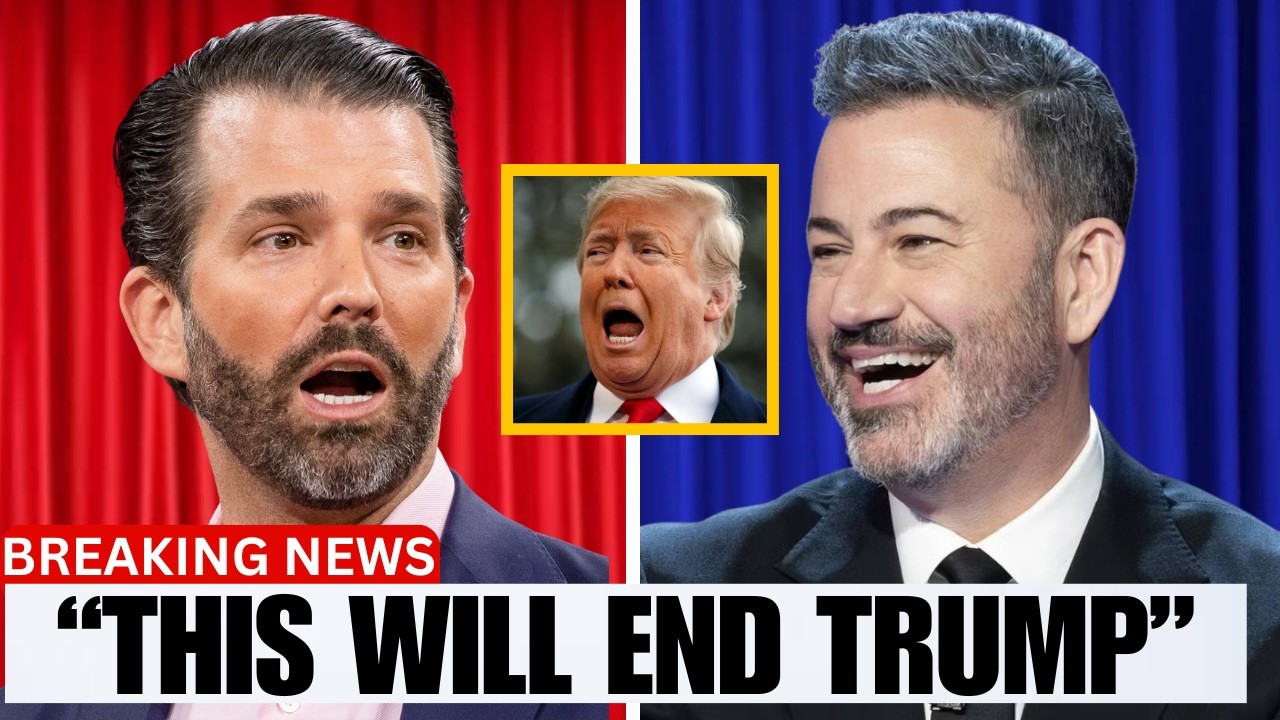
The episode began on Jimmy Kimmel Live!, where Mr. Kimmel devoted part of his monologue to dissecting a recent public appearance by former President Donald Trump. The host replayed clips of what he characterized as rhetorical inconsistencies and awkward moments, offering commentary in the dry, observational style that has become a staple of late-night television.
Studio audiences responded with laughter, and within hours the segment circulated widely online. In another era, the exchange might have ended there — a fleeting moment in the rapid churn of digital media. Instead, it prompted a forceful reaction from Mr. Trump’s eldest son.
Mr. Trump Jr., who has increasingly positioned himself as a vocal defender of his father’s political brand, took to social media to denounce the segment. He described the monologue as unfair and suggested that it crossed lines of propriety. In subsequent posts, he raised questions about the motivations behind the broadcast and called for closer scrutiny of what he framed as coordinated media attacks.
The intensity of the response drew attention in its own right. Critics argued that seeking official remedies against a comedy program risked blurring the boundary between political disagreement and regulatory pressure. Supporters countered that public figures are entitled to defend themselves against what they view as misleading portrayals.
The dispute unfolded against the backdrop of ongoing legal proceedings in New York involving members of the Trump family business. Mr. Trump Jr. has testified in a civil fraud case brought by state authorities, a matter separate from the late-night exchange but one that has heightened media focus on the family’s public posture. In that courtroom context, he has rejected allegations of wrongdoing and emphasized reliance on professional advisers.
For media analysts, the Kimmel episode highlights a deeper shift in how political families manage criticism. “In a brand-driven environment, satire is not just humor — it’s reputational risk,” said one communications scholar who studies the intersection of entertainment and politics. When leaders cultivate images of strength and resilience, even light mockery can be interpreted as a challenge to core identity.

Late-night comedy has long served as a venue for political critique. From the monologues of Johnny Carson to the pointed segments of modern hosts, humor provides a culturally accepted mechanism for questioning authority. Unlike formal journalism, satire operates through exaggeration and framing rather than investigative revelation. Yet in the age of viral clips, its impact can rival that of traditional reporting.
In his response, Mr. Trump Jr. invoked language more commonly associated with compliance and oversight, referencing regulatory standards and suggesting that broadcasters bear responsibility for the tone and content of their programming. Media lawyers note that federal rules governing indecency and licensing apply differently to broadcast and cable networks, and that political satire generally falls within protected speech.
The escalation also carried an unintended consequence familiar to digital strategists: renewed attention to the original clip. Online engagement surged in the days following Mr. Trump Jr.’s posts, a phenomenon sometimes described as the “Streisand effect,” in which efforts to suppress or condemn content amplify its reach.
Beyond the personalities involved, the episode underscores a broader erosion of middle ground in media discourse. Political figures increasingly function as brands, complete with loyal consumer bases and rapid-response teams. In that framework, criticism is not merely disagreement but a perceived infringement on identity.
Mr. Kimmel did not substantially extend the segment beyond its initial airing, though he alluded to the controversy in subsequent broadcasts with characteristic irony. Representatives for the Trump family have continued to argue that hostile media coverage distorts public perception and fuels partisan divides.
The question raised by the exchange is less about who “won” the feud than about the evolving rules of engagement. In a fragmented information ecosystem, satire can be both cultural commentary and political catalyst. Attempts to counter it through formal channels may satisfy core supporters while reinforcing narratives of persecution, yet they also risk normalizing the idea that jokes warrant official intervention.
As the 2026 campaign cycle approaches, the interplay between entertainment and politics shows no sign of cooling. Candidates court late-night hosts for relatability, even as they bristle at unscripted humor. Viewers, meanwhile, navigate a landscape where punchlines travel faster than press releases.
In the end, the segment that sparked the dispute remains readily accessible, replayed and reframed across platforms. The response to it — swift, indignant and amplified — may prove as revealing as the comedy itself.






