Canada Draws a Line at the Water’s Edge
The longest undefended border in the world has rarely felt so brittle.
As tensions simmer between Washington and Ottawa, a once-technical dispute over the future of the Columbia River Treaty has widened into something far more elemental: who controls the freshwater lifeblood of North America. When British Columbia announced that the United States had paused negotiations over renewing the decades-old treaty, the move might once have been filed under routine diplomatic recalibration. Not this time.
In recent weeks, President Donald Trump has revived a familiar refrain — that America does not need Canadian resources and should not be constrained by Canadian hesitation. In comments that ricocheted across both countries, he suggested that water flowing through American territory ultimately belongs to the United States, and that Canada’s objections should not stand in the way of American need.
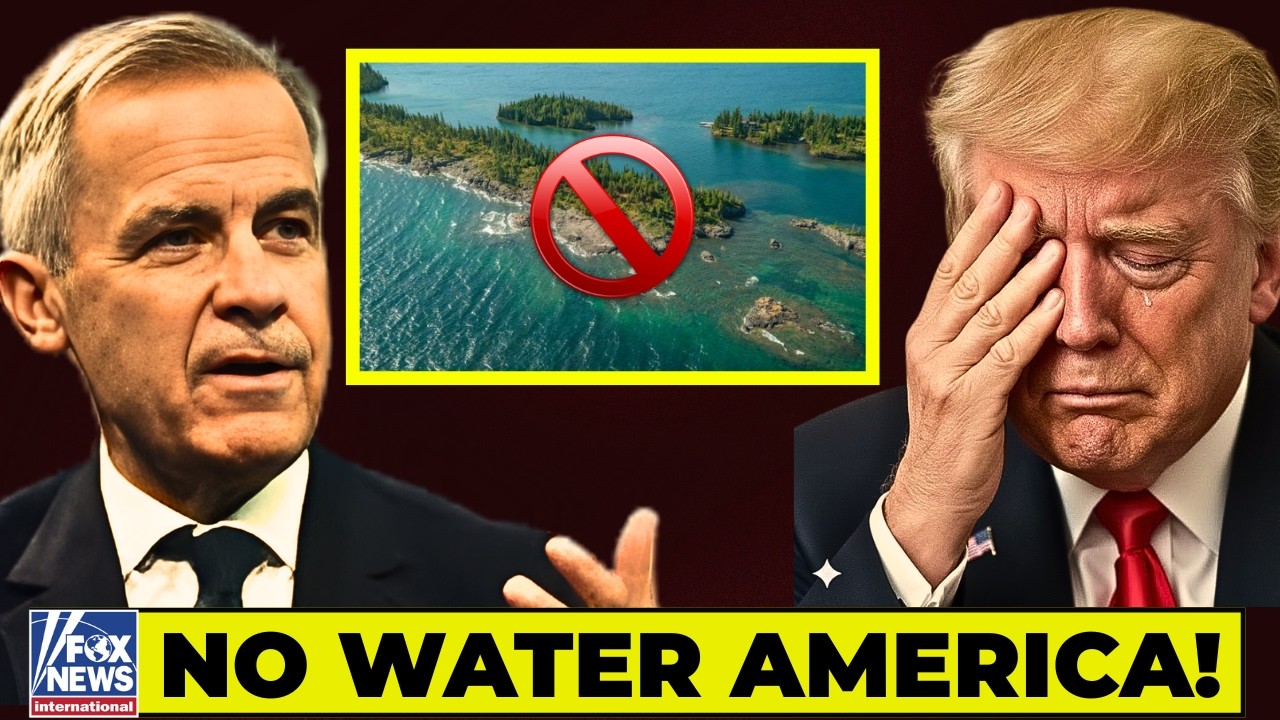
Canada’s response was swift and unusually stark. Prime Minister Mark Carney declared that “not one drop leaves Canada without our explicit permission.” The statement marked a rhetorical break from generations of careful cross-border diplomacy. It was followed by the rapid passage of the Great Lakes Protection Act, which closed longstanding legal ambiguities and formally prohibited bulk water removals from the basin without federal and provincial approval.
For decades, the Great Lakes — Superior, Michigan, Huron, Erie and Ontario — operated under a spirit of shared stewardship. The lakes straddle the boundary, with roughly half of the basin under Canadian jurisdiction and the other half in eight American states. The water was abundant, seemingly inexhaustible. Cities grew on their shores. Factories drew freely from their depths. Farmers irrigated fields without contemplating scarcity.
Together, the lakes contain roughly one-fifth of the world’s surface freshwater. Forty million people rely on them for drinking water. The basin supports hundreds of billions of dollars in annual economic activity across manufacturing, agriculture, shipping, tourism and energy production. The scale fostered complacency: there was always more water, until there wasn’t.
Beginning around 2010, record low water levels in Lakes Superior and Michigan-Huron signaled a shift. Warmer temperatures increased evaporation. Ice cover diminished. Rainfall patterns grew erratic. At the same time, the American West was confronting a starkly different water crisis. The Colorado River shrank. Aquifers declined. States such as Arizona and Nevada searched for new supplies.
Engineering studies explored the once-unthinkable: piping Great Lakes water thousands of miles westward. The proposals were technically feasible, if enormously expensive. Politically, they gained traction under the argument that American water should serve American needs.
That assumption collided with geography. The Great Lakes are not solely American. Their outflows pass through Canadian territory. The St. Lawrence Seaway runs through Canada before reaching the Atlantic. Hydroelectric operations at Niagara Falls are jointly managed. Canada controls critical choke points in a system on which both nations depend.
The Great Lakes Protection Act crystallized that reality. While Canada had banned bulk water exports in 1999, loopholes allowed bottled water extraction and left cross-border transfers in a gray zone. The new law requires explicit approval for any removal from the basin, whether industrial, commercial or municipal. Pipelines designed to move water out of the watershed are effectively prohibited.
The implications are less about immediate shortages than about leverage. Water is not oil or timber. It cannot be substituted or imported at scale. There is no global freshwater market that could compensate for even partial restrictions. Factories require it for cooling and processing. Crops depend on it. Power plants rely on stable lake levels. Shipping lanes function only if water depths are maintained.
Canada has not threatened to turn off the tap. Indeed, doing so would damage its own provinces as much as neighboring states. But the legal authority now exists, and in geopolitics, authority can matter as much as action. The mere fact that access rests on Canadian consent alters the psychology of every trade negotiation and tariff dispute.
Western governors, facing their own climate-driven shortages, have reacted with frustration. Some have accused Ottawa of hoarding resources during a continental emergency. Canadian officials counter that domestic water security must come first — that sovereignty over essential resources cannot be bargained away under pressure.
In quieter moments, policymakers on both sides acknowledge the deeper truth: climate change is eroding the assumptions that underpinned 20th-century water management. Abundance is no longer guaranteed. Cooperation, once effortless, now requires deliberate reinforcement.
The Columbia River Treaty pause may yet be resolved through negotiation. Cooler rhetoric may return. But the episode has exposed a structural imbalance that can no longer be ignored. The United States depends absolutely on water systems it does not fully control. Canada, long content with gentleman’s agreements, has chosen to formalize its authority.
Between allies, that shift is not a declaration of hostility. It is a recognition that in an era of scarcity, even friendship bends under the weight of necessity.