THE INVITATION, THE ISLAND, AND THE PHOTOGRAPH
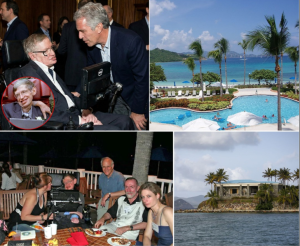
It’s 7 PM on March 17, 2006.
The sun is melting into the Caribbean Sea, painting the water gold and amber. At the Ritz-Carlton in St. Thomas, U.S. Virgin Islands, the ballroom is humming. More than twenty of the most brilliant minds on Earth are unpacking laptops and notebooks, shaking hands, pouring wine.
Three of them have Nobel Prizes. One of them cannot move his hands.
Stephen Hawking sits in his motorized wheelchair near the window, his eyes tracking the horizon. His voice synthesizer is quiet for now. His caregivers stand nearby — always nearby — ready for whatever he needs.
On paper, this is a physics symposium. The topic is gravity. The questions are enormous: What is the fabric of spacetime? What happened before the Big Bang? How does the universe hold itself together?
But the man paying for all of it — the hotel rooms, the catered meals, the private boat tours, the flights — is not a physicist. He is not a professor. He has no degree of any kind.
His name is Jeffrey Epstein. And at this exact moment in 2006, while the world’s greatest scientists are debating the mysteries of the cosmos, federal investigators are quietly beginning to piece together a very different kind of mystery — one involving dozens of young girls, a private island, and a network of powerful men who looked the other way.
Twenty years later, a photograph surfaces.
And nothing is simple anymore.
The Man in the Wheelchair
To understand why Stephen Hawking was in St. Thomas that March, you have to understand what his life actually looked like — not the legend, not the movie, not the inspirational poster. The real life.
In 1963, when Stephen William Hawking was 21 years old and just beginning his PhD at Cambridge, doctors gave him two years to live. He had been diagnosed with ALS — amyotrophic lateral sclerosis, a neurodegenerative disease that slowly shuts down the body’s motor neurons, one by one, until breathing itself becomes impossible.
He outlived that prognosis by fifty-five years.
During those decades, Hawking became the most recognizable scientist since Einstein. His book A Brief History of Time sold 10 million copies. His research on black holes, quantum cosmology, and the nature of spacetime fundamentally reshaped how physicists understand the universe. He gave lectures at Oxford, MIT, Caltech, and the United Nations. He appeared on The Simpsons, Star Trek, and Late Night with Conan O’Brien.
But here’s what those appearances never showed: what it took to get him there.
By 2006, Hawking had lost almost all voluntary muscle control. He could not feed himself, dress himself, or breathe independently without medical support. The only way he communicated with the world was through a cheek muscle that triggered a speech-generating device — one painstaking word at a time. According to neurologist Dr. Richard Bedlack of the Duke ALS Clinic, it was Hawking’s around-the-clock professional care team that kept him alive for as long as he lived: “Somebody like Stephen Hawking had access to 24/7 care for most of his life, which a lot of ALS patients do not. And that really helps with getting in front of things like opportunistic infections.”
Every trip Hawking took — whether to Geneva for a conference or to the Caribbean for a symposium — required at minimum two specialized nurses, a respiratory technician, and a medical equipment coordinator. The women and men who traveled with him weren’t companions. They were the reason he was still breathing.
They were in every photograph. Every room. Every moment.
And in St. Thomas, on that warm March afternoon, two of them happened to be wearing bikinis.
The Man With the Money
While Hawking was building one of the most celebrated careers in scientific history, Jeffrey Epstein was building something else entirely.
Born in Brooklyn in 1953, Epstein dropped out of college without a degree. He briefly taught math at a Manhattan prep school, which is where he met his first patron: the father of one of his students, who hired him at the investment bank Bear Stearns. Within a few years, Epstein had his own financial management firm. His client list was secretive. His wealth was enormous. And his methods were, even then, not quite right.
But that’s not the story that most people in elite circles were told.
The story they were told was this: Jeffrey Epstein is a visionary philanthropist with a passion for science. He believes the great questions of the universe deserve the best minds and the best resources. He gives generously, asks for nothing in return, and genuinely cares about the future of human knowledge.
It was a beautiful story.
It was also, in critical ways, a lie.
What Epstein actually wanted from the scientists he cultivated had nothing to do with black holes or quantum mechanics. According to analysis published by Scientific American in January 2026, Epstein’s real motivation was legitimacy. When you stand in a photograph next to three Nobel Prize winners and Stephen Hawking, you become — in the eyes of the world — a serious man. A man of vision. A man above suspicion.
That photograph was the point. The science was just the backdrop.
The Edge Foundation and the Web Behind It
To understand how Epstein got access to the world’s most brilliant people, you need to know about a small but influential organization called The Edge Foundation.
Edge described itself as a “salon for the 21st century” — a gathering place for the world’s greatest thinkers to ask big questions and share big answers. Every year, Edge posed a single question to hundreds of intellectuals: “What do you think is true but cannot yet be proved?” or “What scientific concept would improve everyone’s cognitive toolkit?” The responses were compiled into books, read by presidents and CEOs.
It sounded extraordinary. It was extraordinarily well-connected.
And Jeffrey Epstein was one of its most significant financial backers.
Lawrence Krauss — the Arizona State physicist who organized the St. Thomas symposium and invited Hawking — had deep ties to both Edge and Epstein. Court documents unsealed years later would show that when Krauss himself faced sexual misconduct allegations in 2018, he reportedly sought advice from Epstein. Think about what that means: a man accused of harassment calling a registered sex offender for guidance.
That single detail tells you everything about how normalized Epstein had made himself within these circles.
He wasn’t an outsider who occasionally got access. He was woven into the fabric of intellectual life at the highest levels — funding labs at Harvard and MIT, attending private retreats with tech billionaires, and hosting symposiums in paradise where the most famous scientists in the world came to discuss the nature of gravity while his private island sat just miles away.
Six Days in St. Thomas
The symposium officially opened on March 17, 2006. The St. Thomas Source, the island’s local newspaper, covered it breathlessly: “The Ritz-Carlton hummed like the inside of an atom Thursday night as 20 of the world’s top physicists — including three Nobel Prize winners — opened an informal symposium to debate the makeup and origins of the universe.”
Epstein told the reporter that the topic was simple, really: “They say Newton discovered it but no one knows what it is. What is gravity?”
He said it with the confidence of someone who belonged there.
The program for those six days included formal lectures, small-group discussions, beach dinners, and — crucially — an excursion to Epstein’s “nearby private island retreat.” That island was Little Saint James: a 75-acre private island in the U.S. Virgin Islands that Epstein had purchased in 1998 and transformed into a personal compound, complete with a mansion, a temple-like structure on the hill, and, notably, a custom-built submarine for touring the seabed.
Stephen Hawking went on that submarine tour.
And here’s the detail that stops you cold.
The submarine had been specifically modified to accommodate Hawking’s motorized wheelchair.
Sit with that for a second. Somebody — whether Epstein himself or someone on his staff — researched the exact dimensions of Hawking’s chair, the weight specifications, the loading requirements, and engineered a solution. They wanted Hawking to descend beneath the Caribbean Sea and witness something extraordinary. They needed him to feel seen. To feel valued. To feel like this trip was worth making.
For a man who had spent fifty-five years trapped in a body that wouldn’t cooperate, who had never been able to simply walk into the ocean or dive beneath the waves — the chance to pilot beneath the surface of the sea was perhaps the one experience he had never been offered before.
Jeffrey Epstein offered it to him.
And somewhere, in a waterproof bag or a hotel safe, someone took a photograph.
The Photograph That Broke the Internet
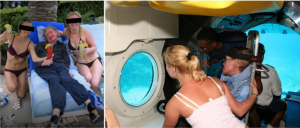
February 25, 2026.
The U.S. Department of Justice releases a new batch of Epstein-related files as part of the ongoing compliance with the Epstein Files Transparency Act. The release includes millions of pages of documents, emails, flight logs, and photographs gathered over two decades of federal investigation.
Within hours, one image begins circulating.
It shows a sun-soaked beach. A man in a wheelchair — instantly recognizable even in silhouette — is positioned between two women in black bikinis. The women are tan and relaxed, holding cocktails. One of them is helping the man in the wheelchair hold his own glass. All three appear to be laughing.
The man is Stephen Hawking.
By nightfall, the photograph has been shared millions of times. The headlines write themselves. The comment sections explode. Theories cascade across every platform — each one more certain than the last, each one assembled from a three-second glance at a 20-year-old image.
By morning, a family spokesperson reaches out to The Times of London.
The two women, they explain, are British professional nurses who had cared for Hawking for years. They traveled with him everywhere. The photograph was taken at the beach portion of the 2006 science symposium at the Ritz-Carlton. The women are wearing bikinis because it is a beach. In a tropical climate. In March.
There is nothing unusual about this photograph — if you know that Stephen Hawking required round-the-clock medical support to stay alive.
But the internet had already made up its mind.
Discovery: 409 Times
The bikini photograph was startling. But it was not the number that stopped investigators.
The number that stopped investigators was 409.
That is how many times Stephen Hawking’s name appears across the full body of Epstein files released by the DOJ. Four hundred and nine references. Across fourteen emails. Three appearances in flight logs — the meticulously kept records of who flew on Epstein’s private aircraft, and when, and where.
409 is not a passing mention. 409 is a chapter.
What do those 409 references say? That question does not have a clean answer yet. Some are clearly administrative — emails organizing the 2006 symposium, references to Hawking’s speech on quantum cosmology, logistics for his caregiving team. But others exist in contexts that have not yet been fully explained publicly.
And then there is an email. One specific email, buried in the thousands of pages from a civil lawsuit, that changes the texture of this entire story.
That email is where Part 2 begins.
THE EMAIL, THE EMPIRE, AND THE QUESTIONS NO ONE CAN ANSWER
The Investigation That Came Too Late
July 2006.
The physicists have gone home. Their luggage is unpacked, their notes transcribed, their papers in progress. Lawrence Krauss is probably writing. Hawking is probably dictating. The symposium is becoming a memory.
And in Palm Beach, Florida, a teenage girl is telling a police detective about a man named Jeffrey Epstein.
She is not the first.
By the time federal investigators open a formal inquiry in the summer of 2006, Palm Beach police have already compiled a file thick with testimonies from young women. The pattern is consistent and devastating: a recruiter would approach girls, often at shopping malls or beaches, with promises of money and opportunity. They’d be brought to Epstein’s Palm Beach mansion. What happened there — what was expected of them — bore no resemblance to the glamorous life they’d been promised.
The FBI opened its investigation in July 2006. Four months after the St. Thomas symposium.
The Nobel laureates were writing papers. The FBI was building a case. And Epstein was already planning his next conference, his next donation, his next introduction to someone who would later testify they had no idea who he really was.
Two worlds, running in perfect parallel.
The Woman Who Fought Back
You cannot tell this story without saying her name.
Virginia Giuffre was sixteen years old when she first met Ghislaine Maxwell at a Palm Beach shopping center. Maxwell — British socialite, daughter of media mogul Robert Maxwell, and Epstein’s closest confidante — was charming, attentive, and impossibly sophisticated. She told Virginia that a wonderful man wanted to help talented young people. That he was generous. That he cared.
Virginia believed her.
What followed were years of abuse, exploitation, and silence — enforced not just by fear, but by the machinery of wealth and legal power that surrounded Epstein and his network. When Virginia finally began speaking publicly, she did so at enormous personal cost. She was dismissed, discredited, and dragged through years of litigation.
She filed a civil lawsuit against Ghislaine Maxwell. The documents from that lawsuit — thousands of pages of depositions, exhibits, and correspondence — became one of the most consequential legal archives in American history.
And inside those documents, buried among the evidence, was a name that nobody expected to see in this context.
Stephen Hawking.
Virginia Giuffre herself did not accuse Hawking of anything. That needs to be stated clearly. But in the correspondence attached to her case, an email surfaced. An email that, once you read it, you cannot un-read.
The Email
The sender: Jeffrey Epstein.
The recipient: Ghislaine Maxwell.
The subject: an unverified, unsubstantiated allegation that had apparently been circulating in certain circles — that Stephen Hawking had participated in an “underage orgy” at Epstein’s property in the Virgin Islands.
And Epstein’s response to this allegation, in his own words, was to offer a financial reward to anyone who could disprove it.
Now.
Stop.
Read that again, slowly.
A man who ran a multi-decade sexual exploitation network was willing to pay money to protect the reputation of a physicist who could not speak, could not move, and who died in 2018 before any of this became public.
Why?
There are exactly two ways to read that email, and neither of them is comfortable.
Reading One: Epstein genuinely liked Hawking, valued the association, and wanted to protect him from a false rumor — perhaps because having Hawking’s name dragged into scandal would draw unwanted attention to Little Saint James and, by extension, to Epstein himself. This reading makes Epstein look self-serving but doesn’t implicate Hawking in anything.
Reading Two: The email’s framing — offering money to disprove an allegation rather than simply denying it — is the kind of language used by someone managing damage, not someone defending the innocent. In this reading, the offer itself is suspicious.
Federal investigators are aware of the email. No public statement has been made about which reading they favor.
And that silence is its own kind of answer.
Science as a Cover Story
In January 2026, Scientific American published a deep investigation into a question that had been floating around academic circles for years: “Why Did Jeffrey Epstein Cultivate Famous Scientists?”
The answer, laid out carefully across thousands of words, was not about intellectual curiosity. It was about armor.
Legitimacy, in elite American culture, functions like a force field. If you are associated with Harvard, you are insulated from doubt. If you fund MIT research programs, you are a visionary, not a predator. If you can say — and mean it, because the photographs exist — that you spent a week on an island with Stephen Hawking and three Nobel laureates discussing the fundamental nature of gravity, then you are not the kind of person who gets investigated by the Palm Beach Police Department.
You are the kind of person who gets a profile in The New York Times.
This wasn’t accidental. According to researchers who analyzed Epstein’s financial trail, his donations to academic institutions followed a very specific pattern: he targeted individuals more than institutions, cultivating personal relationships with professors who would then invite him to conferences, mention his name in social circles, and normalize his presence in rooms where powerful people gathered.
The Edge Foundation’s annual list of contributors included his name. MIT Media Lab took his money — even after 2008, when he was a convicted sex offender. Harvard kept him on as a “visiting fellow” status in certain programs.
When it came out, the institutions scrambled. Donations were returned, or pledged to be returned. Statements were issued. Reviews were launched.
But the network had already been built. And many of the scientists who had traveled on Epstein’s dime, stayed at his properties, or accepted his funding faced the same deeply uncomfortable reckoning: they hadn’t asked questions they should have asked.
Hawking’s situation sits in this larger context. Was he a target, or a participant, or simply a brilliant man who accepted an invitation to a beautiful island to talk about physics and never knew — or never let himself fully know — what funded the trip?
That question does not have a verdict. It has only angles.
The Tsunami of Fake Evidence
Here is where the story takes a turn that most people haven’t fully processed.
When Hawking’s name first became publicly associated with Epstein in early 2024 — when the first round of unsealed documents dropped and journalists started combing through them — something ugly happened online.
Fabricated documents began to circulate.
Screenshots designed to look like official court exhibits described, in graphic detail, specific sexual behaviors allegedly attributed to Hawking. Fake PDFs carried the visual formatting of DOJ filings. AI-generated video content depicted “victims” naming him. The content spread at algorithmic speed across Twitter, Facebook, Reddit, and TikTok.
USA Today and other fact-checking organizations investigated and confirmed: none of these documents were real. Not one. There is no verified court testimony, no authenticated legal filing, no named accuser who has identified Stephen Hawking as a perpetrator of any crime.
The fabrications were so convincing — and spread so widely — that The Times of London had to publish a specific clarification noting that a viral “Epstein document” purporting to describe Hawking’s “proclivities” was entirely manufactured.
But here is the brutal reality of the information ecosystem we live in: A fact-check published by USA Today will be read by 50,000 people. The fake document it is correcting will be seen by 50 million.
Hawking died on March 14, 2018. He cannot file a lawsuit. He cannot give an interview. He cannot sit across from a journalist and say, “Here is what actually happened.”
His family can issue statements. His estate can clarify. His friends can defend.
But the algorithm doesn’t care about any of that. The algorithm rewards outrage. It rewards certainty. It rewards the three-second verdict rendered on a 20-year-old photograph of a man in a wheelchair flanked by two women in bikinis on a beach in St. Thomas.
Trial: What the Courts Actually Found
On December 29, 2021, after a three-week trial in federal court in Manhattan, a jury found Ghislaine Maxwell guilty on five of six counts, including sex trafficking of a minor.
She was sentenced to twenty years in prison.
Jeffrey Epstein did not live to see the verdict. He died in his cell at the Metropolitan Correctional Center in New York City on August 10, 2019 — officially ruled a suicide, though the circumstances remain disputed by his legal team, his family, and a significant portion of the American public.
During the Maxwell trial, and in the years of civil litigation surrounding the Epstein case, hundreds of names surfaced. Former President Bill Clinton. Former President Donald Trump. Prince Andrew of the British Royal Family, who reached a financial settlement with Virginia Giuffre before her death and has repeatedly denied any wrongdoing. Harvard professor and attorney Alan Dershowitz. Tech billionaires. Hedge fund managers. Former heads of state.
And Stephen Hawking.
The DOJ’s official list of “politically exposed persons” connected to the Epstein investigation runs to more than 300 names. Among them: Princess Diana. Elvis Presley. Individuals who died decades before the investigation began.
Appearing on this list does not mean being charged with a crime. It does not mean being accused by a victim. It does not mean guilt.
It means your name appears somewhere in 3.5 million pages of documents about a man who spent decades systematically cultivating powerful people as either participants or, at minimum, unknowing props in his performance of legitimacy.
Which category Hawking falls into — no one can say with certainty. The full documentary record has not been publicly analyzed. Some of those 409 references have not been contextualized. The three flight log appearances have not been explained in full.
What the courts have determined is that Jeffrey Epstein built something monstrous, that Ghislaine Maxwell helped him build it, and that the institutions and individuals who took his money and attended his parties did so in an environment where, if they had asked the right questions, the answers would have been available.
The System That Failed
- Epstein is charged in Palm Beach. His attorneys — a team that included Alan Dershowitz and former independent counsel Kenneth Starr — negotiate with federal prosecutor Alex Acosta.
The result is a plea deal that legal scholars still describe as one of the most outrageous miscarriages of justice in American legal history.
Under the agreement, Epstein pleaded guilty to two state charges — soliciting prostitution and soliciting a minor. He was sentenced to eighteen months in county jail, with work release six days a week. All potential federal charges were dropped. And crucially, in direct violation of federal law governing victims’ rights, the dozens of identified victims were never notified that a deal was being made.
Epstein served thirteen months.
Then he went home.
He flew on his private plane. He hosted dinner parties. He continued donating to universities. He attended an annual off-the-record “Dialog Retreat” in Utah in 2013 — alongside Harvard professors and tech investors — five years after his conviction.
Five years after being a registered sex offender, he was still receiving invitations from serious people.
The Guardian, analyzing the newly released files in February 2026, wrote: “The Epstein files place renewed attention on US authorities’ failure to stop him.” That failure was not accidental. It was the product of a legal system that treated powerful men’s reputations as more valuable than teenage girls’ safety, for decades, in plain sight.
The Inheritance: What Hawking Leaves Behind
On March 14, 2018, Stephen Hawking died peacefully at his home in Cambridge. He was 76 years old.
The world mourned in a way that only happens for a handful of humans per century. The Royal Society flew its flag at half-mast. The Cambridge University Senate House was illuminated in his honor. Thousands gathered outside his office. His quote — “Remember to look up at the stars and not down at your feet” — circled the globe in every language.
His children, Lucy, Robert, and Tim Hawking, managed his estate and legacy with careful attention. The Hawking radiation formula, his most profound theoretical contribution, was inscribed on his memorial stone in Westminster Abbey alongside Newton and Darwin.
That is the man we are talking about when we talk about this story.
Not a villain. Not a saint. A man — brilliant, complicated, and profoundly human — who lived a life of almost unimaginable constraint and accomplished things that almost no one else has accomplished. Who accepted an invitation to a symposium funded by someone whose full nature he may or may not have understood. Who sat on a beach in the Caribbean sun, flanked by the nurses who kept him alive, and smiled for a photograph that would not resurface for twenty years.
His family is fighting, in every interview and every statement, to hold that context intact. To prevent the algorithm from flattening a man’s entire life into one image, one number, one unanswered question.
It is an exhausting battle. It is also one of the most important ones happening in public discourse right now.
Three Angles on an Unanswerable Question
Here is where the honest accounting lands, as of February 2026:
The case for full innocence: Hawking attended a legitimate scientific conference funded by someone he may not have known was a predator. His caregivers were medical professionals. No victim has named him. No criminal allegation has been substantiated. The fake documents are fake. The flight log appearances correspond to known scientific trips. The 409 references are almost certainly administrative and contextual, not evidential.
The case for uncomfortable complicity: The academic world knew — or had serious reason to suspect — that Epstein’s money came with ethical strings attached. The Edge Foundation’s ties to him were documented. His 2008 conviction was public. Scientists who continued to attend his events after 2008 made a choice. Whether Hawking or his team ever discussed this is unknown.
The case for suspended judgment: The full documentary record is 3.5 million pages long. It has been public for roughly four weeks. Professional investigators, journalists, and legal scholars are still working through it. Drawing firm conclusions now — in either direction — is premature. The email about the reward money. The three flight log entries. The 14 emails. These require full context before they can be meaningfully interpreted.
All three positions are defensible. None of them is complete.
Ending
March 2006. The symposium is winding down.
The Nobel laureates are packing their bags. The equations on the whiteboards will be erased by the housekeeping staff in the morning. Outside, the Caribbean is doing what the Caribbean always does — rolling, glittering, indifferent to what humans argue about on its shores.
Stephen Hawking is brought to the beach for one last afternoon. His caregivers sit nearby, attentive, dressed for the weather. Someone takes a photograph.
He is smiling.
Twenty years from now, that photograph will surface in a federal investigation. It will be seen by millions of people who will look at it for three seconds and decide they know exactly what it means. It will be the center of a media storm, a family’s desperate defense, a fact-checker’s nightmare, and a lesson in how quickly the internet can construct a verdict about a man who can no longer speak for himself.
But right now, in this moment, on this beach, the sun is warm and the water is blue, and Stephen Hawking — the most brilliant mind of his generation, a man who has not moved his own hands in decades, who talks through a machine, who sees the universe more clearly than almost anyone alive — is watching the waves.
What he knows about the man who paid for this moment, no one can say.
What we know is that somewhere in 3.5 million pages of documents, there is an email. And in that email, Jeffrey Epstein offered money — real money — for a reason that has never been fully explained.
Was it to protect a friend? To protect himself? To protect something else entirely?
The investigators know about that email. They have read it carefully.
What they found next — and why one senior FBI source described a separate document as “something we still can’t explain” — that story is still unfolding.
And it will not stay buried much longer.






