A Senate hearing that had unfolded with familiar partisan choreography took a dramatic turn when Richard Blumenthal reached into a folder and produced a single photograph.
Across the dais sat Attorney General Pam Bondi, who had spent nearly four hours testifying before the United States Senate Judiciary Committee. She had fielded questions about Justice Department independence, prosecutorial discretion and the handling of matters connected to Jeffrey Epstein with practiced restraint, repeatedly invoking procedural safeguards and classification limits.
Then the rhythm shifted.
Blumenthal did not begin with an accusation. He began with an image. Placing the photograph face down on the desk, he first asked Bondi to reaffirm prior testimony: that she had “no personal connection” to individuals referenced in the Epstein investigation files. Bondi answered without hesitation. That was correct, she said, describing her role as impartial and professional.
Only then did Blumenthal turn the photograph toward the cameras — and toward Bondi.
The image, dated 2018, showed Bondi seated at what he described as a private dinner in Palm Beach, Fla., beside an individual whose name, he said, appears dozens of times in Epstein-related investigative materials. The photograph, Blumenthal added, had been authenticated by multiple sources.

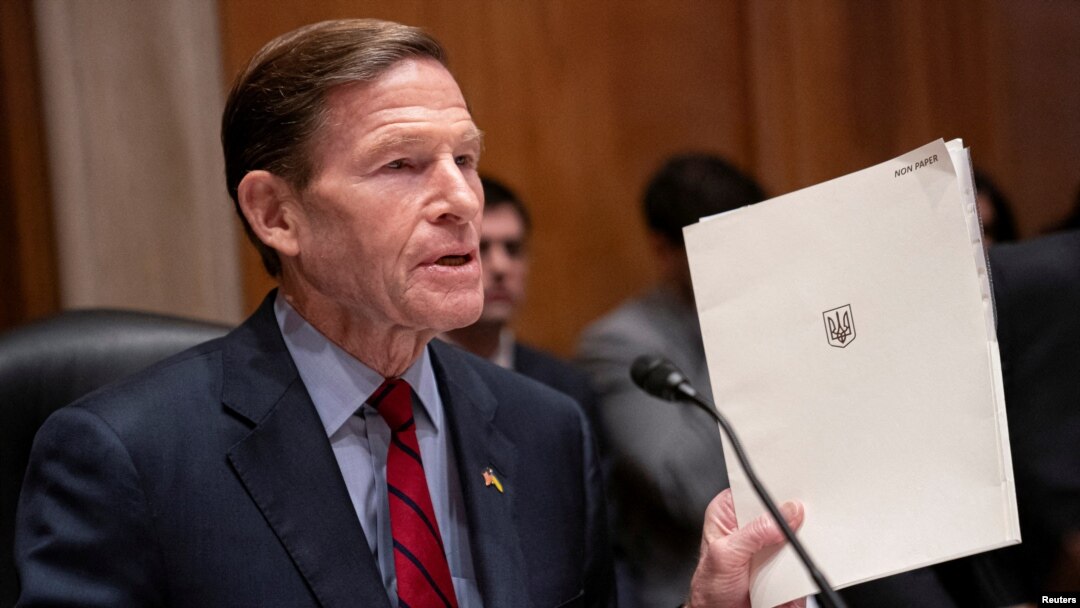
The chamber fell quiet.
Observers later noted that the silence was not theatrical but anticipatory — the pause that follows when a hearing moves from abstract debate to tangible evidence. Bondi leaned briefly toward her legal counsel. A whisper. A nod. Then she returned to the microphone.
“Senator, I attend many events in my capacity as—” she began.
“This wasn’t in your capacity,” Blumenthal interjected, pointing out that in 2018 Bondi held no federal office. This was, he emphasized, a private dinner. And the person seated next to her, he argued, was someone connected to files she now had authority to oversee as the nation’s chief law enforcement officer.
He asked the question again: Did she have any personal connection to individuals referenced in the Epstein files?
Seven seconds passed — a long interval in the clipped tempo of congressional questioning.
Bondi responded carefully. She may have attended social events where various individuals were present, she said, but that did not constitute a “personal connection” within the meaning of her earlier testimony. Her counsel requested a brief recess; the committee chairman denied it.
The exchange quickly spread across social media and cable news, not solely because of the photograph itself, but because of the sequence: a categorical denial followed minutes later by visual evidence of proximity. In the architecture of oversight, legal scholars note, chronology often carries as much weight as content.
Blumenthal’s argument rested less on the dinner than on disclosure. He observed that the photograph had not been mentioned during Bondi’s confirmation process. Disclosure requirements for high-ranking officials are broad, and failure to reveal potentially relevant associations — even social ones — can invite scrutiny. “Never disclosed,” he repeated, allowing the phrase to linger.
Supporters of the attorney general countered swiftly. A photograph at a dinner table, they argued, does not establish a meaningful relationship, let alone a conflict of interest. Washington, particularly in Florida political and philanthropic circles, is dense with overlapping social networks. Proximity, they said, should not be conflated with impropriety.
Yet critics maintained that the issue was credibility. Bondi had testified that no personal connections existed. The photograph, they contended, complicated that assertion — if not legally, then perceptually.
The Justice Department declined to comment beyond Bondi’s testimony. Several legal analysts noted that the term “personal connection” lacks a fixed statutory definition in this context, leaving room for interpretation. Whether attendance at a private dinner constitutes such a connection may hinge on frequency, familiarity and subsequent interactions — details not established in the brief exchange.
Still, the moment underscored the enduring power of imagery in political accountability. Documents can be debated, transcripts parsed and definitions litigated. A photograph, by contrast, presents a frozen fact: two individuals in the same place at the same time. What that fact means becomes the battleground.
Blumenthal closed with procedural precision. The photograph was entered into the record as an exhibit. Bondi’s denial remained part of the official transcript. “The American people now have both,” he said. “They can decide which one tells the truth.”
In an era when congressional hearings often dissolve into partisan spectacle, this confrontation stood out for its stark simplicity. No raised voices. No sweeping rhetoric. Just a sworn statement and a single image placed beside it.
Whether the episode evolves into formal inquiry or fades into the churn of Washington controversy remains to be seen. But for a brief, charged interval inside the Senate hearing room, oversight was distilled to its essence: a question, an answer and the unblinking permanence of a photograph.






