The Corridor of Silence: How Jasmine Crockett’s Documentary ‘Trap’ Pinned the DOJ to the Epstein Files
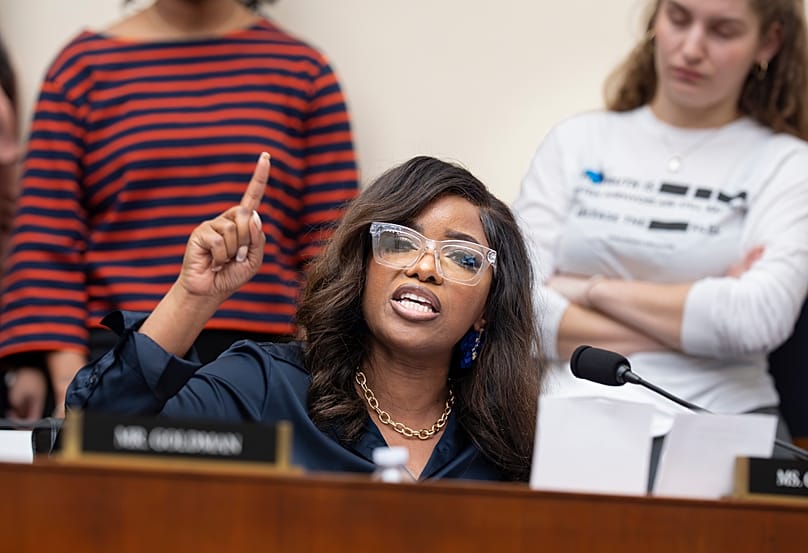
WASHINGTON — In the wood-paneled chambers of the House Judiciary Committee, where grandstanding often serves as the primary currency, a recent 26-minute exchange has fundamentally rewritten the official record of the Jeffrey Epstein investigation. On a Wednesday afternoon in February 2026, Representative Jasmine Crockett (D-TX) moved beyond the rhythmic sparring of Washington oversight to deliver a forensic strike that has left the Department of Justice’s credibility in a state of structural collapse.

The confrontation, which has since dominated legal circles and digital platforms, was not centered on a “new” accusation. Instead, it was built on the precise, internal language of the Department of Justice itself—documents that Crockett read into the record verbatim, forcing Attorney General Pam Bondi to choose between addressing her own department’s words or retreating into a silence that the transcript now records as an admission.
The Architecture of the ‘Hold’
The cornerstone of Crockett’s interrogation was a January 18, 2026, internal memorandum—a directive from the Deputy Attorney General. The document, which Crockett read with the measured cadence of a prosecutor, ordered all Epstein-related investigations involving “current administration officials” to be placed on an administrative hold. Crucially, the directive mandated that no new investigative actions could proceed without the Attorney General’s personal approval.
When Crockett posed the central question—”If these investigations are ongoing, as you claim, why did you order them halted?”—the room fell into a four-second silence that a stenographer’s timestamp has now made permanent. The contradiction was binary: the DOJ could not simultaneously claim the investigation was active while its own internal memos ordered it frozen.
The $47 Million Disparity
Crockett’s “case” was not limited to policy directives; it was grounded in the indisputable arithmetic of the DOJ’s budget. She presented a sequence of figures sourced directly from the department’s internal records:
-
$47 Million: The amount expended on the prosecution of journalists and whistleblowers under Bondi’s tenure, including $2.3 million directed at Sarah Chen, the journalist who exposed the current administration’s links to the Epstein network.
-
34 Percent: The documented decline in child sex trafficking prosecutions during the same period.
-
Seven Cases: The number of child exploitation cases “declined” by the Public Integrity Section, citing—in the department’s own words—”significant political connections.”
“This is not a partisan allegation,” Crockett stated, her hand resting on a manila folder of evidence. “This is arithmetic. A budget is a statement of priorities. You spent $47 million pursuing the journalist who exposed these connections, and zero dollars pursuing the people she exposed.”
The Witness and the ‘Wall’
Perhaps the most visceral moment involved FBI Witness Summary E47. The document, dated March 15, 2023, contained sworn testimony describing observations of Donald Trump at Jeffrey Epstein’s Palm Beach residence. According to the record, the summary had sat in federal files for 36 months without a single documented follow-up action—not an interview, not a subpoena, not a notation.
When Bondi attempted to pivot to the subject of immigration to fill the silence, Crockett refused the lateral motion. “I did not ask about immigration,” she countered. “I asked why a sworn witness summary documenting testimony about the President of the United States sat in FBI files for 36 months without follow-up. What you just did was non-responsive, and I want the record to reflect that distinction.”
The Gallery in White
The exchange was punctuated by the presence of seven Epstein survivors, dressed in white, seated in the back row. They had been functionally invisible throughout five hours of testimony until Crockett turned to them, forcing the Attorney General to acknowledge the human stakes of the procedural “management” she was defending.
“These are not symbols. These are people,” Crockett told the room. Bondi, however, remained focused on her desk, speaking about “inter-agency coordination” without once looking toward the gallery.
The Unanswered Binary
As the hearing neared its conclusion, Crockett delivered the final wall in her “corridor of accountability.” She asked a simple yes-or-no question: Had the DOJ declined investigative action in Epstein-related cases specifically because of the subjects’ proximity to current administration officials?
Bondi’s response—a “sentence-shaped object” that occupied the space of an answer without containing one—effectively closed the trap. In the world of federal oversight, an unanswered binary question under oath does not fade; it becomes a structural component of the institutional record.
The “Crockett Interrogation” has not resulted in an immediate resignation or a new indictment, but it has accomplished something far more durable. It has placed a sequence into the official Congressional Record that no subsequent press release can erase: an administrative hold, a reclassification email aimed at preventing oversight, and a four-second silence that tells the story of an investigation that didn’t just slow down—it was managed into a standstill. For the survivors in white, the question of “why” has finally been documented, even if it remains unanswered.






