The $10 Billion Conflict: Inside Jamie Raskin’s High-Stakes Interrogation of Pam Bondi
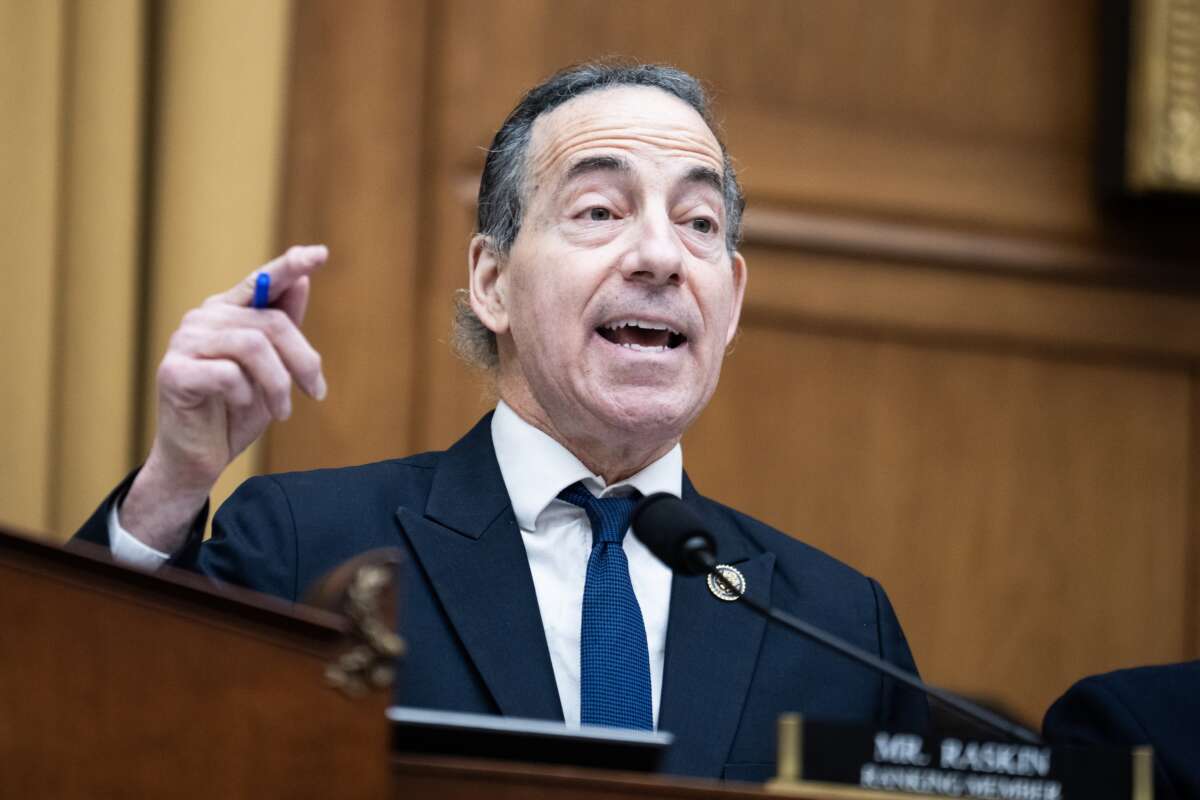
WASHINGTON — In the high-decibel arena of the House Judiciary Committee, where grandstanding often masks the absence of substance, a recent exchange has redefined the 2026 oversight cycle. Representative Jamie Raskin, a constitutional scholar known for his forensic precision, moved beyond the rhythmic sparring of Washington to deliver what observers are calling a “structural indictment” of the Department of Justice’s current posture on executive privilege and victim protection.

The confrontation, which has since dominated digital platforms and legal circles, centered on a fundamental contradiction: the DOJ’s aggressive posture regarding a multi-billion-dollar presidential lawsuit contrasted against its catastrophic failure to protect the identities of sex-trafficking survivors.
The $10 Billion Constitutional Knot
Raskin’s interrogation began with a deep dive into the Domestic Emoluments Clause—Article II, Section 1, Clause 7 of the Constitution. He highlighted a staggering $10 billion lawsuit filed by Donald Trump against the Internal Revenue Service and the Treasury Department for the alleged leak of his tax returns.
The strategy was surgical. Raskin pointed out that the decision to settle this multi-billion-dollar claim now sits with a Justice Department led by the President’s own political appointees. “He himself has remarked, ‘I’m the one that makes the deal… I kind of have to work it out with myself,'” Raskin noted, pressing Attorney General Pam Bondi on whether such a settlement would violate constitutional limits on presidential compensation. Bondi’s refusal to answer, citing “pending litigation,” created an immediate vacuum of accountability that Raskin was quick to exploit.
Trauma vs. Tax Returns
The turning point of the hearing occurred when Raskin forced a visceral comparison between the President’s “embarrassment” over tax leaks and the “ruination” of Jeffrey Epstein’s survivors. While the administration pursues $10 billion in damages for the former, the DOJ recently admitted to a massive failure in redacting the personal information of Epstein victims in a public document dump.
“If Donald Trump can get $10 billion theoretically from the Department of Justice,” Raskin asked, “how much should these people get for a far worse violation of their privacy and a far greater danger established to their lives?”
The scale of the failure was underscored by legal analysts who noted that one survivor’s name appeared unredacted 538 times in the latest release of files. Despite being granted an extension to finalize redactions, the DOJ’s “sloppy” execution resulted in the public release of addresses, phone numbers, and uncensored images of survivors—triggering fresh trauma and documented death threats.
The ‘Chase Mulligan’ Diversion
As the exchange grew more volatile, Bondi attempted to pivot the conversation toward local criminal cases in Raskin’s district, specifically referencing a defendant named Chase Mulligan. Raskin dismissed the move as a “wild goose chase” designed to evade national oversight.
“We’ve never had a witness who has misunderstood our rules and been unable to conform his or her conduct to our rules before,” Raskin shouted, reclaiming his time after Bondi attempted to talk over his questions. He demanded to know if the DOJ would commit to a joint task force with state and local law enforcement to investigate the co-conspirators named in the Epstein files—a move Bondi notably declined to endorse.
The Institutional Fallout
The hearing concluded not with a resolution, but with a widening rift between the legislative and executive branches. While the DOJ recently reached a confidential deal with survivors’ attorneys to pull down thousands of compromised documents, the damage to public trust appears structural.
As the 2026 political landscape intensifies, the Raskin-Bondi exchange stands as a permanent record of the tension between political loyalty and institutional duty. For the survivors in the gallery, the “10 Billion Dollar Mystery” serves as a haunting metric of whose privacy the government treats as a multi-billion-dollar asset, and whose it treats as an administrative error. The files are being corrected, but in the halls of Washington, the search for a justice system that prioritizes victims over a political “deal” continues.






