The Social Contract in Shreds: Senator John Kennedy’s “Powerball” Warning to the DOJ
WASHINGTON — In the grand, often stilted tradition of Senate oversight, Senator John Kennedy (R-LA) has long been known for a rhetorical style that masks a sharp prosecutorial edge. On Thursday, during a high-stakes hearing before the Senate Judiciary Committee, Kennedy utilized that edge to dismantle the Department of Justice’s narrative of impartiality, warning that the “social contract” between the American people and their government is reaching a breaking point.

The confrontation with Attorney General Pam Bondi was not a debate over legal technicalities, but a forensic examination of institutional legitimacy. In a line of questioning that moved from high-profile convictions to the unprecedented prosecution of a former president, Kennedy argued that the DOJ has “broken the seal” on a dangerous new era of political warfare.
The Foundation of Legitimacy
Kennedy began by securing a series of concessions from Bondi regarding the nature of justice itself. He established that the legitimacy of the Department is the “glue” that ensures citizens follow the law. “If Americans come to believe that our Department of Justice is acting illegitimately,” Kennedy posited, “that makes Americans less likely to accept the results of that system, does it not?”
Bondi agreed. Kennedy then pushed the logic to its final conclusion: without legitimacy, the result is “chaos” and a fundamental breach of the social contract. To illustrate the system’s potential for fairness, Kennedy cited the falls of Michael Avenatti and Sam Bankman-Fried—men who once commanded massive media and financial influence but were ultimately “put in jail because they were crooks” by the DOJ.
The “Stupid” Plan
The atmosphere in the room shifted when Kennedy turned his focus to the Department’s actions under the previous administration, specifically the criminal prosecution of Donald Trump by Attorney General Merrick Garland.
Kennedy characterized the decision to prosecute a former president—who was also the chief political rival of the current president’s boss—as the “most destabilizing act” in the history of the department. Using a characteristic Southern flourish, Kennedy remarked that “that kind of stupid takes a plan,” suggesting the move was not an accident of law, but a calculated political maneuver.
“This is America,” Kennedy said. “That had never happened before in America. That’s the sort of thing that happens in a country whose power ball jackpot is 287 chickens and a goat.”
The “2030” Precedent
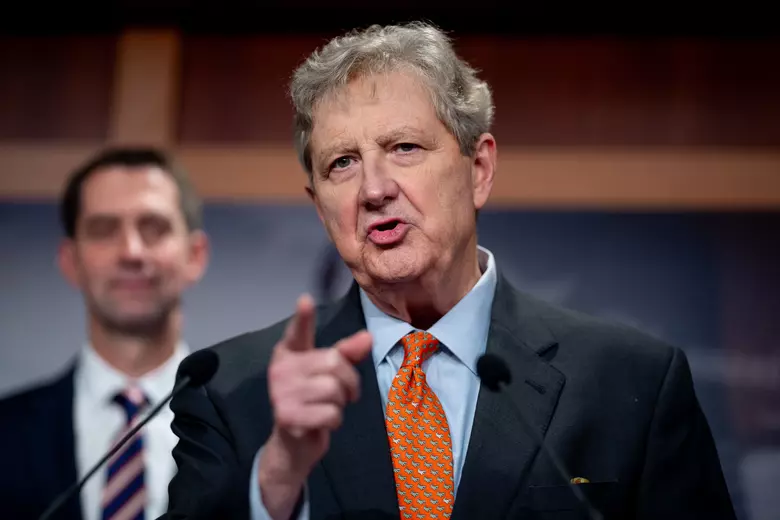
The Senator’s primary concern was not just the immediate political fallout, but the precedent the “seal-breaking” had established. Kennedy warned that the normalization of prosecuting political opponents has opened a “Pandora’s box” for ambitious prosecutors across the country, regardless of party.
He suggested that the road the country is now traveling could lead to local prosecutors filing retaliatory charges against members of the current administration’s inner circle. “There are a lot of ambitious prosecutors in America,” Kennedy warned. “And I’ll bet you right now there’s some prosecutor… thinking about, well, maybe I ought to file criminal charges against President Biden’s inner circle for conspiring to conceal his mental decline.”
A Call for “Cleaning House”
As the hearing reached its zenith, Kennedy’s clinical tone returned. He urged Bondi to “fix it” by identifying and removing what he termed a “minority of people” within the DOJ who have delegitimized the system.
The Senator’s message to the Attorney General was clear: the Thousands of law enforcement officers and dedicated professionals within the DOJ are being overshadowed by the actions of a few at the top. Rebuilding that trust, he argued, requires a return to evidence-based justice rather than “dubious facts and untested legal theories.”
The Unresolved Crisis
By the time the exchange ended, the hearing had evolved from a routine oversight session into a window into the central anxiety of American democracy. While the Department of Justice continues to defend its actions as an adherence to the rule of law, Kennedy’s questioning highlighted a significant and growing portion of the public that views those same actions as a partisan weapon.
For the American public watching the exchange, the takeaways were stark. The “social contract” Kennedy described is increasingly under strain, and the institutional credibility of the DOJ is now a live-wire issue that extends far beyond any single court case. Kennedy did not provide the answers, but he placed the questions on the official record: once the seal of impartiality is broken, can it ever truly be restored?






