Elon Musk’s Stunning Rebuke of Friedrich Merz Sparks a Political Shockwave Across Europe
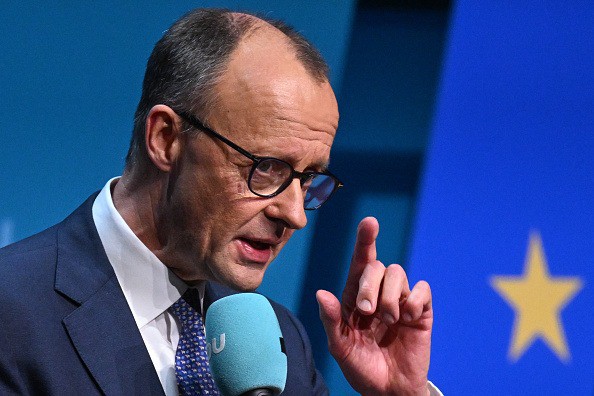
The collapse of political authority rarely begins with a single sentence. Yet in the volatile digital arena of 2026, one remark—brief, direct, and amplified to millions—has ignited a crisis now rippling through Germany and beyond. When Elon Musk publicly accused German opposition leader Friedrich Merz of “supporting censorship,” the fallout was immediate, exposing the fragile boundary between democratic governance and the power of global tech platforms.
What began as a policy proposal in Berlin quickly escalated into a transatlantic confrontation. Merz, positioning himself as a defender of order in an increasingly chaotic digital landscape, had advocated for a controversial “real-name” requirement on social media platforms. The measure, designed to curb hate speech and disinformation, would force users to post under their legal identities—effectively eliminating anonymity online.
To critics, however, the proposal struck at the heart of digital freedom. Among them, Musk—owner of X, the platform formerly known as Twitter—responded not through diplomatic channels but with a public denunciation that reframed the debate. In a post seen by hundreds of millions, Musk declared that a politician who endorses such restrictions “cannot claim to stand for freedom.”
The statement landed with unusual force. Within hours, the narrative surrounding Merz began to shift. No longer seen solely as a conservative reformer, he was recast—at least in the digital discourse—as a symbol of overreach, a leader willing to trade liberty for control. The speed and scale of that transformation underscored a new political reality: reputations can now be reshaped not in parliamentary chambers, but on algorithm-driven platforms.
In Berlin, the reaction was palpable. Officials who had framed the policy as a technical adjustment suddenly found themselves defending its philosophical implications. Was it a necessary safeguard for public discourse, or a step toward surveillance? The question, once confined to policy circles, became a global flashpoint.

Yet the conflict did not remain rhetorical. According to reports circulating in political and financial circles, Musk’s response extended beyond words. Investment decisions tied to Tesla, one of Germany’s most visible foreign industrial partners, appeared to shift. Plans for further expansion—once heralded as evidence of Germany’s enduring economic appeal—were reportedly paused, raising concerns about the broader business climate.
For a country that prides itself on stability and industrial leadership, the implications were stark. Germany’s economic model, built on exports and technological innovation, depends heavily on international confidence. Any signal that the country is becoming hostile to innovation—fairly or not—carries weight in global markets.
Musk, for his part, has continued to press the argument, using his platform to highlight what he portrays as contradictions within Germany’s policy approach. In a series of posts and public remarks, he has criticized energy costs, bureaucratic complexity, and reliance on foreign digital infrastructure—framing them as evidence of systemic inefficiency.
Each message, amplified by X’s vast user base, has contributed to a feedback loop in which political debate and public perception blur. Supporters view Musk as a defender of free expression; critics see a billionaire leveraging his influence to shape national policy. Both perspectives point to the same underlying tension: the growing power of private individuals in public governance.
For Merz, the challenge is multifaceted. His proposal, once a cornerstone of his platform, now sits at the center of a broader controversy that touches on sovereignty, technology, and the limits of state authority. Attempts to reframe the debate have struggled against the سرعة and reach of digital narratives.
Meanwhile, Europe faces a dilemma that extends beyond Germany. The European Union has long sought to assert regulatory authority over global tech companies, positioning itself as a standard-setter for digital governance. But the Musk-Merz clash highlights the difficulty of that ambition in a world where platforms can influence not just markets, but political legitimacy itself.
The broader question is no longer whether governments can regulate technology, but whether they can do so without triggering unintended consequences—economic, political, or cultural. In an interconnected system, actions taken in one domain reverberate across others, often in unpredictable ways.

As the debate continues, the stakes are becoming clearer. At issue is not simply a policy on online anonymity, but the evolving balance of power between elected officials and the architects of the digital age. The outcome will shape not only Germany’s political future, but the contours of governance in a world increasingly defined by information.
In the end, the episode serves as a stark reminder: authority in the 21st century is no longer monopolized by the state. It is contested, negotiated, and at times disrupted by forces that operate beyond traditional borders. Whether this represents a new form of accountability or a challenge to democratic order remains an open—and urgent—question.






