Meloni’s Firm ‘No’ to Zelensky Signals a Turning Point in Europe’s Ukraine Strategy
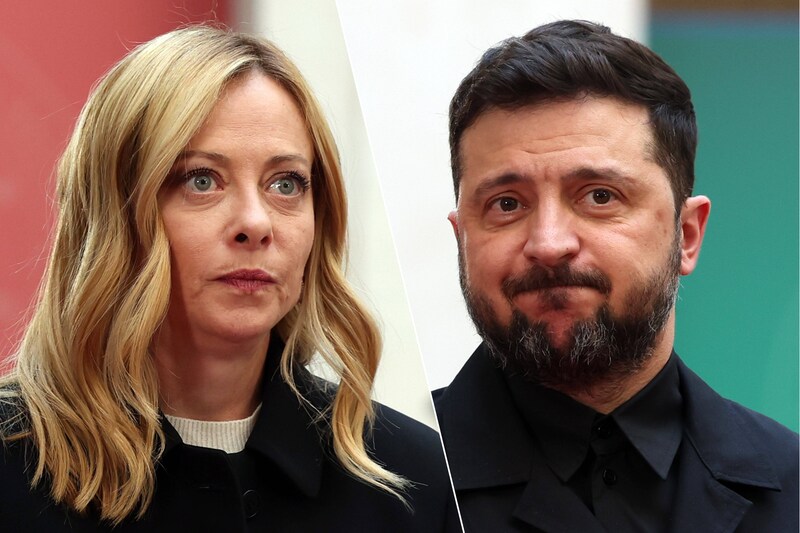
The meeting was expected to reaffirm unity. Instead, it exposed fractures that may redefine Europe’s approach to the war in Ukraine. When Italian Prime Minister Giorgia Meloni declined a key request from Ukrainian President Volodymyr Zelensky, the decision sent ripples through diplomatic circles, raising urgent questions about the durability of Western support.

For much of the conflict, Italy had stood as one of Ukraine’s most vocal allies in Southern Europe. Meloni, often described as a steadfast supporter of Kyiv, had consistently backed military aid packages and aligned herself with broader European efforts to counter Russian aggression. But by early 2026, the tone in Rome had shifted—from unwavering commitment to cautious recalibration.
The turning point came during a closed-door meeting at Palazzo Chigi, where Zelensky reportedly pressed for additional advanced air defense systems. According to accounts circulating among European officials, the Ukrainian leader framed the request as urgent and essential. Meloni’s response, however, was direct and unambiguous: Italy could not meet the demand.
The refusal was not merely about military hardware. It reflected a broader tension between political ambition and domestic reality. Italy, like many European nations, has faced mounting economic pressures, and the cost of sustained military support has begun to weigh heavily on public finances. Reports suggest that after years of aid commitments, Italian defense readiness has been strained, forcing leaders to reassess priorities.
Within Meloni’s governing coalition, the pressure has been particularly acute. Figures such as Matteo Salvini and Antonio Tajani have increasingly emphasized domestic concerns, questioning the long-term sustainability of continued support for Ukraine. Their arguments—once peripheral—have gained traction among voters grappling with inflation, slow growth, and competing national needs.
Zelensky’s approach, some analysts argue, may have unintentionally intensified these internal divisions. By publicly urging European leaders to maintain or expand support, he risked placing allies like Meloni in politically vulnerable positions. What was intended as a show of urgency may have been perceived in Rome as undue pressure.
Complicating matters further are shifting geopolitical currents. The global conversation around the conflict has evolved, with some policymakers exploring pathways toward negotiation rather than escalation. Against this backdrop, Meloni’s decision can be seen as part of a broader recalibration—one that prioritizes strategic flexibility over absolute commitment.
The optics of the encounter spoke volumes. Gone were the highly visible displays of solidarity that once characterized meetings between European leaders and Zelensky. In their place was a more restrained, businesslike tone—suggesting a relationship transitioning from emotional alignment to pragmatic calculation.
For Ukraine, the implications are significant. Italy has served as an important bridge to segments of European politics that are otherwise skeptical of prolonged military engagement. A cooling of that relationship could make it more difficult for Kyiv to maintain a unified front within the European Union, particularly as war fatigue deepens across the continent.
The ripple effects may extend beyond Italy. If other countries follow Rome’s lead, shifting from open-ended support to more conditional engagement, the collective strategy of the West could enter a new phase. Such a transition would not necessarily signal abandonment, but it would mark a departure from the “whatever it takes” approach that defined earlier stages of the conflict.
Meloni’s stance also reflects a broader political reality: leaders must balance international commitments with domestic accountability. In an era of economic uncertainty, even widely supported causes can encounter limits. The challenge lies in navigating those constraints without undermining broader strategic goals.
For Zelensky, the moment underscores the difficulty of sustaining international support over time. Early unity, forged in the shock of invasion, has gradually given way to more complex calculations. Maintaining alliances now requires not only moral persuasion but also sensitivity to the political and economic pressures facing partner nations.
Whether this episode represents a temporary divergence or a lasting shift remains unclear. Much will depend on how both leaders—and their counterparts across Europe—adapt to the evolving landscape. Diplomatic engagement, recalibrated expectations, and renewed efforts at coordination may yet stabilize the relationship.
Still, the significance of the moment is difficult to ignore. The refusal in Rome was not just a policy decision; it was a signal. It suggested that the foundations of European unity on Ukraine, while still intact, are no longer immune to strain.
As the conflict enters a new phase, the question is no longer whether Europe will support Ukraine, but how—and for how long. In that context, Meloni’s “no” may come to be seen not as an isolated incident, but as the beginning of a broader transformation in the West’s approach to war, alliance, and responsibility.






