WASHINGTON — For nearly a century, the 5,525-mile border between the United States and Canada has been the physical manifestation of an unspoken geopolitical absolute: that an attack on the North is an attack on the South. But this week, that foundational certainty was replaced by a cold, transactional silence.
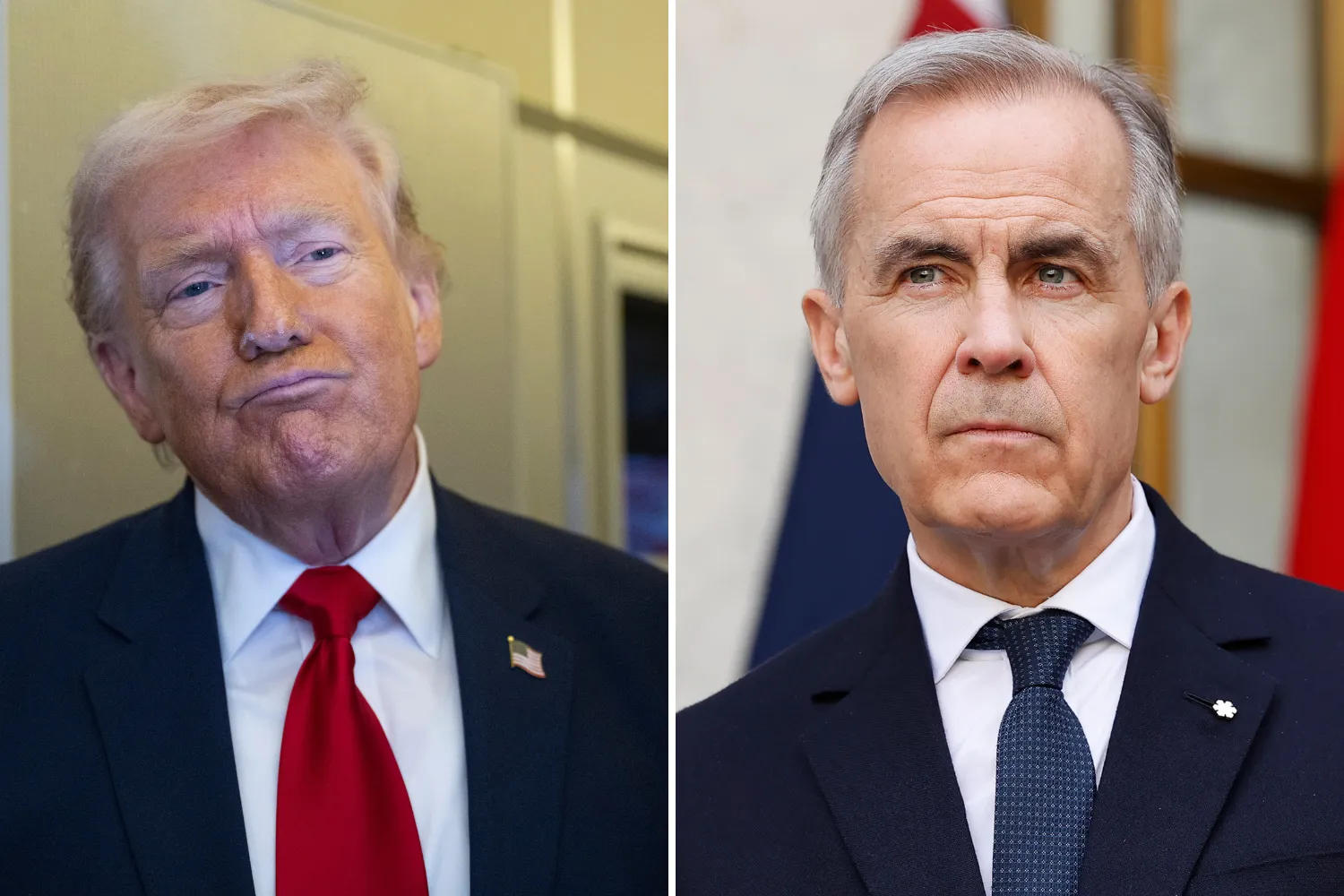
Following a series of public escalations, Donald J. Trump has formally suggested that Canada could lose the umbrella of American military protection. The declaration, aimed directly at Prime Minister Mark Carney’s “Strategic Independence” doctrine, has ignited a firestorm from the Pentagon to the halls of Parliament, marking the most volatile chapter in bilateral relations since the War of 1812.

The Missile and the Silence
The catalyst for this rupture was not a trade dispute, but a plume of smoke over the Kuwaiti desert. On March 1, 2026, an Iranian missile strike targeted the Ali Al-Salem Air Base, a facility housing Canadian personnel. While satellite imagery later confirmed damage to the Canadian sector, the Carney administration’s initial silence was profound.
To the White House, this reticence was not diplomacy; it was a dereliction of the alliance. As the U.S. and Israel move toward a campaign of regime change in Tehran, Mr. Carney’s insistence that “Canada is not engaged in these actions” has been interpreted in Washington as a retreat into neutralism at a moment of existential conflict.
“You cannot enjoy the benefits of a fortress if you refuse to help man the walls,” said a senior official within the Trump administration. “If Ottawa wants to distance itself from our offensive actions, they should not be surprised when we distance ourselves from their defense.”
The Arctic Vulnerability
Nowhere is the threat of an American withdrawal more visceral than in the High North. On March 12, Mr. Carney attempted to pre-empt criticisms of military weakness by announcing a $35 billion investment in Arctic defense, headlined by the Mackenzie Valley Highway—an 800-kilometer corridor from Yellowknife to Inuvik.
But in the corridors of the Pentagon, the project is being viewed with skepticism. Critics, including vocal populist commentators like Spencer Gatten, have dismissed the move as a “re-announcement” of old infrastructure projects rebranded as a security strategy.
The concern is not just about roads, but about resources. Canada’s sole antimony mine—producing a mineral vital for military-grade munitions—remains under the control of Hunan Nonferrous Metals, a Chinese state-linked entity. Beijing’s 2024 export controls on the mineral have turned a Canadian resource into a strategic liability. To Washington, the irony is galling: Canada is promising to defend the Arctic against Russia while its critical military supply chain remains tethered to China.
The Ukraine Aid Shadow
The friction has been compounded by a deepening scandal involving the flow of Western capital. On March 5, Hungarian authorities detained a Ukrainian convoy carrying $82 million in cash and gold—assets Ukraine claims were stolen, but Budapest suspects are part of a massive money-laundering scheme.
In Washington, Republican lawmakers have been quick to link this seizure to the $25 billion in aid Canada has funneled to Kyiv. The optics of gold bars being seized at the Hungarian border have provided Mr. Trump with the political ammunition to frame the Carney-Freeland government as not only militarily hesitant but fiscally reckless.

The Energy Collision
Even as security ties fray, the economic engine is stalling. Mr. Carney’s staunch opposition to easing sanctions on Russian oil—intended to prevent a Moscow-Tehran axis—has placed him in direct conflict with U.S. efforts to stabilize global energy markets. As the closure of the Strait of Hormuz sends fertilizer costs skyrocketing for Canadian farmers, the Prime Minister is finding himself squeezed between his geopolitical principles and the rising anger of his own domestic base.
Conclusion: A Continent Divided
The “Special Relationship” has always relied on a shared sense of reality. But in 2026, Washington and Ottawa appear to be living in two different worlds. Mr. Carney is betting on a multi-polar future where Canada can act as a principled middle power, diversifying its trade and maintaining its distance from “American wars.”
Mr. Trump is betting that geography is destiny—and that without the U.S. Navy and the NORAD shield, Canada’s “sovereignty” is a polite fiction.
As the construction crews prepare to break ground on the Mackenzie Valley Highway this summer, they do so under a sky that feels increasingly unprotected. The paperwork of the alliance may still be in place, but the spirit of the North American shield has never been more fragile.






