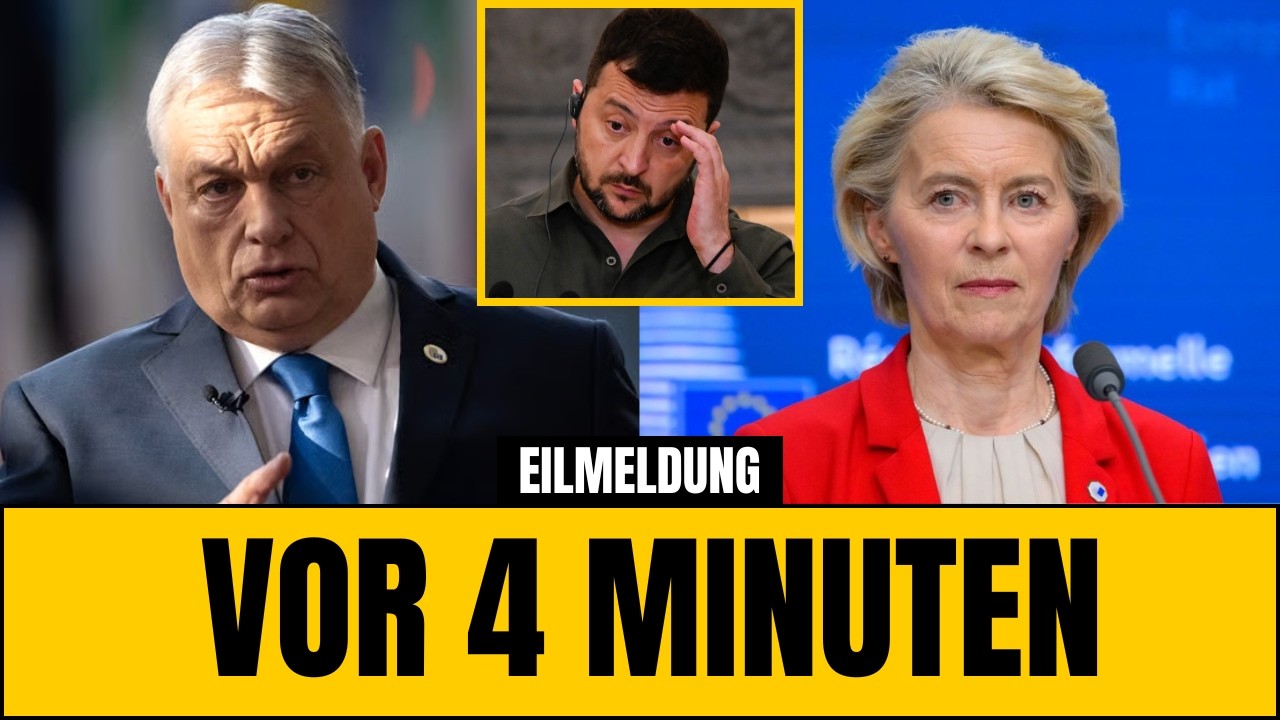
The European Union is facing one of its greatest political challenges in recent years. What is currently happening between Viktor Orbán and Ursula von der Leyen is much more than an ordinary dispute over budgetary issues or political competences. It is an open power struggle that could shake the foundations of the European Union.
For years, the conflict between Brussels and Budapest has been simmering in the background. Hungary is under criticism, especially on issues of the rule of law, media freedom and judicial reforms. In response, the EU Commission, under the leadership of Ursula von der Leyen, has frozen billions of euros in subsidies. Officially, this is done to ensure compliance with European values. Critics, on the other hand, see it as political pressure to bring Hungary into line.
But now the balance of power seems to be shifting. Viktor Orbán has decided to no longer act defensively. Instead, he is going on the offensive – and with a strategy that poses completely new challenges for Brussels.
A central point of this escalation is energy policy. While the EU is trying to break away from Russian energy sources in the long term, Hungary is pursuing its own course. Securing the so-called Druzhba pipeline, an important oil link that continues to supply Hungary with energy, is particularly explosive. Budapest has reportedly even placed this corridor under special protection to secure supplies.
For the EU, this is an affront. This is because it not only undermines the common energy policy, but also sends a signal to other member states: national interests could once again take precedence over joint decisions in the future.
But Orbán’s strategy goes even further. He deliberately uses the EU’s institutional mechanisms to build up pressure. Unanimity is particularly necessary for the multiannual financial framework, i.e. the Union’s long-term budget. Orbán has made it clear that there will be no approval without concessions from Brussels.
This attitude puts the EU in a difficult position. On the one hand, it wants to defend its principles and not compromise on fundamental values. On the other hand, it is dependent on the consent of all member states in order to remain capable of acting. A political dilemma arises for which there is no easy solution.
In addition, there is another explosive aspect: the question of Ukraine support. The EU is planning extensive financial aid, but here too the consent of all member states is required. Hungary is using this situation to substantiate its demands. Decisions are no longer viewed in isolation, but are linked to each other – a strategic move that is putting increasing pressure on Brussels.
At the same time, new political alliances are forming. Reports suggest that Hungary is working more closely with Slovakia, especially under the leadership of Robert Fico. Signals are also coming from other countries such as Italy or Austria that not all governments are prepared to accept every decision from Brussels without objection.
This development could have far-reaching consequences. If such a bloc were to become established, the EU would be forced to fundamentally rethink its decision-making processes. The current balance between national sovereignty and common politics could be shaken.
A particularly sensitive point is the legal dimension of the conflict. Orbán has announced that he will no longer recognise the authority of the European Court of Justice on certain issues. Such a step calls into question the EU’s legal order, which is based on the binding validity of common rules.
The consequences would be enormous. If a member state starts ignoring central institutions, this could set a precedent. Other countries could follow suit, which could lead to a fragmentation of the Union in the long term.
For Ursula von der Leyen, this situation represents an enormous challenge. It is faced with the difficult decision of how far it wants to go in the conflict with Hungary. A hard line could further escalate tensions and deter other states. Too much indulgence, on the other hand, could be interpreted as weakness and undermine the EU’s authority.
At the same time, pressure from the population is also growing. In many European countries, rising energy prices, economic uncertainties and geopolitical tensions are causing dissatisfaction. In this climate, messages that put national interests first are increasingly being heard.
Orbán is making clever use of this mood. He presents himself as a defender of national sovereignty and as the antithesis to what he sees as an overpowering bureaucracy in Brussels. Whether you agree with this portrayal or not, it works. And it is changing the political landscape of Europe.
Internationally, the development is being closely monitored. Major players such as the US, Russia and China are closely monitoring how the EU positions itself in this crisis. Because the stability of Europe is not only an internal matter, but has global implications.
The coming weeks could be decisive. Especially in view of political developments in Hungary itself, where elections are imminent, the dynamics could intensify further. An election victory for Orbán would further strengthen his position and confirm his strategy.
In the end, there is a fundamental question: How much unity is possible in a Union that consists of such different interests? And where is the line between shared responsibility and national self-determination?
The answer to this will not only determine the outcome of this conflict, but will also shape the future of the European Union. One thing is already certain: Europe is at a turning point. And the outcome of this power struggle will decide in which direction it continues.






