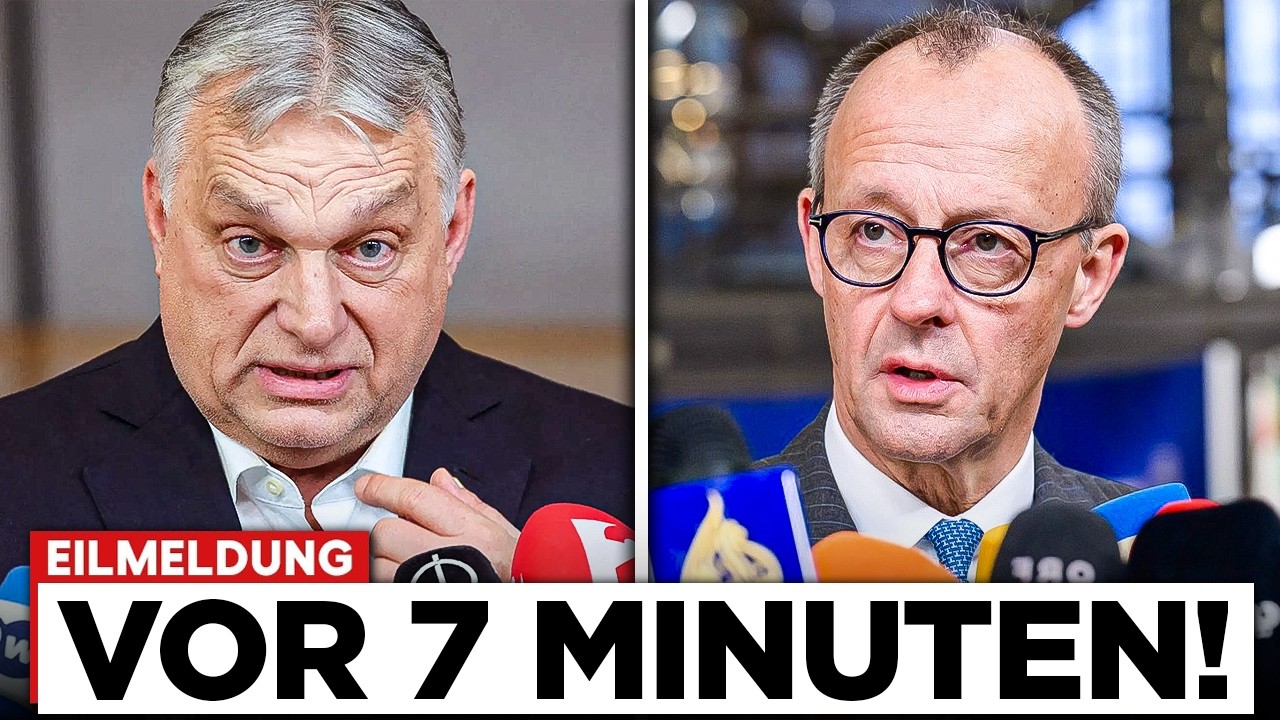
The recent EU summit in Brussels has unleashed a political dynamic that goes far beyond the usual diplomatic tensions. What was officially presented as a demonstration of European unity turns out to be a complex power game full of conflicts, strategic maneuvers and surprising twists and turns on closer inspection.
At the center of this development is Hungarian Prime Minister Viktor Orbán, who has been opposing a billion-dollar financial package for Ukraine for weeks. It is about a credit line of around 90 billion euros – a project that is considered by many EU states to be a necessary step to support Ukraine. But Orbán is blocking.
This blockade has caused considerable tensions in Brussels. Several European heads of government reacted unusually sharply. Public criticism, diplomatic spikes and direct accusations shaped the atmosphere of the summit. Observers speak of one of the most violent collective reactions ever seen in the European Council.
Among the critics was Kaja Kallas, who indirectly accused Orbán of a lack of rationality in the context of political decisions. Other heads of government also joined in, describing his behavior as unacceptable or politically motivated. The pressure on Hungary thus reached a new peak.
But Orbán was unimpressed.
Referring to Hungary’s national sovereignty, he made it clear that his country would not be pressured into decisions that it considered disadvantageous. His stance remained constant: Hungary would not support measures that contradict its own economic interests or impose additional financial burdens on its citizens.
At the same time, the German perspective also played a central role. In the run-up to the summit, Chancellor Friedrich Merz had stressed that the European Union must not allow itself to be blocked by individual member states. His statements reflected the growing frustration within the EU.
But the reality of the summit turned out differently than expected.
An alternative mechanism has been developed to circumvent the blockade. This stipulates that not all EU member states have to participate in the loan program. In concrete terms, this means that countries such as Hungary, Slovakia and the Czech Republic are exempt from financial participation. They bear neither costs nor risks.
At first glance, this seems like a pragmatic compromise. But on closer inspection, this solution raises fundamental questions. While some states are shirking their responsibility, others have to shoulder the financial burden alone.
This could have significant consequences, especially for Germany, as the largest net contributor to the EU. According to estimates, the interest costs alone could represent a significant financial outlay. The economic impact of this decision should therefore not be underestimated.
The role of Slovakian Prime Minister Robert Fico, who openly spoke out against his country’s participation, is also interesting. His position reinforced the impression that increasingly divergent interests and priorities are emerging within the EU.
But the conflict is not limited to financial issues.
Another central point of the summit was a proposal to use frozen Russian state funds as collateral for new loans. However, this project was blocked by several countries, including France, Belgium and Italy. The reasons range from legal concerns to fear of economic countermeasures.
This failure is seen by some observers as a setback for European unity. It shows how difficult it is to find consensus solutions within the EU – especially in times of geopolitical tensions.
At the same time, energy policy is increasingly coming into focus.
Rising gas and oil prices are weighing on many European economies. While some countries are calling for measures to cap prices, there is no uniform line here either. Germany rejects certain interventions, while other states are pushing for stronger regulation.
In this context, Hungary is pursuing its own course. The government is relying on state intervention to stabilize energy prices and emphasizes the importance of national solutions. For Orbán, this is a central part of his political strategy.
The events in Brussels therefore raise a fundamental question: how stable is European unity really?
While official statements emphasize unity, the developments behind the scenes show a different picture. Different national interests, economic challenges and political tensions lead to an increasingly fragmented decision-making landscape.
Public perception also plays an important role.
Media reports and political communication shape the image that citizens get of the events. But the discrepancy between presentation and actual decisions could influence trust in political institutions in the long term.
The EU summit in Brussels thus marks a turning point.
It shows not only the current challenges facing the European Union, but also the limits of its decision-making mechanisms. The ability to find common solutions will be crucial in the future.
For Viktor Orbán, the outcome of the summit is a success, at least in the short term. Its position remained in place, and Hungary was able to stay out of the financial participation in the loan program.
For the European Union, on the other hand, the task remains to strengthen its unity while reconciling the different interests of its member states.
The coming months will show whether this will succeed – or whether tensions will continue to rise.
One thing is certain, however: the events in Brussels will continue to have an impact for a long time to come and could permanently change the political landscape in Europe.






