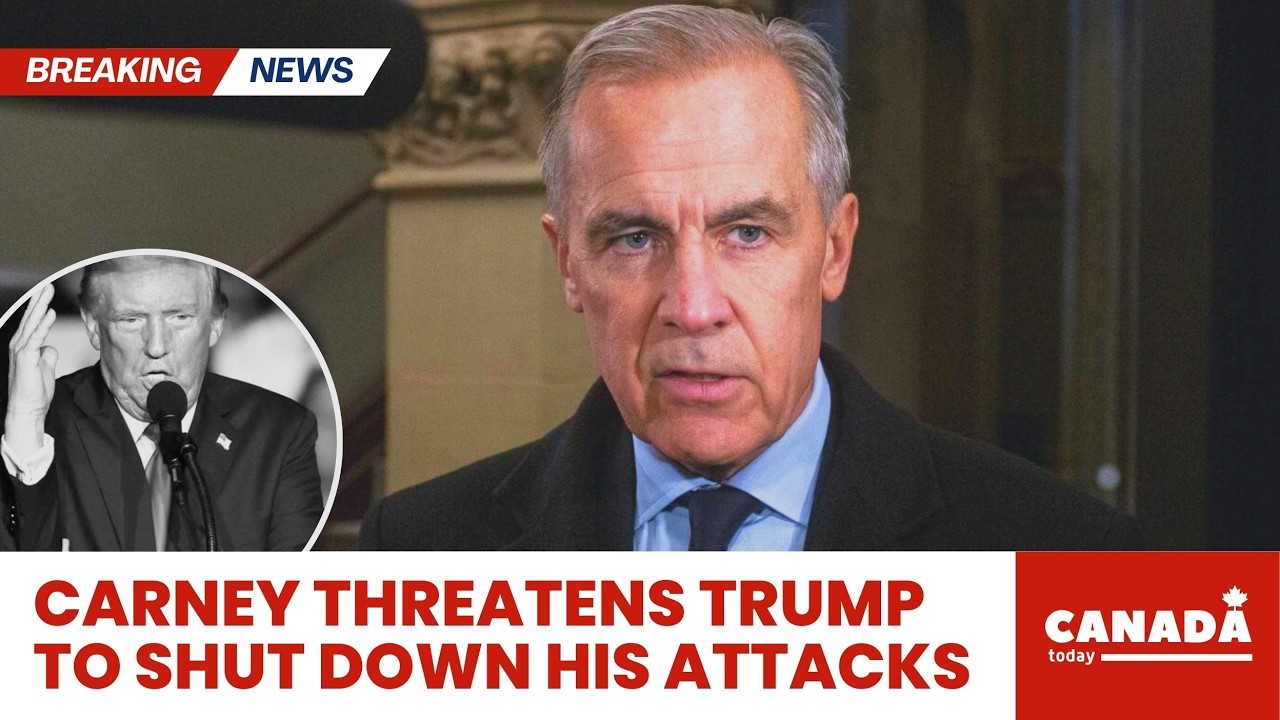
🚨 BREAKING CLASH: CARNEY BOLDY STANDS UP AGAINST TRUMP FOLLOWING MEXICO THREAT BOMBSHELL — Tensions Explode as Cross-Border Drama Heats Up, Whispers of Retaliation and Hidden Alliances Fueling Nonstop Political Turmoil 🔥
When Donald Trump openly suggested that the United States could send troops into Mexico to combat drug cartels, the remarks were widely read as another instance of his confrontational approach to foreign policy. In Canada, however, they were interpreted less as rhetorical excess than as a warning sign — one that demanded a response.
Trump’s comments followed a series of actions and proposals that have unsettled allies and rivals alike: U.S. military operations in Venezuela, renewed discussion of acquiring Greenland for security purposes, and repeated suggestions that borders and sovereignty are negotiable when American interests are at stake. Taken together, analysts say, these moves reflect a worldview in which force is not a last resort but a policy instrument to be deployed when consent proves inconvenient.
Mexico has firmly rejected the idea of American troops operating on its soil, even under the banner of counter-narcotics or counterterrorism. But Trump’s critics note that refusal has not always constrained him. His administration’s actions in Venezuela, undertaken without the host country’s consent, have reinforced concerns that unilateral military steps could follow political threats.
For Canada, the implications extend beyond Mexico. Trump has frequently grouped Canada and Mexico together when discussing border security, drug trafficking, and trade enforcement, treating North America less as a partnership of sovereign states than as a single pressure zone. In that framework, tariffs, sanctions, and military force become interchangeable tools.
“Once a U.S. president begins to normalize threats of force against neighboring countries,” one Canadian security analyst said, “it becomes difficult to argue that any border is entirely insulated.”
Canada’s response has been notably more assertive than in previous periods of tension with Washington. Under Prime Minister Mark Carney, Ottawa has moved to strengthen alliances and signal that any coercive action would carry multilateral consequences. Canadian officials have quietly intensified coordination with European partners, emphasized commitments within NATO, and reinforced diplomatic ties with countries that have also faced annexation rhetoric.
France has been among the most outspoken. French officials have warned publicly that threats against Canadian sovereignty would undermine the global, rules-based order — a system Canada has long championed. That framing matters, Canadian diplomats say, because it recasts any pressure on Canada as not merely a bilateral dispute but a challenge to international norms.
The concern in Ottawa is not an imminent invasion. Rather, it is the risk of gradual erosion: increased U.S. military activity in shared waters or airspace, unilateral security decisions framed as temporary or technical, and assumptions of authority justified by shared threats. Sovereignty, analysts warn, is rarely lost overnight. It is tested incrementally.
Greenland, often treated as a curiosity in Trump’s rhetoric, looms large in Canadian strategic thinking. Trump’s interest in the territory has consistently been framed around Arctic shipping lanes, resource access, and military positioning as ice melts and competition intensifies. Canada’s own Arctic infrastructure, while expanding, remains limited in key regions — a fact that could invite American “assumptions” about patrols and security responsibilities.

Trump himself has dismissed international law and congressional constraints as secondary to what he has described as his personal sense of morality. In a recent interview, he suggested that his judgment, rather than legal frameworks, was the primary check on his actions. For allies accustomed to institutional guardrails, such statements have heightened unease.
Still, Canada is not responding in isolation. By mobilizing alliances early and anchoring its position in multilateral institutions, Ottawa has altered the strategic calculus. Any overt pressure on Canada would likely reverberate far beyond North America, drawing in European allies and reshaping diplomatic alignments.
Trump’s threat toward Mexico has therefore become a clarifying moment. It signals that restraint can no longer be assumed, even among neighbors. But it has also prompted Canada to demonstrate that it is alert, prepared, and supported.
“The risk,” one former Canadian diplomat said, “is not that the United States suddenly turns hostile, but that power is exercised casually. Our task is to ensure that casual coercion becomes very costly.”
In that sense, Canada’s message is not confrontational but declarative: it will not be treated as an afterthought in a hemisphere where force is increasingly discussed. Whether that stance deters further escalation remains uncertain. What is clear is that Ottawa no longer views Trump’s words as merely rhetorical — and is acting accordingly.






