A Sudden Late-Night Upheaval Sends CBS and Its Competitors Scrambling
In an industry where controlled messaging, coordinated publicity, and scripted spontaneity define the rhythm of nightly television, the past 72 hours have delivered an unexpected crisis. CBS, ordinarily confident in its dominance in the late-night arena, is facing a rapidly escalating internal standoff after a pointed on-air remark from Stephen Colbert ignited what insiders now describe as “a structural breach in late-night discipline.”
The moment, captured during a Monday taping of The Late Show, did not match Colbert’s familiar cadence of satire and political commentary. Instead, the host delivered a sharp, uncharacteristically direct statement: “They can try to shut me up… but they have no idea what they just started.”

It was not framed as comedy. It was not buffered with irony. And crucially, it was not cleared with CBS Standards & Practices, according to two senior network staffers who spoke on the condition of anonymity due to ongoing internal reviews.
What began as a single unscripted line has now set off a cascade of repercussions that extend far beyond CBS headquarters. Multiple competing hosts — including Jimmy Fallon, Seth Meyers, and HBO’s John Oliver — have quietly signaled informal support to Colbert, forming what three industry veterans independently referred to as “a soft coalition” or “a late-night pact.”
The development is unprecedented in a segment known more for comfortable rivalry than collective action.
A Brewing Conflict Over Control and Editorial Independence
Sources close to The Late Show describe weeks of rising tension between Colbert’s writing staff and network executives over segments touching on election-year politics, corporate influence, and coverage of several ongoing federal investigations.
Colbert, who has historically enjoyed considerable autonomy, reportedly faced new constraints this season, including tightened pre-approval requirements for monologues addressing sensitive political matters.
The remark heard on air, according to a senior producer, “wasn’t spontaneous — it was simmering. He chose that moment deliberately.”
CBS, for now, has issued no formal statement. Internally, however, executives have initiated what one staff member described as “rapid-response crisis calls” involving not only the network’s entertainment division but also corporate communications and legal counsel.
The concern is not merely reputational. With late-night programming being one of CBS’s most stable revenue anchors, a rift involving its flagship host poses material risk to advertiser confidence and long-term scheduling strategy.
An Unusual Alliance Emerges Across Networks
Even more surprising than the internal CBS turmoil is the reaction from other late-night hosts.
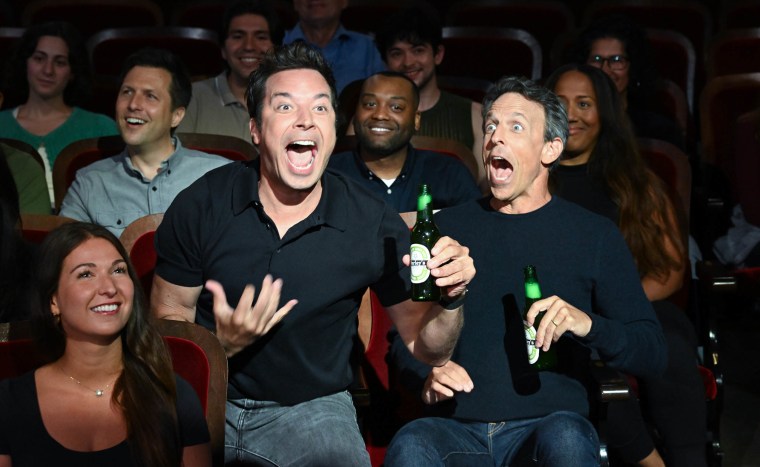
Jimmy Fallon, known for his apolitical approach; Seth Meyers, more closely aligned with Colbert’s political voice; and John Oliver, whose HBO platform gives him editorial freedom unavailable on broadcast television, have reportedly been in direct communication since the incident aired.
Two executives familiar with those conversations described the tone as “quietly strategic,” with discussions centering on shared frustrations over corporate restrictions and the increasing scrutiny on political humor in a polarized media environment.
A senior NBC staffer noted that while Fallon is unlikely to participate in any overt criticism of network leadership, his willingness even to entertain collaborative dialogue with Colbert signals “a shift in late-night gravitational forces.”
Oliver, meanwhile, is said to be exploring a segment on the growing tension between network oversight and comedic independence — a move that could amplify the situation far beyond CBS.
A Social Media Firestorm Adds Pressure
While networks deliberate behind closed doors, fans online have taken the situation in a more dramatic direction.
Within hours of Colbert’s remark, the hashtag #LateNightMutiny began trending across X, TikTok, and Reddit. Clips of Colbert’s statement have generated millions of views, with some viewers framing him as a symbolic challenger to corporate control in entertainment.
Fan speculation about a coordinated on-air protest — ranging from synchronized monologue themes to cross-network appearances — has intensified the perception of an impending event, despite no confirmed plans.
Executives, particularly at CBS and NBC, now face the dual challenge of managing internal dissent while confronting a rapidly escalating narrative outside their control. One veteran communications strategist described the situation as “an uncontrolled feedback loop — the networks are chasing the story instead of dictating it.”

What Comes Next Could Reshape Late-Night Television
Industry analysts are divided on what this moment represents.
Some believe the tensions will resolve quietly, with networks tightening messaging and hosts returning to routine programming. Others argue that an unprecedented realignment is underway, driven by deeper structural stress: declining ratings, fragmented digital audiences, rising corporate caution, and growing pressure on hosts to differentiate themselves in a crowded political news cycle.
If Colbert, Fallon, Meyers, and Oliver continue to align — even informally — it could challenge long-standing norms regarding host independence, cross-network cooperation, and the boundaries of political discourse in entertainment.
For now, the situation remains fluid. There is no public action plan, no confirmed joint statement, and no indication that on-air rebellion is imminent. But inside CBS and across the broader television industry, the anxiety is unmistakable.
A veteran producer with decades in late-night summed up the mood succinctly:
“Something shifted. Even if nothing public happens, the ground underneath these shows is different now.”
What began as a single unsanctioned sentence has become a test of network authority — and a reminder that in late-night television, the battle for control is no longer happening only in front of the cameras.






