
Minneapolis, Minnesota — Just hours after Renee Nicole Good, a 26-year-old American woman, was killed during an encounter involving U.S. Immigration and Customs Enforcement (ICE), the federal government surged additional agents into Minneapolis, a decision that quickly ignited fierce protests and a national debate over how the Trump administration defines “domestic terrorism.”
Ms. Good’s death — which remains under investigation — has become the focal point of a broader political, media, and social crisis. While senior officials at the Department of Homeland Security suggested that the victim could be linked to “domestic terrorism,” a wave of videos, images, and eyewitness accounts circulating across social media platforms have portrayed a starkly different reality: peaceful demonstrations, visible community solidarity, and aggressive enforcement tactics by federal agents.
A City Takes to the Streets — and Competing Narratives Emerge
On Saturday afternoon, thousands of people gathered at Powderhorn Park in south Minneapolis. Aerial footage shared widely on X, Instagram, and TikTok showed a large but orderly crowd, many holding signs opposing ICE operations and demanding transparency regarding Ms. Good’s death.
Another video, viewed hundreds of thousands of times, captured members of the city’s Somali community distributing free samosas to protesters. In the footage, participants thanked one another and emphasized unity. “This is our community,” one woman says. “This is Minneapolis.”
These images sharply contrasted with statements made by federal officials. In an interview on Meet the Press, Tom Homan, President Trump’s top border adviser, suggested that actions opposing ICE should be examined under the legal definition of terrorism.
Pressed on whether Ms. Good herself should be labeled a domestic terrorist, Mr. Homan hesitated. “We don’t yet know all the facts,” he said, declining to directly endorse earlier remarks by Homeland Security Secretary Kristi Noem, who had invoked the term “domestic terrorism” within hours of the shooting.
Language, Power, and Allegations of Double Standards
The rapid use of the terrorism label drew swift backlash, not only from activists but also from commentators often viewed as sympathetic to Mr. Trump. Piers Morgan wrote on social media that “of all the claims made about Renee Good, the idea that she was a domestic terrorist — based on the videos we’ve seen of her final moments — is the most ridiculous.”
Critics also pointed to a contrast with how officials initially described the events of January 6, 2021. Videos showing Trump supporters assaulting police officers at the U.S. Capitol did not prompt immediate, uniform labeling by top officials as acts of domestic terrorism in early public statements.
Viral Footage of ICE Tactics Fuels Outrage
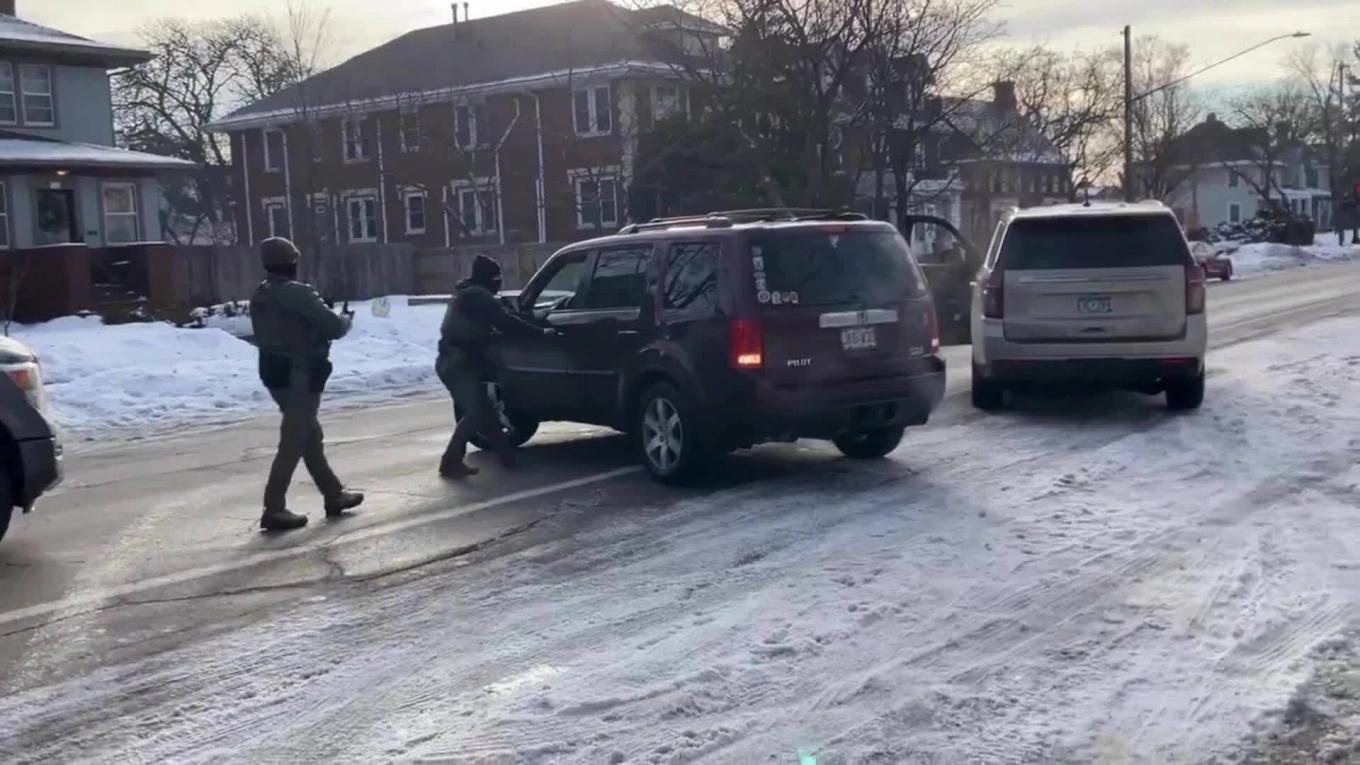
Alongside footage of peaceful protests, social media platforms have been flooded with videos depicting ICE agents using force. In one widely shared clip, verified by local news outlets, agents are seen smashing a car window and forcibly pulling a person out of the vehicle in the middle of a Minneapolis street. Another video appears to show an elderly man being dragged away from a bus stop.
Minneapolis Mayor Jacob Frey confirmed that in one incident, a vehicle was left rolling after its driver was removed — a scenario he said “could have seriously endangered bystanders.”
According to local reporting and posts from investigative journalists, tensions have also emerged between Minneapolis police and federal agencies, particularly after certain investigations were reportedly halted or taken over by the FBI.
“They Killed Someone. I Used a Profane Word.”
The controversy intensified when Mayor Frey appeared on Meet the Press. A significant portion of the interview focused on his remark telling ICE to “get the f— out of Minneapolis.”
His response quickly went viral. “I dropped an F-bomb,” Mr. Frey said. “They killed someone. I think killing someone is the inflammatory act here, not a swear word that we’ve all heard before.”
As the debate played out on national television, protests continued to spread. Demonstrations were reported in Washington, D.C., Chicago, and other cities, with participants braving cold weather to denounce ICE operations and the administration’s rhetoric.
A Larger Reckoning
For many protesters, the issue extends far beyond a single incident. They argue that the administration’s use of terms like “domestic terrorism” represents an inversion of reality: unarmed civilians are portrayed as threats, while heavily armed federal agents, equipped with military-grade resources, are cast as victims.
The Trump administration maintains that ICE operations are essential to national security and the removal of dangerous criminals. Yet the images and accounts emerging from Minneapolis have intensified a central question now reverberating across the country: who is using force to achieve political ends — and who gets labeled a terrorist?
The investigation into the death of Renee Nicole Good is ongoing. But in Minneapolis and beyond, the reckoning it has sparked appears to be only beginning.






