Robert De Niro, Donald Trump, and the Politics of Confrontation
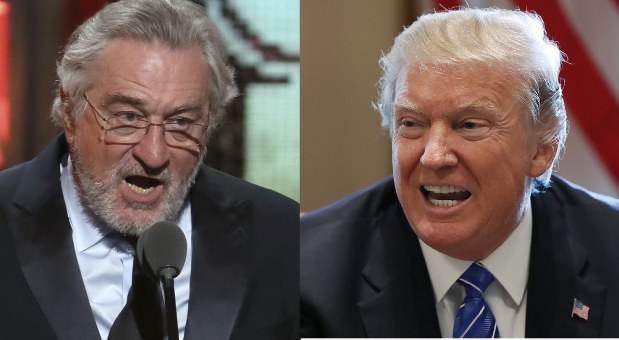
For years, Robert De Niro has occupied a singular place in American culture: a two-time Academy Award winner whose portrayals of volatility and menace helped define modern cinema. More recently, he has become one of the most visible celebrity critics of President T.r.u.m.p, delivering blunt, unsparing assessments of the president’s character and leadership in public forums that range from courthouse steps to awards ceremonies. The exchanges between the actor and the president—often unfolding in real time on social media—offer a revealing study in how celebrity, politics and power now collide in the United States.
De Niro’s criticism is not subtle. He has repeatedly argued that T.r.u.m.p lacks empathy, is driven by insecurity and poses a danger to democratic norms. Speaking outside a Manhattan courthouse during one of the president’s legal proceedings last year, De Niro described T.r.u.m.p as “mean” and “nasty,” a figure he said New Yorkers once tolerated as a flamboyant real estate promoter but could not accept as a national leader. “We make room for clowns,” De Niro said, invoking the city’s tradition of eccentricity. “But not a person like T.r.u.m.p who would run the country.”
Those remarks were widely circulated online, amplified by cable news and social media accounts that track political confrontations. They also prompted a familiar response from the president. On Truth Social, T.r.u.m.p dismissed De Niro as a “wacko former actor,” questioned his intelligence and claimed—without evidence—that the actor’s career had declined because of his political views. The pattern has repeated itself with notable consistency: De Niro delivers a substantive moral critique; the president replies with personal insults and insinuations.
The latest flashpoint came amid controversy surrounding the administration’s public attacks on Federal Reserve Chair Jerome Powell, whom T.r.u.m.p originally appointed. When reports surfaced that the Justice Department was examining aspects of the Fed’s operations, critics across the political spectrum warned that any perception of criminalizing monetary policy could undermine the central bank’s independence. Former Federal Reserve chairs and Treasury secretaries, Republicans and Democrats alike, issued a joint statement emphasizing that the Fed’s autonomy is “critical for economic performance” and warning that political pressure on monetary authorities is more typical of countries with weak institutions.
Several Republican lawmakers echoed that concern, arguing that the Justice Department itself should be scrutinized if its actions appeared politically motivated. Others, including some of the president’s allies, sought to minimize the episode, portraying T.r.u.m.p’s rhetoric as provocation rather than policy. The episode underscored a recurring tension of the current presidency: an aggressive, personalized style that energizes supporters while alarming institutionalists who fear long-term damage to norms.
De Niro has seized on that tension as evidence for his broader argument about T.r.u.m.p’s character. At the Gotham Awards in late 2023, the actor broke from prepared remarks after discovering that references to the president had been removed from a teleprompter. Reading the censored lines from his phone, De Niro accused T.r.u.m.p of habitual lying and of turning falsehood into a political weapon. Video of the moment spread quickly, celebrated by critics as an act of defiance and condemned by supporters of the president as grandstanding.
The White House response was swift and personal. T.r.u.m.p accused De Niro of being manipulated by political opponents and suggested that the actor should “focus on his life,” language that again avoided the substance of the criticism. To De Niro’s admirers, the exchange reinforced the actor’s claim that the president responds to moral challenges with ridicule rather than rebuttal.
These confrontations have unfolded against a backdrop of broader political turmoil. T.r.u.m.p has faced sustained criticism over his rhetoric toward allies and adversaries alike, including contentious statements about NATO and U.S. military power. He has also drawn condemnation from civil liberties groups over aggressive immigration enforcement policies, which opponents liken to the excesses of authoritarian states. Supporters counter that the president is fulfilling campaign promises to assert American sovereignty and restore order at the border.
In this polarized environment, De Niro’s prominence matters. Unlike elected officials, he does not need to balance coalitions or pass legislation. His authority derives from cultural stature and from a persona built over decades of portraying men consumed by power, paranoia and violence. When he labels T.r.u.m.p “dangerous” or “authoritarian,” he is implicitly inviting audiences to see the president through the lens of those characters—and to take the warning seriously.
The president, for his part, appears deeply attuned to such criticism. Many of his responses to De Niro have been posted late at night or early in the morning, fueling commentary that the actor has gotten “under his skin.” Supporters dismiss that interpretation, arguing that T.r.u.m.p relishes conflict and uses celebrity spats to dominate the news cycle. Critics see something else: a leader unsettled by a critic who cannot be dismissed as a partisan operative.
What is striking is how little the exchanges have shifted public opinion. Americans who view T.r.u.m.p as a threat to democracy often cite De Niro’s words approvingly, seeing them as an expression of moral clarity. Those who support the president tend to regard the actor as an out-of-touch elite exploiting his fame. The confrontation, in other words, reinforces existing divisions rather than bridging them.
Yet the spectacle has broader implications. It illustrates how political discourse has become inseparable from performance, with arguments staged for cameras and platforms rather than deliberative forums. It also raises questions about the role of celebrities in democratic debate. De Niro insists he speaks out of civic duty, invoking history’s lessons about leaders once dismissed as clowns who later revealed themselves as tyrants. His critics argue that actors should not presume to instruct voters.
As the election cycle intensifies, the De Niro–T.r.u.m.p feud is likely to continue, offering fresh episodes of insult and indignation. Whether it changes minds is uncertain. What it does reveal, with unusual clarity, is the emotional temperature of American politics: a climate in which moral condemnation and personal grievance collide, and where the line between governance and spectacle grows ever thinner.
In that sense, the exchanges say as much about the country as they do about the two men at their center. One is an aging actor who believes silence would be complicity. The other is a president who treats criticism as an affront to be crushed. Between them lies a public asked to decide not only which vision of leadership it prefers, but what kind of political culture it is willing to accept.






