Canada’s Quiet Trade Pivot Tests Life Beyond America’s Economic Orbit

For decades, Canada’s economic strategy rested on a powerful and rarely questioned assumption: no matter how turbulent global markets became, the United States would remain a constant — Canada’s primary buyer, strategic partner, and economic safety net. Geography reinforced that belief. So did history. Energy pipelines ran south, supply chains intertwined, and trade agreements promised stability through rules and institutions.
That assumption is now under strain.
While political attention in Washington has remained fixed on tariff threats, trade rhetoric, and domestic battles over economic nationalism, Canada has begun a quieter recalibration — one that could have long-term consequences for its economic posture and its relationship with its most important ally.
The shift did not announce itself with a speech or a retaliatory measure. It arrived instead with a plane touching down in Beijing.
When Prime Minister Mark Carney visited China — the first Canadian prime minister to do so in eight years — the trip was officially described as a step toward “re-engagement.” But beneath the careful language lay a more consequential reality. This was not a nostalgic reopening of ties. It was an effort to test whether Canada could finally loosen the gravitational pull of near-total dependence on the United States.
A Relationship Frozen, Not Forgotten
Canada’s relationship with China did not erode gradually. It froze.
The arrest of a senior Chinese technology executive at the request of U.S. authorities triggered a breakdown in trust that spilled quickly into trade. Beijing responded not with sweeping declarations but with measures that proved just as effective: tightened inspections, suspended import licenses, and regulatory delays that quietly choked off Canadian exports.
Canola shipments stalled. Pork and seafood exports collapsed. Producers across the Prairies and the West Coast watched access to one of the world’s largest markets disappear with little warning and no clear path back.
At the same time, diplomatic channels fell silent. Leader-level communication stopped. Ministerial dialogues withered. Trade mechanisms remained technically intact but practically unusable. The damage was not only economic. It was institutional.
Yet even as trade with China froze, Canada’s exposure elsewhere grew more pronounced. Nearly three-quarters of Canadian exports continued to flow south to the United States. That imbalance had long been accepted as a feature of efficiency. It increasingly began to look like vulnerability.
When Trade Becomes Leverage
The reckoning did not begin in Beijing. It began in Washington.
Under President Donald Trump, trade was framed less as partnership and more as leverage. Tariff threats were issued publicly, casually, sometimes personally. Economic penalties were discussed as tools of compliance rather than last resorts. Even close allies were not exempt.
For Canadian officials, the message was unsettlingly clear. Access to the U.S. market — once treated as durable — could be questioned, conditioned, or weaponized with little notice. Loyalty offered no immunity. Alignment did not guarantee predictability.
The realization forced a recalibration in Ottawa. If trade access could be threatened overnight, then dependence was no longer merely inefficient. It was dangerous.
Canada did not respond with retaliation or rhetorical escalation. Instead, it began building insurance.
Reopening a Suspended Option
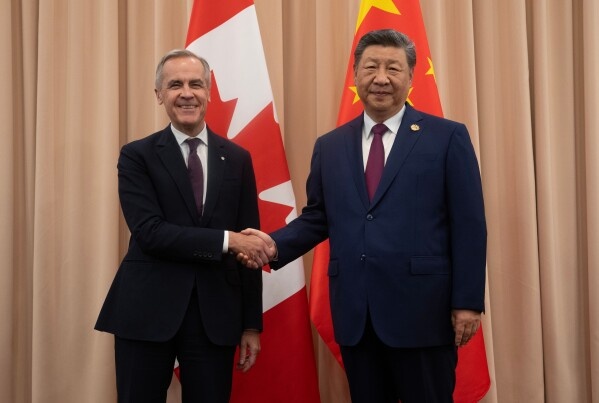
China was not a new market. It was a suspended one.
Behind closed doors in Beijing, discussions during Carney’s visit focused less on ideology than on transactions. According to officials familiar with the talks, one core proposal centered on mutual de-escalation: reduced barriers for Chinese electric vehicles entering Canada in exchange for the lifting of agricultural tariffs that had crippled Canadian exporters.
For farmers and producers, the stakes were immediate. Canola prices had been battered. Pork producers had lost one of their largest markets. Seafood exporters had seen contracts vanish. A functional reopening, even without full trust restored, offered relief.
From Beijing’s perspective, the talks signaled something equally important: a willingness to move disputes out of punishment mode and back into negotiation. The goal was not reconciliation. It was functionality.
Infrastructure Changes the Equation
Agriculture was only part of the story.
A more profound shift was already underway on Canada’s west coast. The long-delayed expansion of pipeline capacity to the Pacific quietly transformed Canada’s energy geography. For the first time at scale, Canadian oil could reach Asian markets directly without passing through U.S. infrastructure.
Shipments followed quickly. Refineries adapted. Contracts were signed.
In energy markets, these changes matter disproportionately. Once refineries calibrate for a specific crude blend, switching suppliers is costly and disruptive. Supply chains, once established, tend to lock in for years — sometimes decades.
At the same time, global disruptions affecting other heavy crude suppliers created openings. Canada filled them. What appeared on paper as logistics began to function in practice as leverage.
Liquefied natural gas projects aimed at Asian markets — long stalled by political and environmental battles — were suddenly reframed as strategic assets rather than optional investments.
None of this was announced as a geopolitical pivot. But infrastructure has geopolitical consequences whether governments advertise them or not.
Diversification, Not Alignment
Canadian officials have been careful to emphasize that this strategy is not about choosing China over the United States. It is about refusing to be cornered by any single partner.
Strategic autonomy does not mean disengagement. It means options.
Australia learned this lesson after absorbing years of Chinese trade pressure. By diversifying export routes and markets, it reduced vulnerability. Restrictions eventually eased, not because trust returned, but because leverage faded.
Canada appears to be applying the same logic. Build routes. Expand buyers. Spread exposure. Reduce the ability of any one country to dictate terms through pressure alone.
There are risks. China has used economic leverage before. Over-reliance can simply shift vulnerability rather than eliminate it. Ottawa is acutely aware of that danger. That is why this approach extends beyond China to Europe, Southeast Asia, and India.
Balance, not purity, is the objective.
Calling the Bluff
Diversification changes negotiations in subtle but powerful ways.
When a country has no alternatives, threats carry weight. When alternatives exist — credible buyers, functioning routes, long-term contracts — threats lose urgency. Tariffs become bargaining chips rather than knockout blows.
The United States remains deeply reliant on Canadian energy, critical minerals, and agricultural inputs. Disrupting those flows would raise costs for American consumers and manufacturers alike, adding inflationary pressure at home. That reality constrains how far pressure tactics can go.
By building options instead of escalating rhetorically, Canada is quietly calling a bluff.
This is not about punishing Washington or provoking confrontation. It is about removing asymmetry. When both sides need each other — and both sides know it — negotiation replaces intimidation.
A Structural Shift, Not a Moment
Whether Canada’s strategy succeeds will depend on execution. Trade diversification takes time. Infrastructure projects face political resistance. Managing relationships among competing powers requires discipline and restraint.
Voters will ultimately judge outcomes, not intentions.
But one thing is already clear. Canada no longer accepts a future in which its economy can be paused, pressured, or punished by a single partner. Dependence worked when trade was predictable. It fails when trade becomes a weapon.
When Canada stepped onto the runway in Beijing, it was not choosing a new patron. It was closing the door on automatic dependence.
And once that door closes, it rarely opens again.






