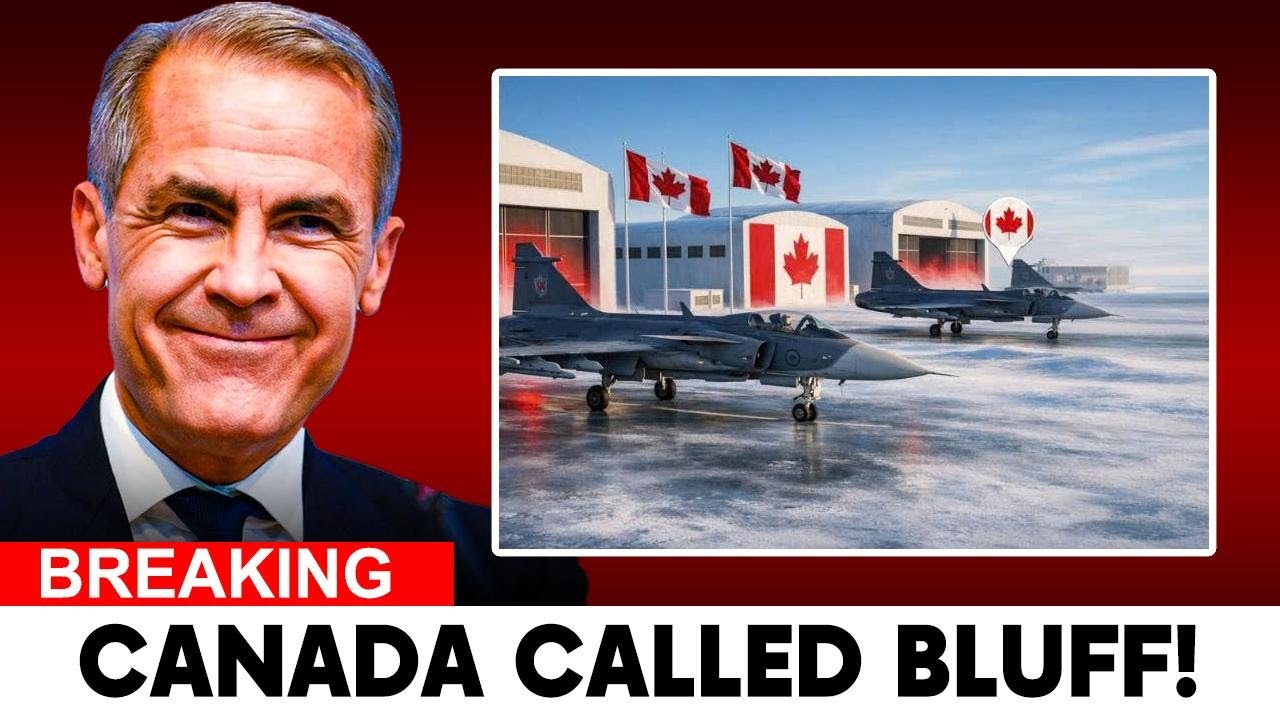
In a stunning political rupture that has sent shockwaves through Washington and Ottawa alike, Canada has abruptly reopened one of the most expensive military procurement programs in its history, effectively putting the $33 billion Lockheed Martin F-35 contract on life support. What began as routine budget scrutiny has exploded into a full-blown sovereignty showdown, with Prime Minister Mark Carney’s government openly flirting with Sweden’s Saab Gripen E fighter jet — a move that has left Pentagon officials furious and American defense contractors reeling in disbelief.
The crisis erupted without warning in the final months of 2025. For years, Canada had appeared locked into purchasing 88 F-35A Lightning II stealth fighters to replace its aging CF-18 fleet. The deal, initially pitched at roughly $19 billion, had already ballooned past $27.7 billion according to the Auditor General’s explosive June 2025 report, with lifetime costs now projected to hit a staggering $33 billion. Those numbers alone were enough to spark outrage across Canadian politics, but the real detonator came from an unexpected direction: escalating trade hostilities with the United States under President Donald Trump.
Trump’s repeated threats of sweeping 25 percent tariffs on Canadian exports, coupled with his provocative suggestion that Canada consider becoming America’s 51st state, ignited a wave of national indignation. What had once been framed as a purely technical defense decision suddenly became entangled with questions of national pride and economic independence. In this toxic atmosphere, Ottawa found itself under intense domestic pressure to demonstrate that it would no longer accept what many Canadians now viewed as exploitative dependence on Washington.
Enter Saab. The Swedish aerospace giant, whose Gripen E had been decisively outscored in the 2021 competition, never fully left the table. Behind closed doors, Saab nurtured relationships with Canadian officials and quietly positioned itself as the patriotic alternative. By August 2025, Canada and Sweden had signed a sweeping new defense and aerospace cooperation framework, with a particular focus on Arctic security — exactly the theater where Russia and China are expanding their military footprints. Saab seized the moment, promising to assemble every single Gripen E in Canada, transfer full technology, and create between 12,000 and 12,600 high-skilled manufacturing and research jobs across the country.
The employment pledge struck like lightning. Industry Minister Melanie Joly publicly declared that defense spending must deliver tangible benefits to Canadian workers, not just foreign corporations. Saab’s offer of complete industrial sovereignty — Canadian technicians able to upgrade and maintain the jets without begging for American permission — stood in stark contrast to the F-35’s notoriously restrictive model, where critical source code remains firmly under Pentagon control.
The backlash from Washington was immediate and ferocious. Pentagon officials issued stern warnings that any defection from the F-35 program could jeopardize Canada’s interoperability with NATO allies and invite retaliatory measures in other defense sectors. Retired Canadian air force generals, including Lieutenant General Yvan Blondin and Major General Chris McKenna, went public with dire predictions: a mixed fleet of 16 F-35s supplemented by Gripens would leave Canada dangerously outmatched against advanced threats in the Arctic. Even Bombardier’s CEO Eric Martel cautioned that walking away from the F-35 risked billions in existing U.S. contracts for Canadian suppliers.
Yet the momentum appears unstoppable. Leaked documents from the original 2021 evaluation — showing the F-35 scoring 57.1 out of 60 points compared to the Gripen’s 19.8 — have done little to slow the rebellion. Instead, they have fueled a narrative that Canada is willing to sacrifice raw capability for strategic autonomy and domestic economic gain. Proponents argue that in an era of rapid technological change, the Gripen’s modular, continuously upgradable design offers greater long-term flexibility than the F-35’s locked-in architecture.
As of mid-January 2026, no final axe has fallen. Ottawa remains committed to accepting the first 16 F-35s already in production, but the fate of the remaining 72 aircraft hangs in the balance. Negotiations with Lockheed Martin continue, focused on extracting far greater industrial offsets, while parallel talks with Saab and European partners deepen by the day.
This is no longer merely a procurement debate. It is a high-stakes test of whether a middle power can break free from the gravitational pull of its superpower neighbor without catastrophic consequences. For Canada, the choice pits alliance loyalty against national self-determination; for the United States, it raises uncomfortable questions about the sustainability of its defense export dominance in an increasingly multipolar world. And for Saab, it represents the chance of a lifetime — turning a distant second-place finish into one of the most dramatic upsets in modern military aviation history.
The drama is far from over. Every new statement from Ottawa, every leaked memo, every tariff tweet from Mar-a-Lago could tip the scales in an instant. What happens next will reverberate through NATO capitals, defense boardrooms, and factory floors from Montreal to Malmö for decades to come.






