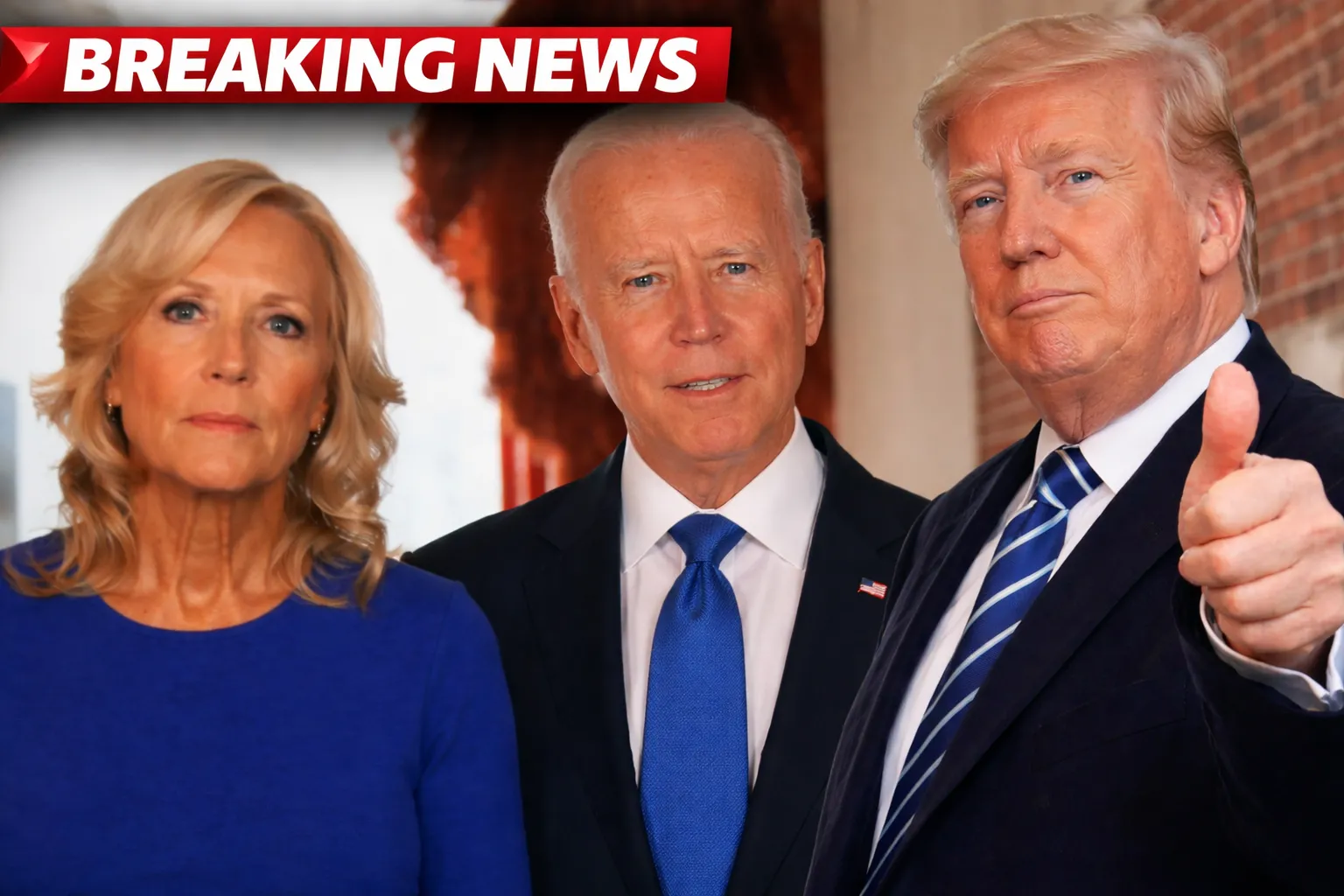
“Leave My Husband’s Legacy Alone!”: Jill Biden Steps Forward as Trump’s Policies Reignite a Battle Over History
The words were sharp. The emotion unmistakable. And the timing deliberate.
In a rare and deeply personal intervention, Jill Biden has publicly accused President Donald Trump of “ruining” her husband’s legacy — framing his policies not merely as political disagreements, but as a reversal of years of sacrifice, effort, and sleepless nights.
“Joe handed him a strong economy,” Jill Biden said, according to accounts of her remarks. “And he’s squandering it with policies that drive up costs.”
She did not stop there.
“It breaks my heart,” she added, “to watch everything Joe worked so hard to achieve being reversed.”
For a former First Lady who has largely avoided direct confrontation, the comments marked a striking shift — one that underscores how intensely personal the fight over presidential legacy has become.
A First Lady Who Rarely Entered the Arena
Throughout Joe Biden’s presidency, Jill Biden was widely seen as a stabilizing, understated presence. She focused on education, military families, and public service, often resisting pressure to become a political combatant.
That restraint is precisely why her remarks now carry such weight.
This was not a campaign rally or a partisan event. It was a moment of raw defense — a wife responding to what she perceives as the dismantling of her husband’s life’s work.
Those close to the Bidens say Jill has long bristled at how quickly Joe Biden’s presidency has been reduced to talking points and blame, rather than acknowledged for its scope and intent.
This time, she chose not to remain silent.
“He Stayed Up Day and Night”
Perhaps the most striking part of Jill Biden’s remarks was not her criticism of Trump, but her description of Joe Biden himself.
According to her, Joe Biden would “stay up day and night” trying to get things done for the American people — poring over details, calling aides, pressing for compromises, and worrying constantly about whether his decisions were enough.
This portrayal stands in sharp contrast to the caricatures that often dominate political debate.
Jill Biden did not describe a distant technocrat or a figure detached from consequences. She described exhaustion. Anxiety. Persistence.
In her telling, the presidency was not a title — it was a burden carried relentlessly, even in private moments the public never saw.
The Economy at the Center of the Dispute
At the core of Jill Biden’s accusation is the economy — the most politically potent and emotionally charged issue in American life.
She argues that Joe Biden left Trump a “strong economy,” one stabilized after crisis and positioned for long-term growth. In her view, Trump’s policies are now undermining that foundation, driving up costs and eroding the progress made.
Trump and his allies fiercely dispute this narrative, contending that economic challenges stem from Biden-era spending, global instability, and structural issues beyond any single administration.
The disagreement reveals a deeper truth: economic legacy is never neutral. It is defined as much by perception as by data.
And perception, Jill Biden suggests, is being shaped in ways that erase effort while magnifying blame.
Legacy as a Battlefield, Not a Footnote
Presidential legacies are rarely settled quickly. They evolve over decades, shaped by historians, voters, and subsequent administrations. But in today’s hyperpolarized climate, legacy battles begin immediately.
Every policy reversal becomes symbolic.
Every economic shift becomes evidence.
Every hardship becomes an indictment.
Jill Biden’s plea — “Leave my husband’s legacy alone” — reflects frustration with this reality. She is not asking for praise. She is asking for fairness.
Fairness in acknowledging context.
Fairness in recognizing intent.
Fairness in remembering how difficult governing through crisis truly was.
Trump as the Catalyst for Emotion
Donald Trump has a unique ability to provoke not only political opposition, but deeply personal reactions. His leadership style thrives on contrast — framing the past as failure and the present as correction.
For Jill Biden, that framing feels like erasure.
Trump’s return to power has reopened wounds that never fully healed. It has forced comparisons that are not abstract but immediate, affecting policies that shape daily life.
Each reversal is not just a policy choice — it is, in her eyes, a statement about what mattered and what did not.
That is why her response is emotional rather than procedural.
Critics Push Back — And Push Hard
Trump’s supporters quickly dismissed Jill Biden’s remarks as sentimental and selective, arguing that emotion does not equal evidence. They contend that Biden-era policies laid the groundwork for inflation and economic strain, and that Trump is correcting course rather than undoing success.
Some critics also questioned whether Jill Biden’s role as former First Lady gives her standing to weigh in so directly on economic policy.
But allies counter that she is not positioning herself as an economist or policymaker — she is speaking as someone who witnessed the cost of leadership firsthand.
“Legacy isn’t just charts and graphs,” said one Democratic strategist. “It’s the human effort behind them.”
The Human Cost of Governing
Jill Biden’s comments tap into something rarely discussed in political discourse: the private toll of public power.
Presidents are expected to be tireless. Failure is scrutinized; exhaustion is invisible. The personal cost of decision-making — the sleepless nights, the strain on families — is rarely part of the conversation.
By invoking those nights, Jill Biden reframes the presidency as an act of endurance rather than ambition.
She is not asking voters to agree with every policy.
She is asking them to recognize the labor behind them.
A Changing Role for Political Spouses
Jill Biden’s intervention also reflects a broader shift in the role of political spouses. In an era of constant scrutiny and rapid narrative shifts, silence can feel like surrender.
By speaking out, Jill Biden joins a growing number of spouses who refuse to remain symbolic figures — instead choosing to defend, contextualize, and humanize the leaders they stood beside.
That choice carries risk. It invites criticism. It exposes vulnerability.
But it also reshapes how power is remembered.
Why This Moment Resonates Now
The timing of Jill Biden’s remarks matters.
They come amid economic anxiety, political fatigue, and a nation deeply divided over how to interpret recent history. Many Americans feel whiplash — told repeatedly that progress has been undone or that disaster has been averted, depending on who is speaking.
In that environment, Jill Biden’s words cut through not because they resolve the debate, but because they personalize it.
They remind listeners that behind every administration are people who believed they were doing the right thing — and who feel the sting when that belief is dismissed.
Legacy Is Not Frozen in Time
Ultimately, Jill Biden’s plea cannot be granted. Legacies are not preserved by request. They are contested endlessly, shaped by events long after a presidency ends.
But her words ensure that Joe Biden’s presidency will not be discussed solely through partisan frames.
They inject memory into the record.
Effort into the analysis.
Sacrifice into the argument.
Conclusion: A Wife’s Defense, A Nation’s Argument
“Leave my husband’s legacy alone.”
It is an emotional appeal in a system that rewards conflict. But it captures something essential about this moment in American politics.
The battle over Joe Biden’s presidency is not just about economics or policy direction. It is about how effort is remembered, how sacrifice is weighed, and who gets to define success.
As Trump reshapes the present, Jill Biden is fighting for the past — not to freeze it, but to ensure it is not erased without acknowledgment.
The argument over legacy is far from over.
And now, it has a voice that speaks not from ambition, but from loyalty — and from a belief that history should remember more than just outcomes.
It should remember the cost.






