🔥 BREAKING: TRUMP THREATENS THE FED CHAIR — MARKETS REEL AS WALL STREET PLUNGES INTO PURE CHAOS ⚡
WASHINGTON — For more than a century, presidents of both parties have observed an unwritten rule when it comes to the nation’s central bank: disagree privately if necessary, but never publicly undermine the independence of the Federal Reserve. That restraint has been viewed as essential to market confidence, insulating monetary policy from short-term political pressure.
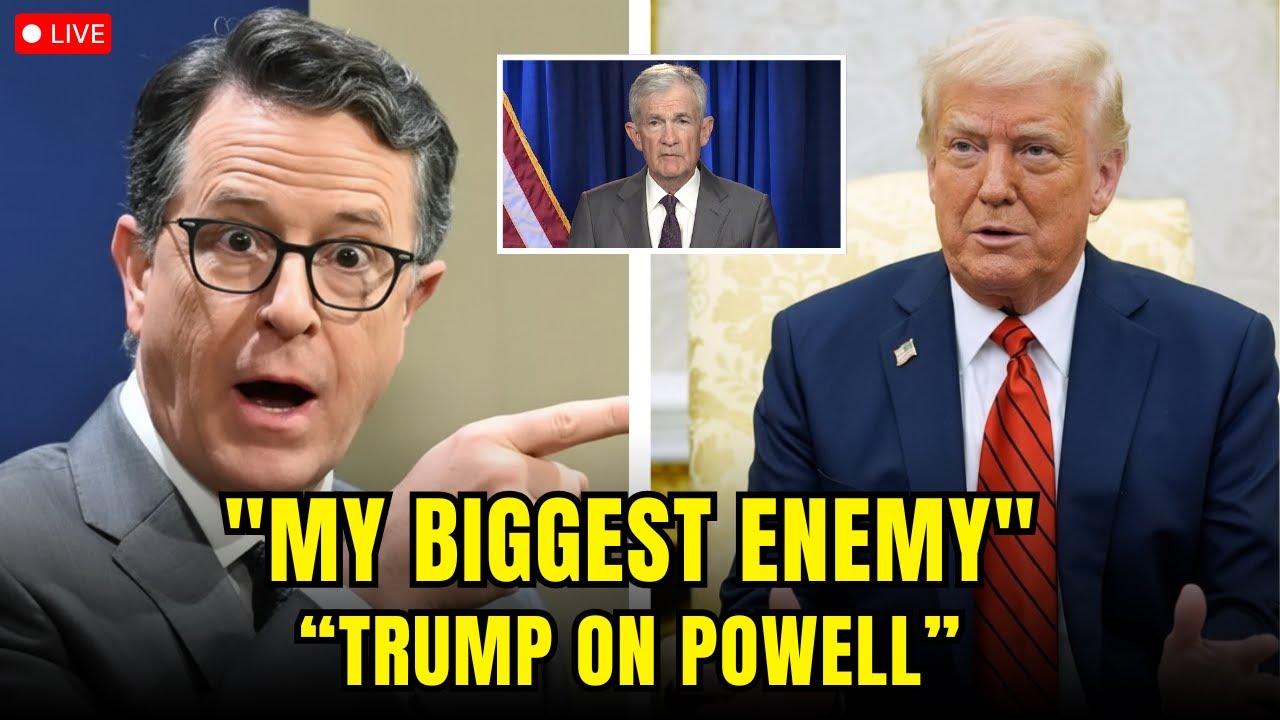
That norm came under sustained strain during the presidency of Donald Trump, whose repeated public attacks on the Federal Reserve and its chairman unsettled investors and revived anxieties more commonly associated with emerging economies than with the world’s largest financial system.
Mr. Trump’s criticism focused on Jerome Powell, whom he himself nominated in 2017. At first, the relationship appeared conventional. The Fed, under Mr. Powell, raised interest rates gradually as the economy expanded, following a trajectory laid out before Mr. Trump took office.
But by 2018, the president’s tone shifted sharply. He began accusing the central bank of tightening policy too aggressively, describing its actions as “crazy” and calling higher interest rates his administration’s “biggest threat.” In a series of interviews and social media posts, Mr. Trump went further, questioning whether Mr. Powell was more harmful to the United States than foreign adversaries — an extraordinary comparison that startled economists and investors alike.
The Federal Reserve’s authority rests largely on credibility. Its independence reassures markets that decisions about inflation, employment, and financial stability are made based on economic data, not electoral calendars. When that perception weakens, even rhetorically, uncertainty grows.
Market participants noticed. Volatility picked up during periods when the president’s comments were most aggressive. Analysts at major banks warned clients that political interference in monetary policy could have lasting consequences, including higher inflation expectations and a weaker dollar. International observers, accustomed to watching governments pressure central banks in less stable economies, expressed unease that similar dynamics appeared to be surfacing in the United States.
What alarmed investors was not disagreement — presidents have long disliked tight monetary policy — but the public nature of the confrontation. Mr. Trump openly mused about firing Mr. Powell, insisting he had the authority to do so. Legal scholars disputed that claim, noting that while the president appoints the Fed chair, removal is constrained by statute and precedent.
Even the suggestion carried weight. Treasury officials and White House advisers were reportedly forced into damage-control mode, emphasizing that the Fed would remain independent. The central bank itself declined to engage, adhering to its tradition of silence in the face of political criticism.
:max_bytes(150000):strip_icc():focal(749x0:751x2)/stephen-colbert-donald-trump-071825-92fb9871176b4d839a73f9121a75b466.jpg)
The episode highlighted a broader feature of Mr. Trump’s governing style: a willingness to challenge institutional boundaries that previous presidents treated as inviolate. Courts, intelligence agencies, and the news media all experienced similar pressure. The Federal Reserve, however, occupies a uniquely sensitive position. Its decisions ripple through global markets, affecting borrowing costs, currency values, and capital flows far beyond U.S. borders.
Economists noted that in countries where political leaders routinely interfere with central banks, inflation tends to be higher and growth more volatile. The United States had long been held up as a counterexample — a system in which institutional norms mattered as much as formal rules. Mr. Trump’s rhetoric raised the question of how durable those norms truly were.
In practical terms, the Fed continued to operate as before. Mr. Powell was not removed, and policy decisions remained data-driven. But the damage, some analysts argued, lay in precedent rather than outcome. Once a president demonstrates that openly pressuring the central bank is politically acceptable, future leaders may be tempted to do the same, particularly in moments of economic stress.
By the end of Mr. Trump’s term, the immediate market turbulence had faded, but the memory lingered. Former Fed officials, including past chairmen, publicly defended the institution’s independence — a rare intervention underscoring the seriousness with which they viewed the threat.
The episode served as a reminder that financial stability depends not only on laws and regulations, but also on shared understandings about restraint. Those understandings, once broken, are difficult to restore.
For investors, policymakers, and foreign governments alike, Mr. Trump’s attacks on the Federal Reserve were less about interest rates than about trust — and how quickly it can be shaken when political power collides with institutions designed to stand apart from it.






