A recently circulated YouTube video titled “Melania Trump Tried to Control the Narrative — Jasmine Crockett Broke It on Live TV” plays like breaking news, but it is best understood as political storytelling: a dramatized script that borrows the visual language of televised interviews—soft lighting, a host’s measured tone, a studio audience—and then turns that familiar setting into a high-pressure confrontation about identity, legitimacy and power.
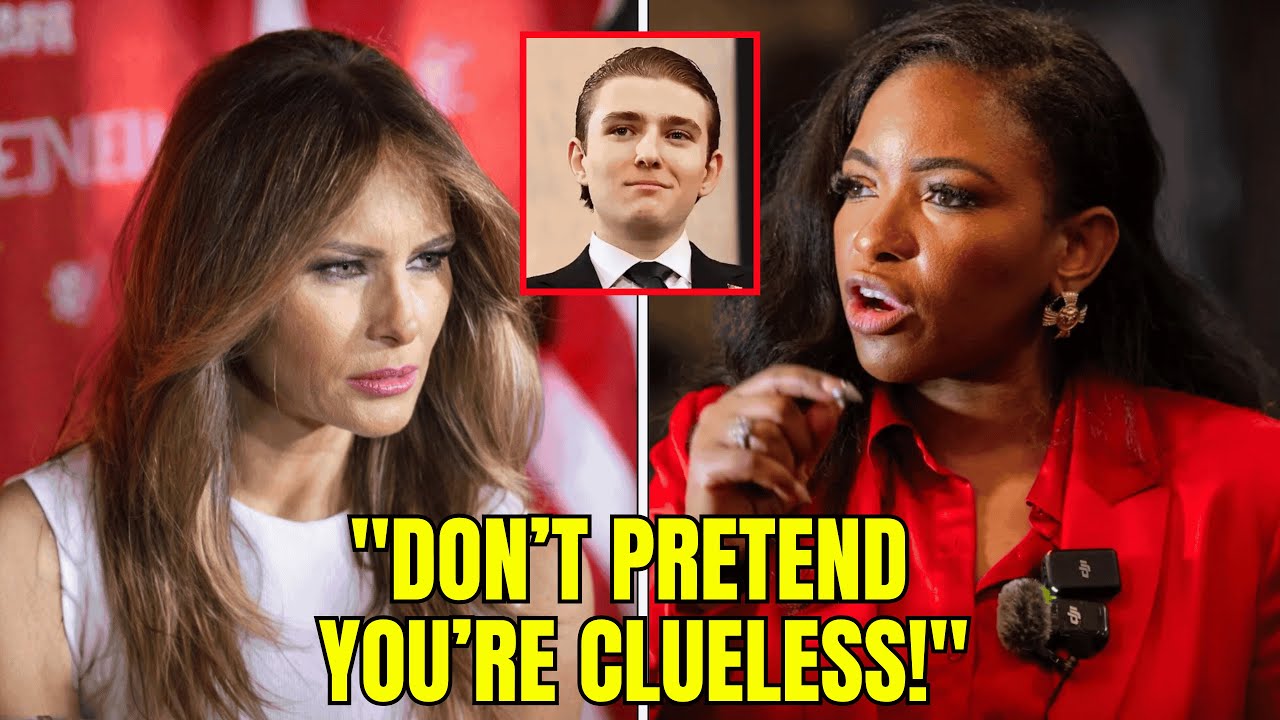
In the video’s narrative, Representative Jasmine Crockett, the first-term Democrat from Texas, sits opposite Melania Trump as a conversation that begins with policy quickly veers into insinuation. The script depicts a moment many viewers recognize from America’s political past: a public figure raising questions about who “gets to define” the nation and who “belongs,” framed as accountability rather than attack. Crockett, in turn, is portrayed refusing the implied premise, pressing for clarity and challenging the rhetorical move itself—arguing that coded doubt about someone’s place in public life is a distraction from substance.
What makes the clip travel, as these clips so often do, is not the specific claim it stages, but the structure. It follows an internet-native formula: provocation, an unhurried pause, and then a response written to sound crisp enough for reposting. The drama is heightened through “receipts”—a folder, a timeline, a promise of documentation—used as a prop to signal seriousness even as the piece remains a performance.

The video lands in a real political environment where Crockett has already become a national figure, in part through confrontations that ricochet online. In June 2025, she drew attention for remarks during a House Judiciary Committee hearing that questioned the standards used for Melania Trump’s immigration path, including the EB-1 visa category often nicknamed the “Einstein visa.” Crockett, an attorney who has represented Texas’s 30th Congressional District since 2023, has built a reputation for sharp exchanges that supporters describe as plainspoken and critics call inflammatory.
That context helps explain why the YouTube script feels plausible to viewers even when its “live TV” showdown appears to be staged. It does not invent the underlying tensions so much as remix them into a more cinematic form—compressing committee-room disputes, cable-news commentary, and social-media argument into a single, scripted set piece.
The broader phenomenon is less about any one politician than about how political identity is now mediated. The modern audience is trained to watch not just for facts, but for posture: who stays calm, who blinks, who seems prepared, who appears to be improvising. In that economy, “truth” can become as much an aesthetic—documents on a desk, language that sounds clinical—as a standard of verification.
And so the clip functions as a kind of political short story, one that invites viewers to take sides while also rewarding them with the sensation of witnessing a decisive moment. Whether that moment happened as shown is almost beside the point. The point is that millions of Americans now experience politics through scenes designed to be shared—scenes where the argument is real, even if the stage is not.






