Canada’s Fighter Jet Dilemma: Sovereignty, Alliance, and the Arctic at a Crossroads
By late 2025, Canada found itself confronting a decision that few middle powers ever face so starkly: whether to double down on military integration with its closest ally or to take a costly, uncertain step toward greater strategic independence. At stake is not just the choice of a fighter jet, but the direction of Canadian defense policy for the next half-century.
The immediate question before Ottawa is deceptively simple. Should Canada proceed with its plan to acquire 88 F-35 Lightning II fighter jets from the United States, or should it pivot toward Sweden’s Saab JAS 39 Gripen, a smaller, less stealthy aircraft marketed as flexible, resilient, and sovereign by design?
The deeper context is anything but simple.
Canada possesses the second-largest national territory on Earth, with tens of thousands of kilometers of coastline and an Arctic frontier that is rapidly transforming. Climate change is melting sea ice, opening new shipping lanes and exposing untapped resources. At the same time, it is drawing heightened military attention. Russia has expanded its northern bases and patrols. China, calling itself a “near-Arctic state,” has increased its research and commercial presence. The United States, long the dominant Arctic power, is stepping up its own involvement.
For Canada, whose northern infrastructure is thin and whose defense budget has long lagged behind ambition, the challenge is profound. Fighter aircraft are not simply tools of war; they are instruments of sovereignty, surveillance, and alliance politics.
On paper, the F-35 appears to be the obvious choice. It is one of the most advanced combat aircraft ever built, boasting stealth capabilities, sensor fusion, and interoperability with NATO allies. More than a dozen allied countries have committed to the program, making it the backbone of Western air power for decades to come.
But Ottawa’s confidence in the program has been shaken. In March 2025, the Canadian government quietly began re-examining its F-35 contract after projected costs surged. What had been estimated at roughly 19 billion Canadian dollars in 2023 rose to nearly 27.7 billion, with analysts warning that long-term sustainment costs could climb further.
Cost overruns are not unique to Canada. The F-35 program has drawn criticism across allied capitals for its expense and complexity. Yet money is only part of Ottawa’s concern.
The aircraft’s dependence on U.S.-controlled software, upgrades, and maintenance systems has become an increasingly sensitive issue in a world where alliance politics feel less predictable. American officials have repeatedly stated that there is no “kill switch” allowing Washington to disable allied F-35s. Still, the United States retains control over critical software updates and certification processes. Some partners, such as Israel, have negotiated exceptional autonomy. Most have not.
For Canada, the question is not whether Washington would ever restrict access, but whether Ottawa wants to accept that vulnerability at all.
Geography adds another layer of doubt. The F-35 performs best from long, well-maintained runways supported by sophisticated infrastructure. Canada’s Arctic has very few such bases. In a crisis, when speed and dispersal matter, that dependence could become a liability.
This is where Sweden’s Gripen enters the debate.
The Gripen is not a technological peer to the F-35. It lacks deep stealth and is less optimized for high-intensity, peer-to-peer conflict against advanced adversaries. But it was designed with a different philosophy. Sweden, long neutral and acutely aware of its vulnerability, built the Gripen to operate from highways, improvised runways, and austere environments. It can be refueled in minutes, serviced by small crews, and returned to the air quickly, even in harsh weather.
Perhaps more importantly for Ottawa, the Gripen’s software architecture separates core flight controls from mission systems. That design allows operators to upgrade sensors, weapons, and electronic warfare packages without re-certifying the entire aircraft. Defense analysts describe this as “sovereign sustainment,” the ability to maintain and adapt a system without constant reliance on the original manufacturer.
Saab’s pitch to Canada goes far beyond aircraft performance. The company has offered to assemble the jets domestically, primarily in Quebec and Ontario, and to transfer significant technology and training to Canadian engineers. Saab estimates that such a program could generate between 9,000 and 12,600 direct and indirect jobs and revive a domestic aerospace capability Canada largely abandoned after canceling the Avro Arrow program in 1959.
To Swedish officials, the model is proven. Brazil, which selected the Gripen in 2014, has built a domestic assembly line and developed its own engineering expertise in the process.
Yet even this vision has caveats. The Gripen still relies on a U.S.-made General Electric engine, meaning Washington would retain some leverage regardless of the aircraft chosen. And Canada has already committed to purchasing an initial batch of F-35s. Switching course entirely would likely force the Royal Canadian Air Force to operate two fighter fleets simultaneously, multiplying training, maintenance, and logistics costs.
Former Canadian Air Force leaders have also warned that while the Gripen excels in patrol, interception, and dispersed operations, its performance in a high-end conflict against a peer adversary remains unproven. In that environment, they argue, the F-35’s stealth and sensor dominance could be decisive.
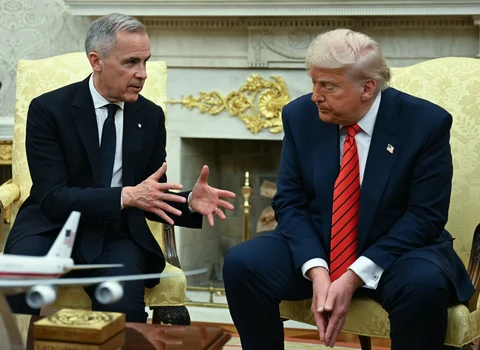
Politics loom over the debate. Trade tensions with the United States under President Trump have pushed Ottawa to quietly explore diversification, not only in defense procurement but across its economic relationships. American officials, for their part, have made clear that walking away from the F-35 would carry consequences, though they have been vague about what those might be.
Adding another layer of intrigue is Ukraine. Kyiv has signaled interest in acquiring up to 150 Gripen fighters, a move that would require Saab to expand production capacity beyond Sweden. A Canadian assembly line could, in theory, serve both countries, turning Canada into a manufacturing hub and tying its defense industry more closely to Europe.
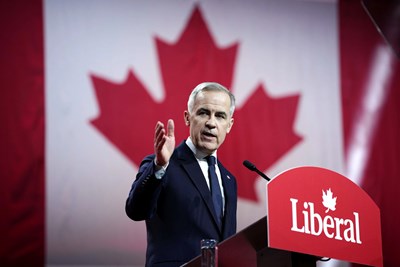
For Prime Minister Mark Carney, the decision is as philosophical as it is technical. Three broad options remain under discussion: proceeding with all 88 F-35s, adopting a mixed fleet combining F-35s and Gripens, or shifting toward a Gripen-centered force paired with advanced surveillance aircraft such as Saab’s GlobalEye.
Each path carries risks. Deep integration with the United States offers unmatched capability and alliance security, but at the cost of autonomy and escalating expense. A turn toward Sweden promises flexibility, industrial revival, and a measure of independence, but introduces operational uncertainty and logistical complexity.
In the end, the debate is not truly about which jet is superior. It is about what kind of country Canada wants to be in an era of resurgent great-power competition. As the Arctic warms and global alliances strain, Ottawa’s choice will signal whether it sees its future anchored firmly within American power or cautiously charting a more independent course.
The decision, still unresolved as of January 2026, will echo far beyond 88 aircraft. It will shape Canada’s role in the Arctic, its defense industry, and its understanding of sovereignty in a world where even close allies can no longer be taken for granted.






