By revisiting a half-century-old academic claim, a recent monologue by Stephen Colbert did not so much reveal new information as expose a familiar tension at the heart of modern American politics: the gap between branding and substance.
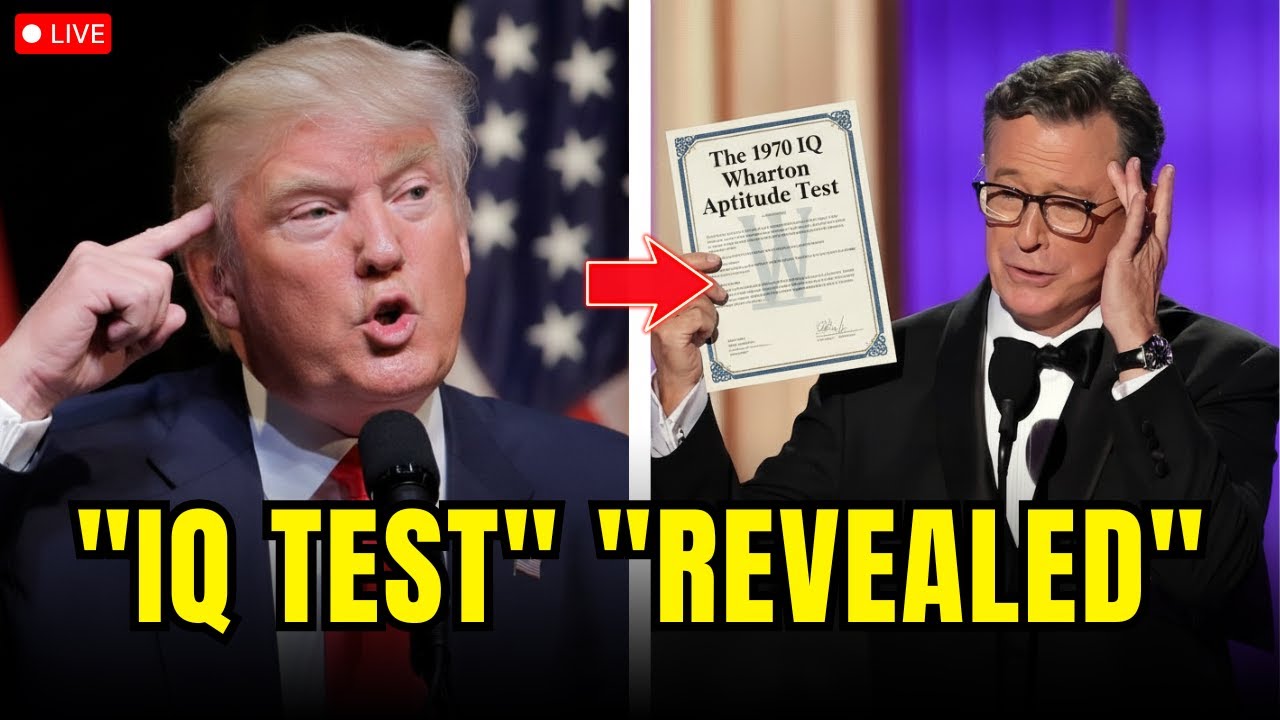
On his late-night program, Colbert devoted an extended segment to Donald Trump and the former president’s long-standing insistence that his intellect is self-evident, frequently traced back to his education at the Wharton School of the University of Pennsylvania. The premise of the segment was deliberately theatrical: Colbert staged what he described as the “unsealing” of Trump’s Wharton-era aptitude test results from around 1970.
The documents, of course, were fictional. The exercise was satire, not investigative reporting. But the performance drew laughter precisely because it touched a nerve that has remained sensitive for years. Trump has repeatedly invoked Wharton as proof of intellectual superiority, often offering the credential as a rebuttal to critics questioning his policy knowledge, command of detail, or rhetorical discipline.
Colbert’s approach was not to dispute Trump’s claims with counterevidence, but to parody the very desire for validation through a decades-old test score. In doing so, he reframed the debate. The question was no longer whether Trump was “smart enough,” but why such a metric continues to hold symbolic power in the public imagination.
The segment unfolded as a mock ceremony, mimicking the solemnity of political disclosures that dominate cable news. By elevating a trivial and unverifiable artifact to the level of national importance, Colbert mirrored the media ecosystem that has long amplified Trump’s self-mythologizing. The joke landed because it felt uncomfortably familiar.
Throughout his presidency and beyond, Trump has cultivated an image of instinctive brilliance: a businessman whose intuition outperforms expertise, and whose confidence substitutes for conventional analysis. Colbert’s satire suggested that even if an aptitude test existed, it would likely measure something very different from academic rigor. In his telling, Trump’s “genius” lay not in abstract reasoning or scholarly depth, but in dominance of narrative, relentless self-promotion, and the ability to command attention.
That distinction has long been at the center of Trump’s appeal. His supporters often frame intelligence not as mastery of institutions or facts, but as effectiveness — the ability to win deals, humiliate opponents, and bend systems to one’s will. Critics, by contrast, point to repeated factual errors, policy reversals, and impulsive decision-making as evidence of intellectual shallowness.
:max_bytes(150000):strip_icc()/stephen-colbert-donald-trump-071825-1-4d6ec25df5ec4d33a18dbe8c518951cc.jpg)
Colbert did not attempt to resolve this divide. Instead, he exposed its absurdity. By joking that the supposed test evaluated skills like aggressive interruption or unshakable self-belief, he highlighted a truth that is rarely stated so plainly: the standards by which Americans judge leadership have shifted. Charisma and confidence now compete with, and often eclipse, expertise.
The satire also underscored the limitations of retrospective validation. Whether Trump scored highly or poorly on any test taken in 1970 would say little about his conduct decades later. Leadership, Colbert implied, is not a static trait certified in youth, but a practice continually evaluated in public life.
The segment’s closing note was one of weary skepticism rather than triumph. There was no final “score,” no definitive answer, only the suggestion that the real examination is ongoing. Voters, institutions, and history itself serve as the proctors, assessing not aptitude on paper but performance in power.
In that sense, the Wharton test was never the point. Colbert’s satire functioned as a mirror, reflecting the persistence of political branding in an era saturated with spectacle. The enduring fascination with Trump’s intelligence — and with symbolic proofs of it — reveals less about the former president than about the culture that continues to debate him.
Late-night comedy has always thrived on exaggeration, but its sharpest moments often illuminate genuine contradictions. By resurrecting a fictional test from the past, Colbert reminded his audience that in contemporary politics, myth often travels farther than measurement, and confidence can masquerade as competence long after the laughter fades.






