🔥 March 4th TARIFF WAR — Canada’s $155B Retaliation CRUSHES Trump’s Strategy 🔥🔥
March 4th was supposed to mark a show of strength. Instead, it detonated into one of the most destabilizing trade confrontations North America has seen in decades. As sweeping U.S. tariffs kicked in under the Trump camp’s hardline economic posture, Canada responded within hours — not with rhetoric, but with a staggering $155 billion retaliation package that instantly rewired the battlefield and sent shockwaves through markets, boardrooms, and political war rooms on both sides of the border.
What followed was not a negotiation. It was a trade war escalation — precise, targeted, and devastating.
According to trade experts, Canada’s response wasn’t emotional or symbolic. It was surgical. The retaliatory measures zeroed in on politically sensitive U.S. exports: agriculture, manufactured goods, machinery, steel-linked components, and consumer products sourced from swing states and industrial corridors critical to Trump’s political messaging. Within hours, exporters began warning of canceled contracts, frozen shipments, and sudden cost spikes that could not be absorbed.
By nightfall, the narrative had flipped. The administration’s claim of leverage was drowned out by a harsher reality: Canada had anticipated the move — and prepared for it.
A Retaliation Years in the Making
Insiders familiar with Ottawa’s planning say the $155B package was not assembled overnight. Canadian trade officials had quietly modeled scenarios for months, stress-testing supply chains and identifying U.S. pressure points. When the tariffs hit on March 4th, the response was immediate because the groundwork was already complete.
The message was unmistakable: Canada would not absorb the blow quietly — and it would not negotiate from weakness.
Markets reacted instantly. Logistics firms flagged disruptions across border crossings. Manufacturers warned of cascading delays. Agricultural exporters sounded alarms over perishable goods stuck in limbo. Analysts described the moment as the collapse of the “easy win” theory — the idea that America’s economic size alone guaranteed dominance.
Instead, the retaliation exposed a critical vulnerability: interdependence.
Trump’s Strategy Hits a Wall
Trump’s tariff strategy has always relied on a simple premise — pressure first, concessions later. But Canada’s response shattered that assumption. Rather than rushing to the table, Ottawa escalated, signaling that it was prepared for sustained conflict.
Former trade negotiators described the move as “a strategic reversal.” Instead of isolating Canada, the tariffs isolated U.S. exporters, forcing domestic industries to absorb losses while foreign buyers explored alternative suppliers.
Behind closed doors, industry groups reportedly flooded Washington with emergency calls. Auto suppliers warned of cross-border bottlenecks. Food producers cautioned that Canadian countermeasures could permanently redirect trade flows to Europe and Asia. Energy analysts flagged ripple effects that could distort pricing well beyond North America.
The administration, caught off-guard by the speed and scale of the retaliation, scrambled to reframe the moment as “expected resistance.” But the damage was already visible.
Political Shockwaves in Washington
On Capitol Hill, reactions were swift — and divided. Some lawmakers praised the hardline stance, framing the retaliation as proof the strategy was “working.” Others were far less convinced. Behind the scenes, aides described growing anxiety as polling districts tied to targeted exports began reporting economic fallout almost immediately.

For Trump allies, the concern wasn’t just economic — it was narrative. The tariffs were meant to project control. Instead, the headlines told a different story: Canada dictating terms, the U.S. reacting.
Cable news panels lit up with questions the administration struggled to answer. Why was Canada so prepared? Why were retaliatory targets so politically precise? And why did markets seem to believe Ottawa had the upper hand?
A Calculated Canadian Signal
Canadian officials, for their part, kept their tone measured. Public statements emphasized “defending national interests” and “maintaining fair trade,” but the subtext was clear: Canada would not blink.
Trade analysts noted that the $155B figure itself carried symbolism — large enough to hurt, structured enough to sustain, and flexible enough to escalate further if needed. It wasn’t a single punch. It was a warning shot with follow-through.
Crucially, the retaliation also reassured domestic audiences. Canadian industries saw a government willing to shield them aggressively, even at the risk of prolonged confrontation. That unity blunted internal pressure to compromise early — another blow to Trump’s leverage.
Markets Sense a Shift
By the end of the week, investors were already recalibrating expectations. Companies began revising earnings forecasts. Supply chain managers explored rerouting options. Analysts warned that if the standoff dragged on, structural damage — not temporary disruption — could take hold.
Some economists went further, suggesting the March 4th clash marked a turning point in North American trade dynamics. Once supply chains adapt away from established routes, they rarely snap back fully.
That possibility rattled Washington. A strategy designed to force quick concessions now risked accelerating long-term decoupling — the opposite of its stated goal.
What Comes Next
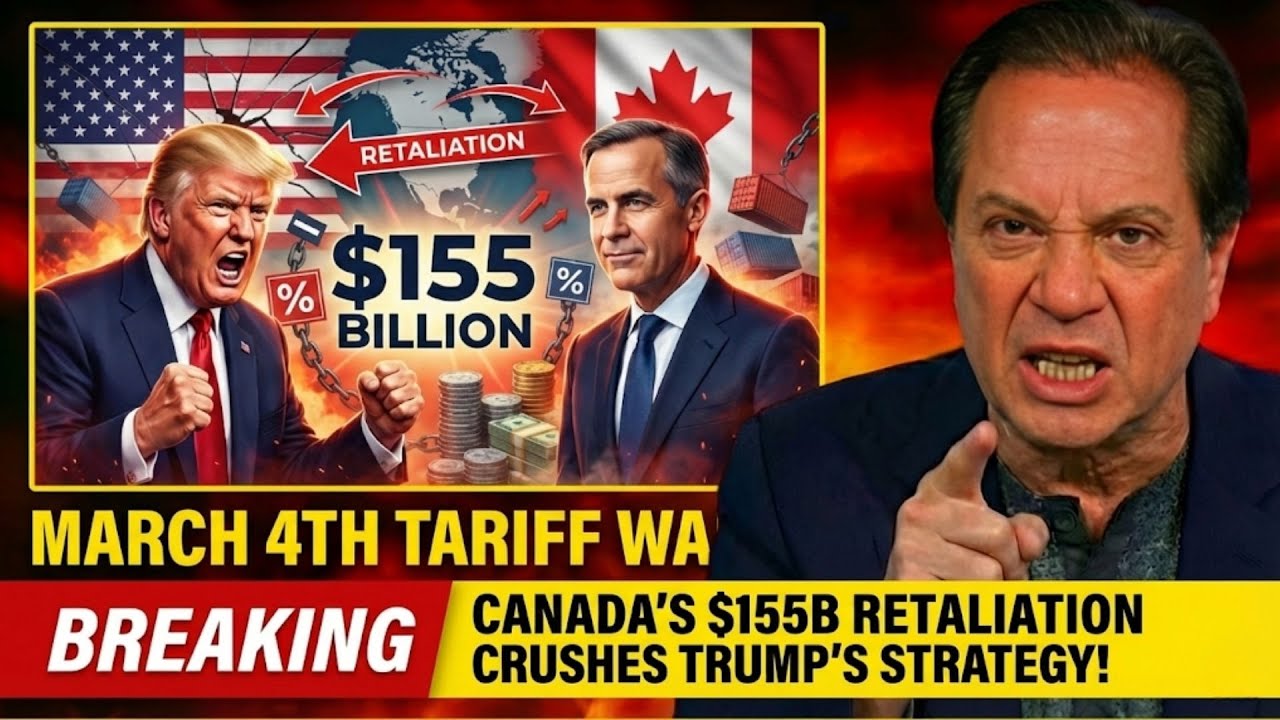
As both sides dig in, one reality is becoming harder to ignore: this is no longer about tariffs alone. It’s about credibility, preparation, and who controls escalation.
Canada’s $155B retaliation didn’t just answer Trump’s move — it reframed the conflict. It showed that middle powers with deep planning and targeted responses can blunt even the most aggressive economic tactics.
Whether the standoff de-escalates or spirals further remains uncertain. But one thing is clear after March 4th: the assumption that Canada would fold was a miscalculation — and the cost of that error is already being felt.
In the escalating tariff war, Trump fired first.
But Canada’s response may have changed the rules entirely. 🔥🔥






