Jimmy Kimmel’s Trump Obsession, and Why It Keeps Working
Late-night television has long thrived on exaggeration, but Jimmy Kimmel’s ongoing fixation with Donald Trump operates differently. It is less about punchlines than exposure — a running effort to place Trump’s words, desires, and insecurities on public display, often with minimal commentary and maximum contrast.
In recent weeks, that approach has coalesced around a singular episode that even seasoned political satirists found difficult to parody: Trump’s decision to publicly accept — and keep — a Nobel Peace Prize medal that was not awarded to him.
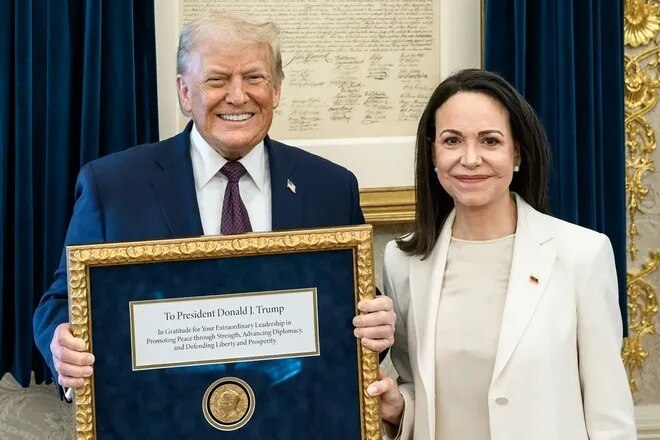
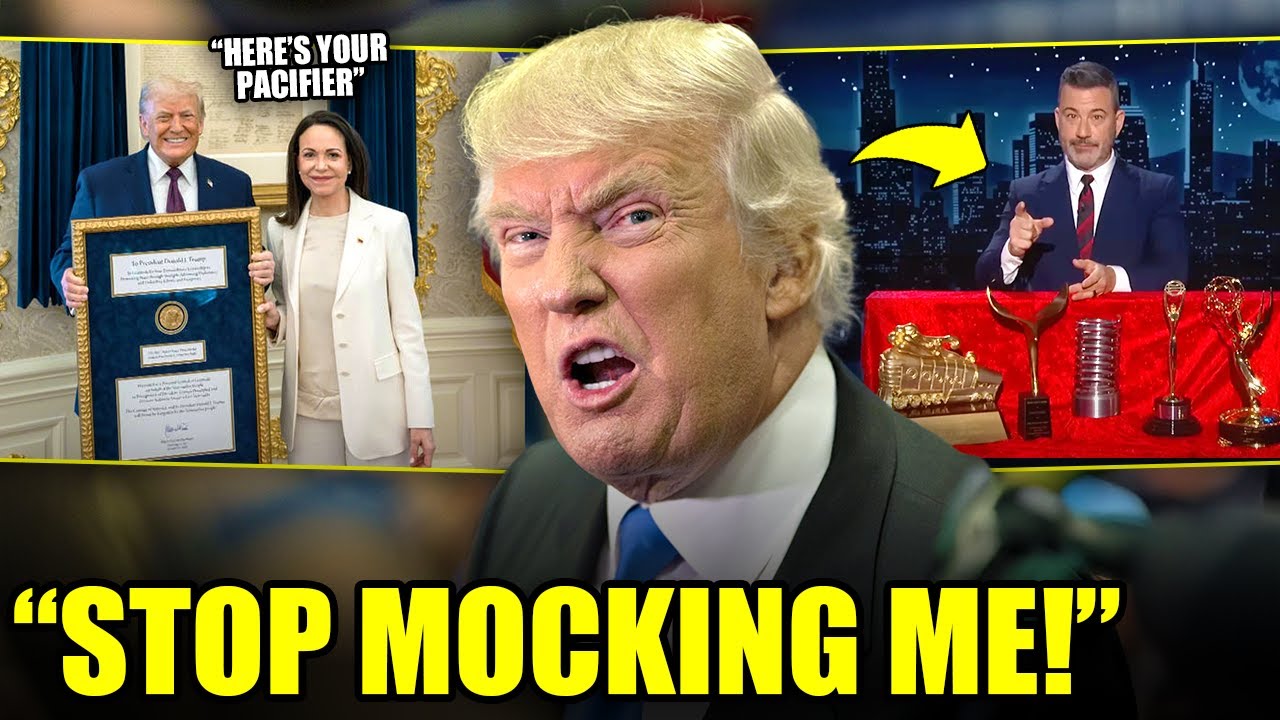
The medal belongs to María Corina Machado, the Venezuelan opposition leader who received international recognition for her political advocacy. During a visit to Washington, she presented Trump with the medal as a symbolic gesture of gratitude for his past statements on Venezuela. Trump later described the moment on social media as her “presenting me with her Nobel Peace Prize for the work I have done,” language that suggested ownership rather than symbolism.
Kimmel seized on the distinction immediately.
On his show, he replayed Trump’s statement, then paused. No shouting. No name-calling. Just the central contradiction: Nobel Prizes are not transferable, symbolic or otherwise. They are awarded to individuals, not borrowed, gifted, or reassigned.
“The funny part isn’t that he wanted it,” Kimmel said. “It’s that he’s pretending it’s his.”
The Award Trump Has Always Wanted
Trump’s fascination with the Nobel Peace Prize is well documented. He has repeatedly argued that his diplomatic efforts — particularly in the Middle East — were overlooked by the Nobel Committee due to political bias, often comparing himself unfavorably to former President Barack Obama, who received the prize in 2009.
That comparison remains central to Trump’s self-image, according to political analysts. Obama’s presidency represented not just a political foil, but a cultural one — elite recognition, global admiration, and institutional validation. The Nobel Prize, in that sense, is not merely an award but a symbol of legitimacy Trump believes was unfairly denied to him.
Kimmel framed the medal episode accordingly: not as corruption, but as insecurity.
“Everyone can see it isn’t yours,” he said. “And pretending doesn’t change that.”
Satire as Transaction
Kimmel escalated the bit by staging a mock negotiation. If Trump would agree to withdraw federal immigration enforcement operations from Minneapolis, Kimmel said, he would be willing to give Trump one of his own awards — an Emmy, a Clio, a Webby, even a novelty honor he once received in jest.
The segment worked because it leaned into a familiar truth about Trump: he responds to praise, trophies, and symbolic wins more consistently than to policy arguments.
“Give him an award,” Kimmel joked, “and it’s the only way to get him to do anything.”
The audience laughed, but the underlying critique was unmistakable. Trump’s relationship with power has always been performative. Validation matters more than outcomes.
Polls and Political Reality
What made the moment land more sharply was its timing. New polling shows Trump struggling across nearly every major issue. According to recent national surveys, his approval ratings remain underwater on the economy, immigration, foreign policy, and healthcare — issues that once formed the backbone of his political appeal.
Even on immigration, long considered a core strength, Trump now faces net negative approval. On healthcare, critics point to the absence of a detailed plan, despite repeated promises of sweeping reforms.
During a recent speech, Trump claimed his policies would reduce drug prices by “300, 400, even 500 percent” — a mathematical impossibility that Kimmel highlighted without embellishment. A price reduced by 100 percent becomes free; anything beyond that defies basic arithmetic.
Kimmel’s approach here mirrors a broader shift in political satire: less mockery, more documentation. Let the numbers speak. Let the quotes sit uncorrected.
The Obama Shadow
No theme recurs more frequently in Kimmel’s Trump commentary than Obama. The former president’s Affordable Care Act expanded healthcare access to millions, a legacy Trump has repeatedly vowed to dismantle, even as some of his own supporters rely on its protections.
Kimmel replayed a familiar exchange in which a voter praised the Affordable Care Act while condemning “Obamacare,” unaware they are the same program. The clip has circulated for years, but Kimmel used it to underscore a larger point: policy ignorance is not incidental — it is baked into the political ecosystem Trump thrives in
https://youtube.com/watch?v=q0Zu1StwOZE.
Why the Joke Keeps Landing
Kimmel’s sustained focus on Trump works not because it is meaner than other critiques, but because it is clearer. He rarely speculates. He shows clips. He cites polls. He lets contradictions remain unresolved.
That restraint has proven disarming.
Trump, for his part, continues to respond the same way — with insults, grievances, and personal attacks that never address the substance of what is shown. Each reaction sends viewers back to the original clip, where the facts remain unchanged.
In media terms, it is a losing feedback loop.
The Real Punchline
The Nobel medal episode will not alter Trump’s political future on its own. But it crystallizes something voters increasingly recognize: a former president more invested in symbols of greatness than its responsibilities.
Kimmel ended the segment not with a punchline, but a shrug.
“You can’t tariff the Nobel Committee,” he said. “You can’t threaten it. You can’t bully it. So you pretend.”
That, ultimately, is why the joke lands — and why it keeps landing.
Not because Trump is mocked, but because he is revealed.