OTTAWA — For more than a decade, Canada’s decision to purchase the F-35 fighter jet was treated in Washington as inevitable. The aircraft, built by Lockheed Martin, is the cornerstone of American air power and the most ambitious weapons program ever attempted by the United States. To join it was to lock in interoperability, loyalty, and a long-term strategic alignment with Washington.
That certainty has now cracked.
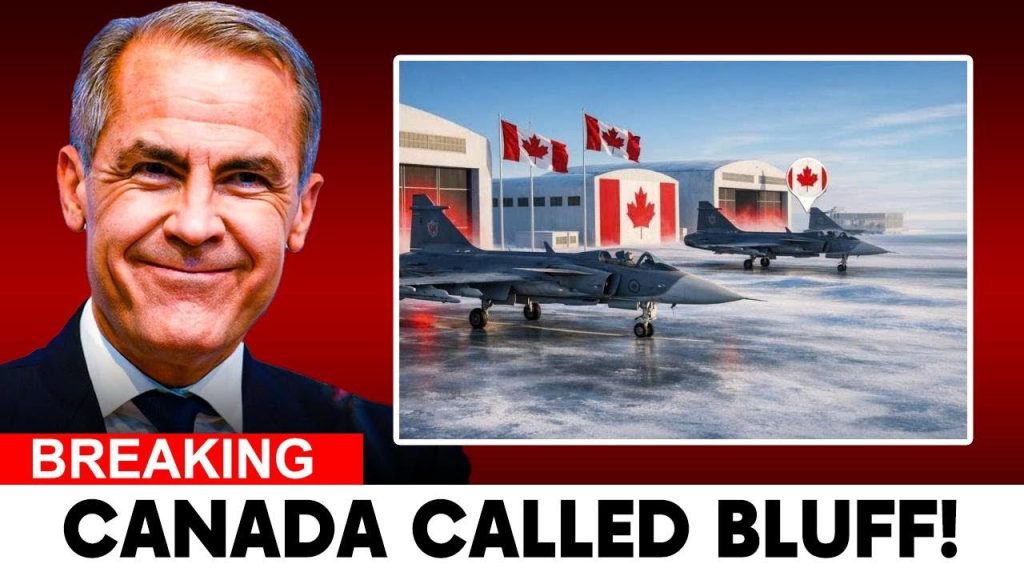
In recent months, Prime Minister Mark Carney’s government has begun openly re-examining its $33 billion commitment to acquire 88 F-35s, triggering unease inside the Pentagon and across the U.S. defense establishment. At the center of the reassessment is an unexpected revival of a rival aircraft: the Gripen E, produced by Sweden’s defense firm Saab.
The issue is not simply which jet Canada flies. It is who controls the future of Canada’s air force.
Canada formally selected the F-35 in 2023 after years of political debate and a competitive procurement process. The choice was presented as final. Deliveries were scheduled to begin in 2026, replacing the Royal Canadian Air Force’s aging CF-18 fleet. For Washington, the deal reinforced a familiar hierarchy: allies bought American systems, trained to American standards, and remained embedded in American-led command structures.
But as relations with the United States grew more strained under Donald Trump, defense procurement began to intersect with questions of sovereignty. Trump’s repeated threats of tariffs on Canadian goods and his remarks suggesting Canada could become the “51st state” shifted public attitudes. Defense policy, long insulated from political tensions, suddenly felt exposed.
That vulnerability was sharpened in mid-2025 when Canada’s auditor general revealed that the true cost of the F-35 program had been significantly understated. Once infrastructure upgrades, weapons systems, and operating expenses were included, the projected cost ballooned from $19 billion to as much as $33 billion over the aircraft’s lifetime. Parliament was left grappling with the realization that the most expensive military purchase in Canadian history also came with limited national control.
It was at that moment that Saab re-emerged.
The Swedish company offered Ottawa something Washington has historically resisted: full domestic assembly, deep technology transfer, and the ability for Canada to maintain and upgrade its aircraft without foreign permission. Saab pledged to build every Gripen E in Canada in partnership with Canadian firms, potentially creating more than 12,000 jobs across the aerospace sector.
The proposal reframed the debate. This was no longer just about stealth versus performance. It was about industrial strategy, economic resilience, and whether Canada was willing to remain dependent on a weapons system governed by software updates, source code, and permissions controlled in the United States.
That dependence lies at the heart of Washington’s concern. The F-35 is not a conventional fighter program. Its effectiveness relies on continuous software updates managed by the Pentagon’s Joint Program Office. Access to the aircraft’s source code — essential for independent modification — is denied to all buyers except Israel. In practice, this means that long-term operational autonomy rests in American hands.
Pentagon officials insist this arrangement ensures security and standardization. Canadian skeptics see something else: leverage.

Those anxieties are compounded by political memory. Trump has previously stated that weapons sold to allies would never match U.S. versions because “alliances can change.” In Ottawa, that remark lingers. While Lockheed Martin and the Pentagon deny the existence of any remote “kill switch,” the reality is more subtle. Without updates and approvals, a fifth-generation fighter can quickly lose its edge.
The alternative, however, is far from straightforward. Leaked evaluation documents from Canada’s 2021 fighter competition show the F-35 dramatically outscoring the Gripen E in mission effectiveness and upgrade potential. Senior Royal Canadian Air Force figures have warned that a mixed fleet — combining a small number of F-35s with Gripens — could dilute deterrence, especially in the Arctic, where Canada faces advanced Russian and Chinese capabilities.
There are also hidden dependencies in the Swedish option. The Gripen uses an American-made General Electric engine, meaning export licenses would still require U.S. approval. Complete independence, analysts note, is largely an illusion.
Yet the political signal matters. No NATO country has ever publicly reconsidered an F-35 purchase after signing on. Canada’s willingness to do so has sent shockwaves through Washington because it challenges an assumption that underpins U.S. defense influence: that once allies enter America’s weapons ecosystem, they do not leave.
For now, Ottawa is treading carefully. The government has confirmed it will accept delivery of the first 16 F-35s already in production while continuing talks with both Lockheed Martin and Saab. Officials describe the process as leverage, not rupture — an attempt to extract greater industrial benefits rather than abandon the program outright.
Still, the message has landed.
At a time when American leadership is increasingly questioned, Canada’s fighter jet recalculation reflects a broader shift among middle powers. Alliances remain vital, but dependence is being reassessed. Control, once ceded quietly for the sake of integration, is now a political issue.
Whether Canada ultimately stays the course or forces concessions, the episode has already changed the dynamic. What was once America’s untouchable flagship weapons program is now being negotiated — not on Washington’s terms alone, but on an ally’s demand for autonomy.






