Canada’s Quiet Rebellion: How Tariffs Meant to Force Obedience Opened a New Trade Corridor Across the Pacific

By the time Washington realized what was happening, the decision had already been made.
For months, the Trump administration had relied on a familiar playbook: tariffs, pressure, and public warnings meant to remind allies where economic gravity still lay. Canada, deeply integrated into the American economy and historically cautious in its trade posture, was widely assumed to have little room to maneuver. The logic in Washington was straightforward. Apply enough pressure, and Ottawa would fall back in line.
Instead, Canada walked through another door.
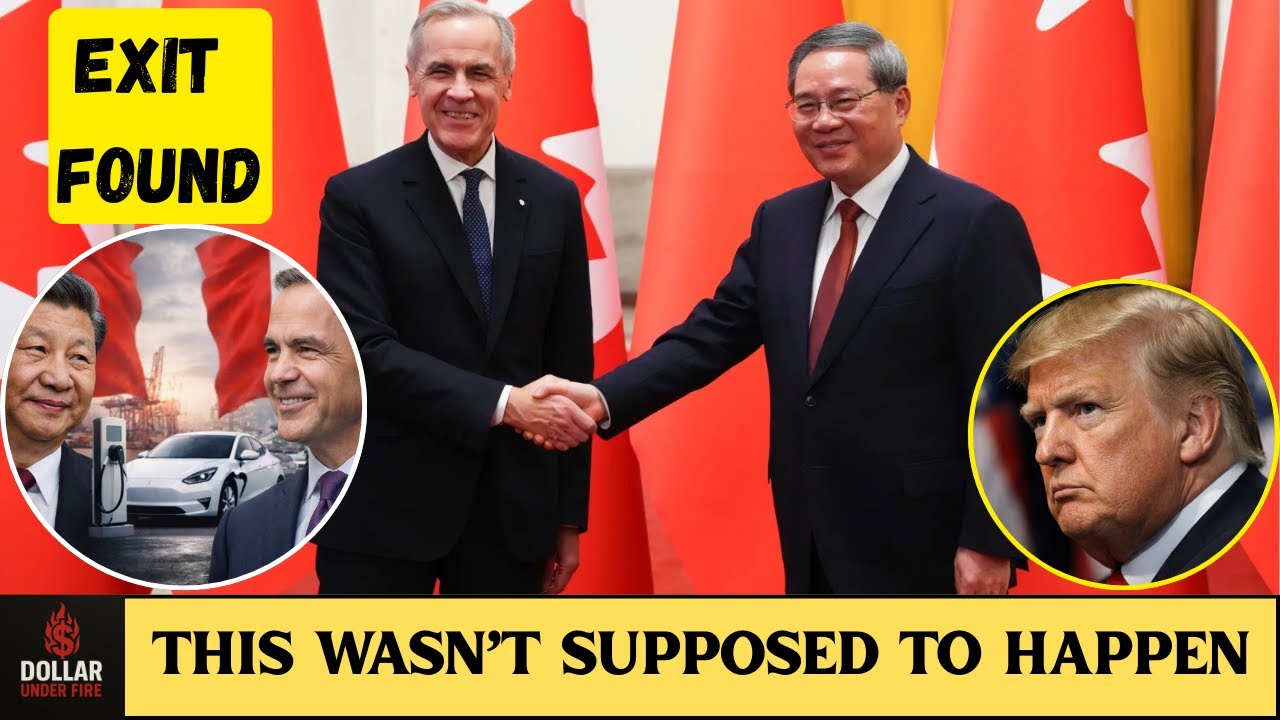
In January, as new tariff threats circulated in Washington, Canada’s prime minister stood beside China’s president in Beijing and announced what amounted to a trade reset few analysts thought possible so soon. It was not framed as a pivot away from the United States, nor as a grand geopolitical realignment. The language was measured, deliberate, almost clinical: partnership, predictability, mutual interest.
But the implications were anything but modest.
Within hours, the symbolism gave way to substance. Tariffs that had frozen billions of dollars in trade were rolled back. Agricultural markets long sealed were reopened. A tightly controlled but meaningful pathway for Chinese electric vehicles into Canada was established. And buried beneath the headline announcements was a longer-term bet: direct investment in Canadian manufacturing that could reshape supply chains across North America.
This was not a protest. It was an adaptation.
Pressure Without an Exit
For years, Canada had balanced carefully between its largest trading partner and a global economy that was steadily fragmenting. The United States accounted for roughly three-quarters of Canadian exports, a level of dependence that made diversification more aspiration than policy. Even when relations with China deteriorated in the late 2010s, Ottawa moved cautiously, wary of triggering retaliation from either side.
That caution began to erode as trade policy in Washington grew more unpredictable.
Tariffs were announced and adjusted with little warning. Exemptions appeared and disappeared. Threats of escalation became routine. For Canadian policymakers and business leaders, the problem was not disagreement, but uncertainty. Supply chains cannot pivot on tweets. Investment decisions cannot hinge on election cycles.
As one senior Canadian official put it privately, the question was no longer how to defend existing access, but how to reduce exposure to sudden loss.
Matching U.S. tariffs was never a viable strategy. Canada’s economy is simply too intertwined to absorb that kind of shock without severe self-inflicted damage. The alternative was not retaliation, but escape: expanding the map rather than fighting inside a shrinking box.
A Door Reopens
The Beijing meeting marked the first top-level engagement between Canada and China in nearly a decade. Its timing was unmistakable. Just days after fresh tariff warnings from Washington, Canada chose the world’s largest non-U.S. stage to signal that it still had options.
The language mattered. There was no talk of alignment or friendship. Differences were acknowledged openly. Cooperation was defined narrowly. But cooperation was pursued nonetheless.
Then came the economic terms.
On the Canadian side, tariffs on Chinese electric vehicles were reduced from triple-digit levels to a standard rate, under a strict quota that limits volume and minimizes disruption to domestic producers. On the Chinese side, punitive duties on Canadian agricultural exports — including canola, peas, pork, and seafood — were slashed or removed entirely.
For farmers and exporters, the change was immediate. Contracts could restart. Ships could move. Storage facilities that had been filling with unsold product suddenly had an outlet again.
“This wasn’t about politics,” said one agricultural exporter in Western Canada. “It was about oxygen.”
The EV Calculus
The electric vehicle provision drew the most attention, and the most criticism. Skeptics warned of foreign competition and long-term dependency. Supporters pointed to a reality few governments like to admit: electric vehicles remain too expensive for mass adoption.
Under the agreement, a significant share of incoming vehicles must meet affordability thresholds. The goal is not market domination, but market entry — lowering prices enough to accelerate adoption without overwhelming domestic manufacturers.
More important, Canadian officials emphasized, was what comes next. Chinese automakers committed to investing directly in Canada, not just selling into it. That distinction changes the political and economic calculus entirely.
Importing vehicles invites backlash. Building them locally creates jobs, anchors supply chains, and transforms trade access into leverage.
The incentives are clear. With the U.S. market effectively closed to Chinese EVs, Canada offers stability, skilled labor, and an existing automotive ecosystem. For Beijing, it is a foothold. For Ottawa, it is an opportunity to convert short-term imports into long-term industrial capacity.
Agriculture and Relief
If electric vehicles symbolized the future, agriculture represented the present crisis.
Years of trade barriers had devastated Canadian producers, particularly in regions where farming is not just an industry but the backbone of local economies. Canola exports collapsed. Storage filled. Prices fell. Entire supply chains seized up.
The tariff rollbacks did not solve every problem. Processed oil remains restricted, though workarounds have kept some supply moving. But the bleeding stopped. For many producers, that alone was transformative.
“No one thinks this is a fairy tale,” said one farm cooperative manager. “But it’s functional. And right now, functionality is everything.”
Predictability as Power
The most consequential moment may have come not in the agreements themselves, but in how Canada described them.

When the prime minister said China had become a more predictable economic partner than the United States, the statement landed like a diplomatic shockwave. Not because it praised Beijing, but because it quietly criticized Washington where it hurts most.
Predictability is not about values. It is about rules. About knowing tariffs will not appear overnight. About trusting agreements will be honored long enough to justify investment measured in decades.
The contrast was stark. On one side: defined quotas, multi-year horizons, formal negotiations. On the other: sudden threats, shifting demands, and uncertainty that makes long-term planning nearly impossible.
Allies noticed.
Across Europe and Asia, policymakers were already grappling with the same dilemma. How do you plan economic futures when trade rules can change without warning? Canada’s move did not create that anxiety, but it offered a visible response: diversify, hedge, build exits.
South Korea recalibrated its China policy. European leaders openly questioned permanent confrontation. Japan emphasized risk-spreading. Mexico accelerated diversification beyond a single market.
None of this signaled abandonment of the U.S. alliance system. It signaled adaptation.
An Unintended Outcome
The irony is difficult to ignore.
The tariffs were meant to narrow choices. Instead, they expanded them. Pressure designed to enforce compliance accelerated diversification. Threats intended to isolate competitors helped legitimize alternatives.
Canada did not rewrite the global order. But it exposed a truth many governments already sensed: in a fragmented global economy, resilience matters more than tradition.
Power no longer comes only from size or force. It comes from being predictable.
And when predictability disappears, even the closest partners start looking for another door.






