Canada Reconsiders Its Fighter Jet Future, Reopening a Deal Once Thought Settled

For nearly two decades, Canada’s path toward acquiring a new generation of fighter jets has been marked by controversy, political reversals and ballooning costs. Now, after formally committing to the United States’ flagship F-35 program, Ottawa is once again reopening a decision many assumed was final — a move that has startled allies, unsettled defense planners and reignited a national debate over sovereignty, cost and strategic autonomy.
At the center of the renewed discussion is Saab, the Swedish defense firm behind the Gripen E fighter jet, which has publicly offered Canada a sweeping industrial partnership: full domestic assembly, technology transfer, and the creation of up to 10,000 manufacturing and research jobs. The proposal arrives at a moment when Canada’s $27.7-billion agreement to purchase 88 F-35A Lightning II aircraft from Lockheed Martin is under unprecedented scrutiny.
In March 2025, Canada’s Minister of National Defence confirmed that the government was actively reviewing the F-35 contract — a statement that sent shock waves through NATO capitals and defense markets alike. No NATO country has ever gone this far after formally joining the F-35 program, the most expensive and strategically sensitive weapons platform in modern history.
A Deal That Grew Far Larger Than Advertised
When the current agreement was finalized in 2023, Canadian officials described it as the culmination of the Future Fighter Capability Project, a competition that followed years of reassessment and delay. The original price tag was estimated at roughly $19 billion. By mid-2025, that figure had climbed to $27.7 billion, according to a report by Auditor General Karen Hogan — with lifecycle costs projected to approach $33 billion once infrastructure upgrades, weapons integration and long-term sustainment were included.
The scale of the increase reignited long-standing concerns that the F-35’s true costs had been understated from the outset. Critics in Parliament and among defense economists argued that Canada had once again committed to a massive procurement before fully grasping its long-term fiscal and strategic implications.
Those concerns have gained traction amid broader political turbulence. Trade relations between Canada and the United States deteriorated sharply during President Donald Trump’s second term, as threats of sweeping tariffs on Canadian exports — and remarks questioning Canada’s sovereignty — unsettled public opinion north of the border. Defense policy, long treated as a technical domain insulated from politics, became entwined with questions of economic dependence and national dignity.
Saab’s Return and the Appeal of Autonomy
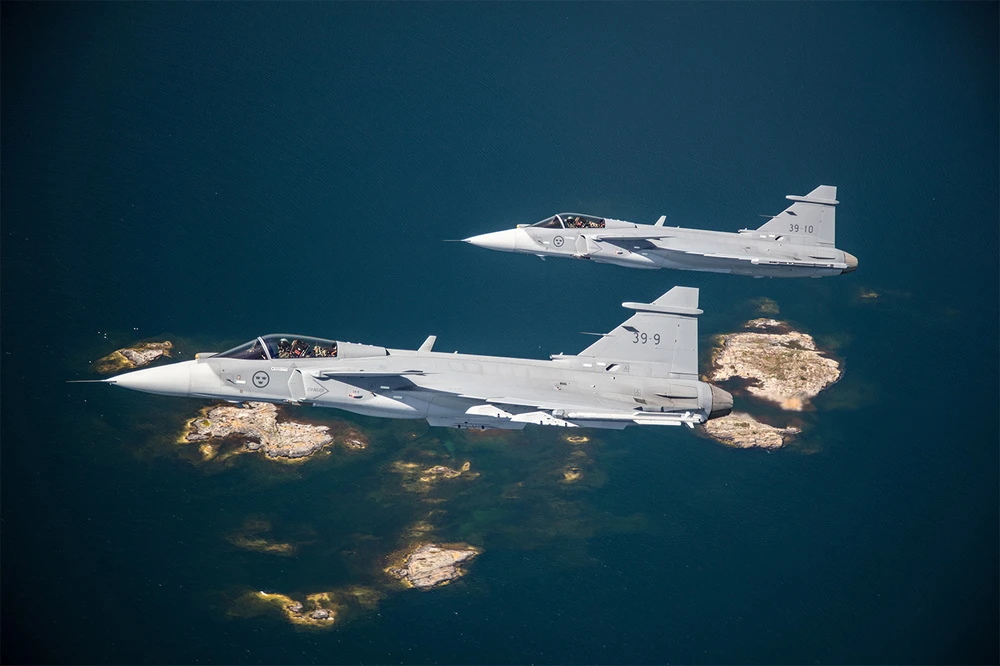
Saab’s Gripen E had lost to the F-35 in the 2021 competition, but the company never fully disengaged from Canada. Behind the scenes, Swedish officials and defense executives maintained dialogue with Ottawa. Those contacts became more visible in August 2025, when Canada and Sweden signed a framework agreement on defense and aerospace cooperation, with a particular focus on Arctic security.
The timing was notable. As Russia and China expand their activity in the Arctic, Canada has placed renewed emphasis on defending its northern approaches — a domain Saab argues plays to the Gripen’s strengths. Designed for operation from short runways in harsh Nordic climates, the aircraft has been marketed as well suited to Canada’s geography.
More significantly, Saab has framed its proposal not merely as an aircraft sale, but as an industrial strategy. The company has pledged to assemble the fleet in Canada, transfer technology rights and allow Canadian engineers to independently maintain and upgrade the aircraft without external approval. Saab estimates that the program could generate between 12,000 and 12,600 jobs across the country’s aerospace sector.
Industry Minister Mélanie Joly has said publicly that Canada must demand greater domestic benefits from its defense spending — remarks widely interpreted as a signal that alternatives to the F-35 are being taken seriously.
The Capability Gap
Yet the technical debate remains stark. In December 2025, leaked internal assessments from the 2021 competition, reported by the Canadian Broadcasting Corporation, revealed how decisively the F-35 outperformed its rivals. On a 60-point scale, the F-35 scored 57.1, while the Gripen E received 19.8. In mission effectiveness, the F-35 was rated at 97 percent, compared with 22 percent for the Gripen. Lifetime upgrade potential showed an even wider gap.
Former senior commanders of the Royal Canadian Air Force have warned that these disparities are not academic. Retired Lieutenant General Yvan Blondin and Major General Chris McKenna have both argued publicly that pilot survivability and deterrence depend on maintaining clear technological overmatch — particularly in scenarios involving advanced Russian or Chinese systems.
A compromise option, discussed within policy circles, would see Canada accept the first 16 F-35s already under contract while filling out the rest of the fleet with Gripens. Critics argue that such a mixed force could complicate logistics, training and command integration, while delivering neither full stealth capability nor full autonomy.
Dependence, Real and Perceived
Much of the public debate has centered on concerns over dependence on the United States. The F-35’s software updates, maintenance systems and upgrade pathways are controlled by the Pentagon’s Joint Program Office, and access to the aircraft’s source code is tightly restricted. Only Israel enjoys partial exceptions.
Although Lockheed Martin and U.S. officials have repeatedly denied the existence of any “kill switch,” analysts note that delayed updates or restricted access could degrade operational effectiveness over time. President Trump himself has publicly stated that aircraft sold to allies would never be equivalent to U.S. versions.
Yet the Gripen option is not free of U.S. leverage either. The aircraft relies on the General Electric F414 engine, meaning export approvals would still require Washington’s consent — a point frequently raised by defense analysts in the United States and Europe.
Industrial Risks and Alliance Politics

Canadian industry leaders have also urged caution. Bombardier’s chief executive has warned that a withdrawal from the F-35 program could jeopardize existing U.S. defense contracts held by Canadian firms, potentially affecting dozens of suppliers integrated into American military supply chains.
From Washington’s perspective, Canada’s deliberations are being watched closely. The F-35 is not merely a weapons system; it is the backbone of allied air power integration. Any move away from the program would carry symbolic weight at a time when NATO unity is under strain.
An Unsettled Choice
As of January 2026, Prime Minister Mark Carney’s government has not made a final decision. Officials have confirmed that Canada will take delivery of the first 16 F-35s scheduled for early 2026, while negotiations with Lockheed Martin continue over costs and industrial benefits. Talks with Saab and European partners are proceeding in parallel.
What began as a procurement decision has evolved into a defining question of Canadian strategy: how a middle power balances alliance commitments, fiscal reality and the desire for greater control over its own defense capabilities in an increasingly volatile world.
The answer, whatever it may be, will shape Canada’s air force — and its place in the transatlantic security architecture — for decades to come.






