Canada Draws a Line as Trump Escalates Pressure Over Greenland
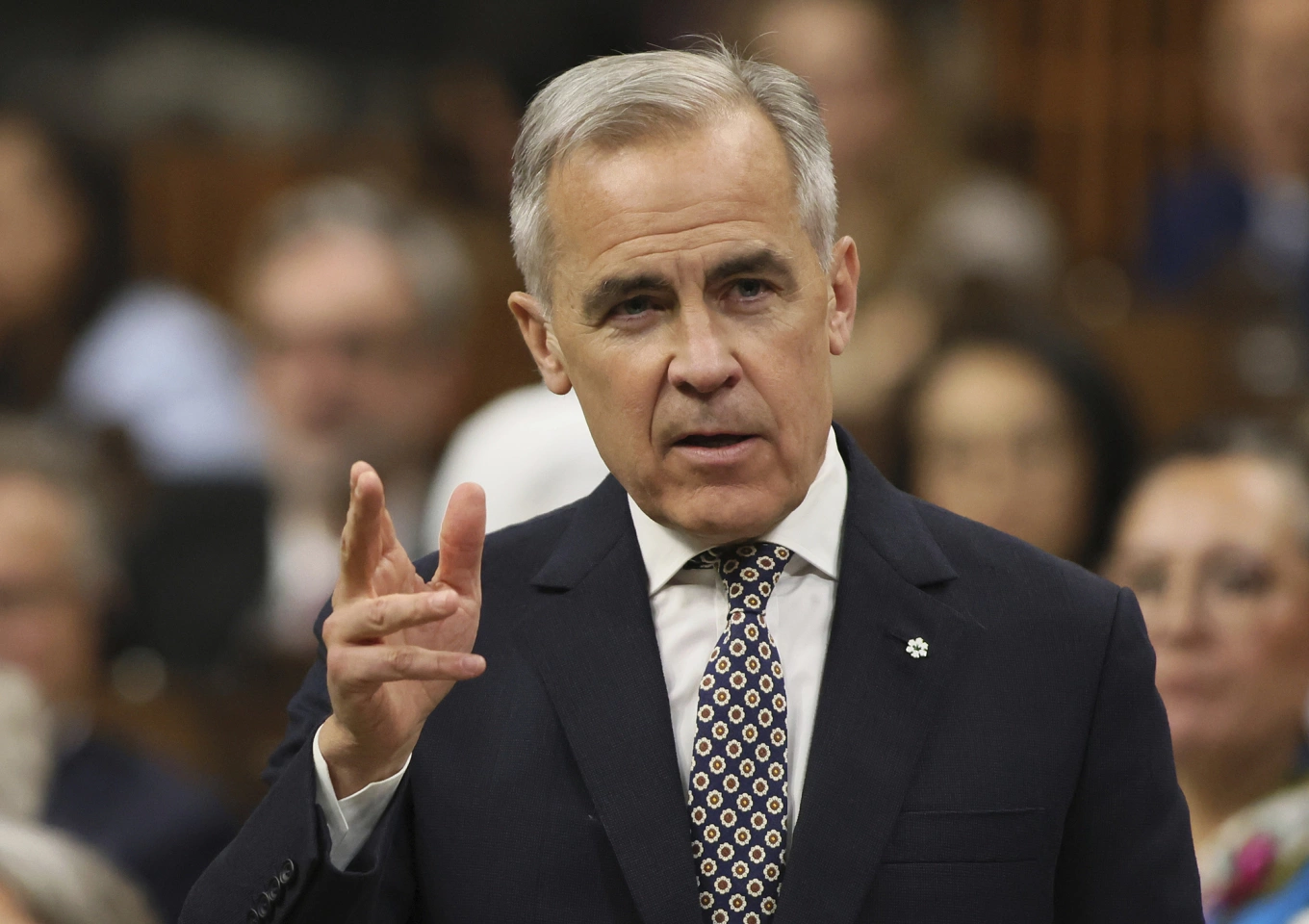
From a stage in Qatar, far from Washington and even farther from the Arctic ice of Greenland, Canada’s prime minister delivered one of the most consequential foreign policy statements of his tenure.
Mark Carney did not raise his voice. He did not attack Donald Trump by name. But when asked about the former U.S. president’s renewed threats to impose sweeping tariffs on European allies unless they support the sale of Greenland to the United States, Carney used a word that landed with unmistakable force in diplomatic circles: “escalation.”
In the careful language of statecraft, escalation is not a synonym for disagreement. It is a warning. It signals that pressure has crossed into provocation, that tactics once tolerated are now considered destabilizing. And in applying it publicly to Trump’s Greenland threats, Carney made clear that Canada no longer views such behavior as rhetorical theater. It sees it as a strategic risk.
The remark reverberated quickly. Within hours, European officials were circulating clips of Carney’s comments. NATO analysts on X called the statement “a turning point.” Former U.S. diplomats, speaking on CNN and MSNBC, noted that Canada had gone further than most American allies had dared to go publicly.
This was not casual criticism. It was alignment.
A Threat That Crossed a Line
Donald Trump’s fixation on Greenland is not new. During his presidency, he floated the idea of purchasing the Arctic territory from Denmark, prompting widespread ridicule and a firm rejection from Copenhagen. What is new — and what alarmed European capitals — is Trump’s latest framing.
According to reporting by Politico and Bloomberg, Trump has privately and publicly suggested that if Denmark and several European allies refuse to entertain negotiations over Greenland’s status, they could face punitive tariffs beginning at 10 percent and escalating to 25 percent by June. The targets reportedly include not just Denmark, but as many as seven NATO countries.
Economic punishment, in other words, as leverage to force a territorial outcome.
“This is not diplomacy,” one former State Department official wrote on X. “It’s coercion — and allies are treating it as such.”
Carney did not dispute that characterization. Instead, he placed Canada firmly on the side of sovereignty.
“The future of Greenland,” he said, “is for Greenland and Denmark to decide.”
That sentence alone amounted to a direct rejection of Trump’s logic: no borders for sale, no deals under duress, no economic blackmail disguised as negotiation.
Canada Steps Out of the Middle

For decades, Canada has walked a careful line between its European partners and its powerful southern neighbor. Even during periods of tension — over trade, defense spending, or climate policy — Ottawa has often chosen quiet diplomacy over public confrontation.
That posture has now changed.
Carney went further than many expected, explicitly linking Greenland to a broader global pattern of threats to territorial integrity. He cited Ukraine as a prominent example, a comparison that several European diplomats privately described as “intentional and sobering.”
He also confirmed that Canada has already been coordinating with European and Nordic partners, NATO leadership, and Greenland’s prime minister on security matters. While he emphasized that Greenland’s security remains primarily the responsibility of Denmark and Greenland itself, the implication was unmistakable: this is a NATO issue, not a bilateral bargaining chip.
On U.S. cable news, the reaction was swift. A former Pentagon official told MSNBC that Canada’s position “raises the political cost for Washington if Trump follows through.” A CNN panelist noted that once an ally publicly frames a threat as escalation, “it’s no longer just noise — it becomes something that demands response.”
Backed by Capital, Not Just Words
What gives Carney’s stance unusual weight is not only what he said, but where he said it and what followed.
On the same day he addressed Trump’s Greenland threats, Carney confirmed that Qatar had committed to strategic investments in Canada’s nation-building projects, spanning infrastructure, energy, advanced technology, and defense cooperation. These are not symbolic memoranda. Qatar’s sovereign wealth apparatus is among the most powerful sources of global capital, known for long-term, politically consequential investments.
Just days earlier, Carney had returned from Beijing, where Canada and China announced a partial trade reset that lowered tariffs on electric vehicles and agricultural exports. European leaders, meanwhile, have been openly coordinating responses to Trump’s rhetoric, with countries like France, Norway, and Sweden sending limited troop deployments to Greenland in what analysts describe as “symbolic deterrence.”
Taken together, these moves suggest a deliberate strategy.
Canada is not simply reacting to Trump. It is diversifying its economic and strategic dependencies — aligning with Europe on sovereignty, with China on trade, and with Gulf states on capital and infrastructure. In Carney’s words, Canada and Qatar are now “strategic partners.”
That phrase matters. Strategic partners plan around instability. They do not flinch when tariffs are threatened. They build alternatives.
Why This Unsettles Washington
Trump has long relied on bilateral pressure: one country at a time, one threat at a time. What Carney is building instead is multilateral gravity — a network of aligned partners that reduces the effectiveness of unilateral coercion.
That shift has not gone unnoticed in Washington.
A senior Republican strategist told Axios that Canada’s posture is “more dangerous politically than open hostility,” because it signals independence rather than opposition. “Trump knows how to fight critics,” the strategist said. “He struggles with irrelevance.”
On social media, conservative commentators dismissed the tariff threats as bluff — invoking the now-common refrain that “Trump always chickens out.” But European officials are not betting on that assumption. Neither, it appears, is Canada.
A Line That Cannot Be Undrawn
Whether Trump ultimately follows through on his Greenland tariff threats remains uncertain. History suggests he often escalates rhetorically before retreating. But something has already changed.
By calling Trump’s actions an escalation, Carney has reframed the debate. Silence, in geopolitics, is permission. Ambiguity is tolerance. Canada has offered neither.
This was not a dramatic speech. It was not an ultimatum. It was something more consequential: a clear statement of limits, delivered calmly, and backed by alliances and capital.
As the World Economic Forum convenes in Davos, and as NATO leaders quietly reassess the stability of the transatlantic relationship, Carney’s words will linger.
Canada is no longer pretending this is normal.
And that may be the line Donald Trump did not expect anyone to draw.






