A Moment of Visible Resistance on Capitol Hill

In Washington, moments of internal party resistance are often muted, handled behind closed doors or softened through carefully chosen language. This week, however, the tension surrounding D.O.N.A.L.D T.R.U.M.P spilled into public view. What had been promoted by allies as a strategic assertion of leadership instead encountered a wall of skepticism from lawmakers in his own party, particularly in the Senate. The result was not a dramatic rupture, but something arguably more damaging: a slow, unmistakable display of limits.
For a political figure long associated with commanding loyalty through pressure and spectacle, the shift was notable. Senators who once avoided public disagreement began speaking in measured but unmistakably firm terms, signaling that the proposal at the center of the controversy had little institutional support. The episode exposed a widening gap between rhetorical dominance and legislative reality.
Republican Senators Signal Discomfort
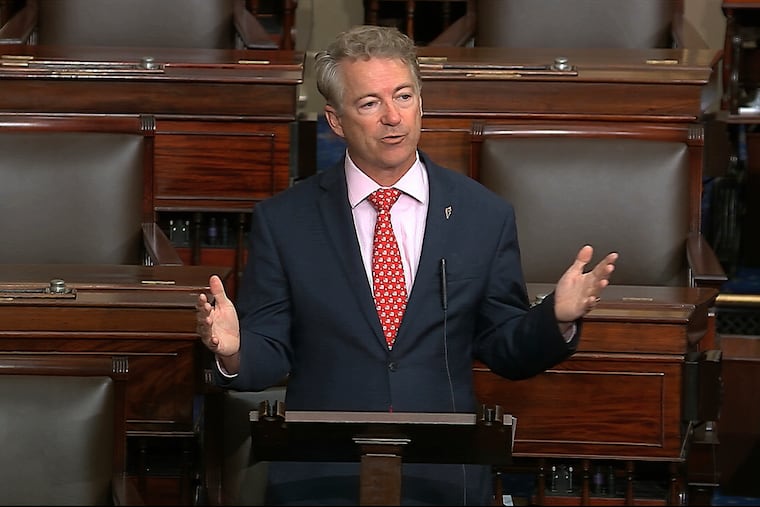
Several Republican senators made clear that the plan being discussed — framed by its backers as strategic and forward-looking — was not gaining traction. Rand Paul was among the most direct, suggesting that there was no meaningful appetite in the Senate to advance such an idea. His remarks, delivered calmly, carried weight precisely because they lacked theatricality.
Others followed a similar script. Even lawmakers known for hawkish positions avoided full endorsement, choosing instead to emphasize constitutional process, political feasibility, or geopolitical caution. The cumulative effect was difficult to ignore: this was not an isolated disagreement but a pattern of restraint emerging across the chamber.
The House Tries to Deflect
In the House, leadership attempted to project calm. Mike Johnson dismissed suggestions of escalation, characterizing the controversy as media exaggeration and historical misinterpretation. He pointed to past administrations that had acknowledged strategic interests in the Arctic, urging observers not to overread the current moment.
Yet such reassurances struggled to contain the narrative. The contrast between the House’s rhetorical containment and the Senate’s visible reluctance only sharpened the sense that something had shifted. Analysts noted that when leaders focus on denying the scale of a controversy rather than defending its merits, it often signals internal concern rather than confidence.
Loyalty Tested — and Retracted
The most telling development came not from policy debate but from political retaliation. After years of attempting to rebuild favor following earlier disagreements, Bill Cassidy found himself abruptly sidelined. The endorsement of a primary challenger was widely interpreted as a message: loyalty is expected, but never guaranteed in return.
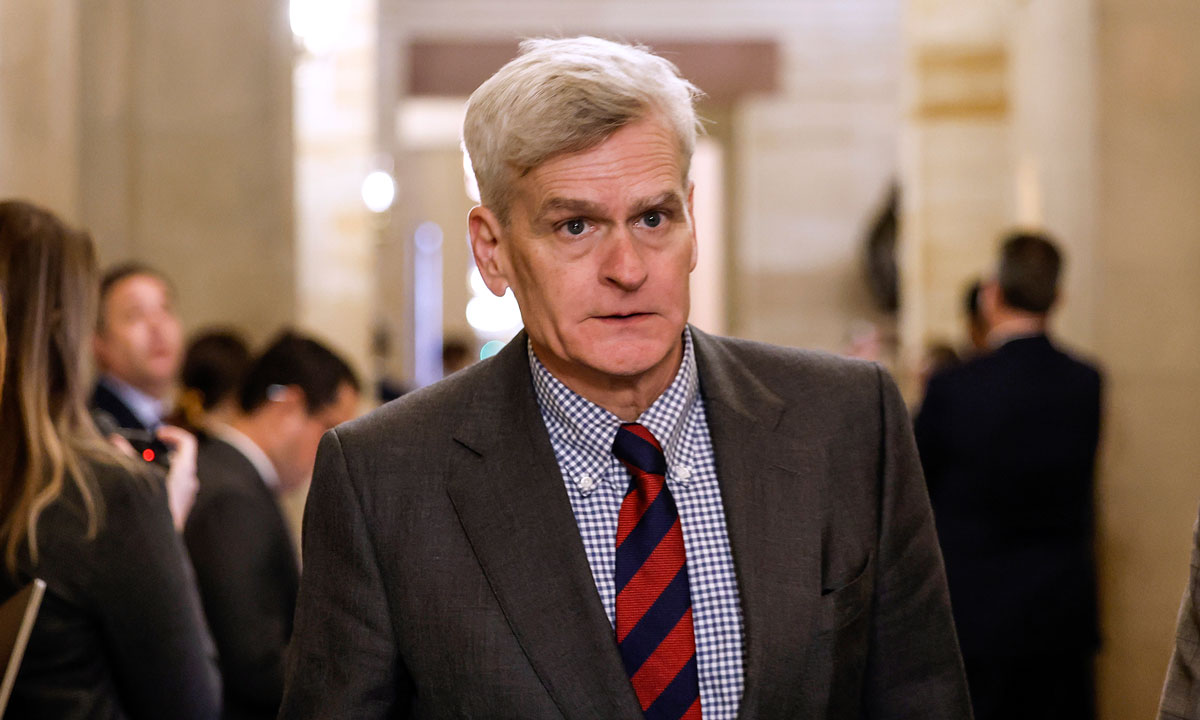
For observers of American politics, the move was familiar yet revealing. It reinforced a long-standing perception that allegiance within this political orbit is transactional and fragile. As one strategist remarked privately, “The lesson isn’t about policy — it’s about power, and who decides when loyalty still counts.”
Symbolism Over Substance
While the immediate policy implications remain uncertain, the symbolic impact is already resonating. Senators opposing the initiative have framed their resistance not as defiance, but as institutional responsibility. In doing so, they repositioned themselves as guardians of process rather than rebels, a distinction that complicates efforts to portray dissent as disloyalty.
Political analysts suggest this moment may recalibrate internal dynamics. Public resistance, even when limited in scope, can embolden others who share similar doubts but fear isolation. The Senate’s posture sends a subtle signal that collective hesitation can dilute individual risk.

A Narrative in Flux
For D.O.N.A.L.D T.R.U.M.P, the episode underscores a recurring challenge: transforming personal influence into durable institutional support. The optics of resistance — senators speaking openly, leadership deflecting, allies losing favor — have begun to reshape the broader narrative around authority and control.
This does not mark an endpoint. Power in Washington is rarely lost in a single moment. Yet the scene unfolding on Capitol Hill suggests a recalibration is underway, one defined less by spectacle and more by quiet, collective limits. In a city attuned to symbols, that may prove to be the most consequential message of all.






