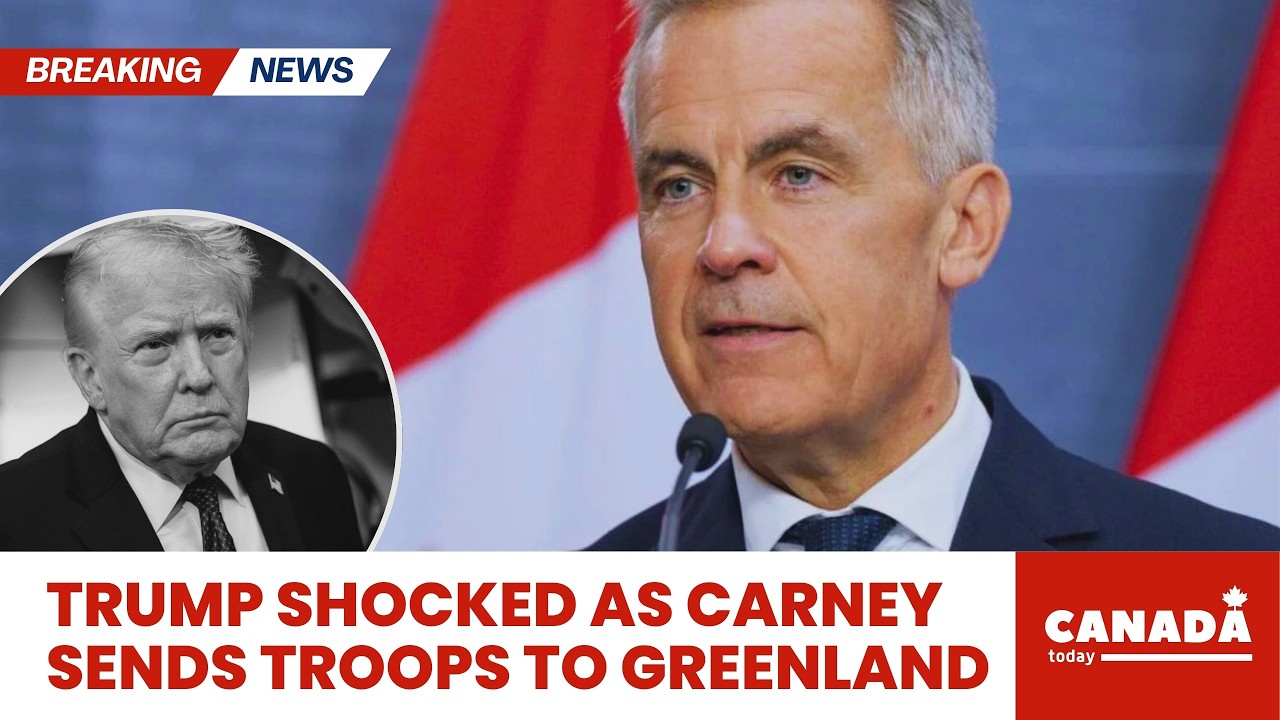
In a stunning political rupture that has sent shockwaves across the Atlantic, Prime Minister Mark Carney has thrust Canada into the heart of an explosive geopolitical showdown by fast-tracking the deployment of Canadian troops to Greenland — a move that directly confronts U.S. President Donald Trump’s aggressive campaign to seize control of the strategically vital Arctic island. Overnight, what began as heated rhetoric has escalated into a full-blown NATO solidarity crisis, with Carney defying American coercion through bold military signaling and unyielding defense of sovereignty.
The drama unfolded rapidly in mid-January 2026, as Trump revived and intensified his long-standing fixation on acquiring Greenland, framing it as essential for U.S. national security amid rising Arctic competition from Russia and China. He threatened escalating tariffs — starting at 10% and climbing — on Denmark and seven other European NATO allies, including Germany, France, the UK, Norway, Sweden, the Netherlands, and Finland, unless they yielded to American demands for “complete and total” purchase or control of the vast, mineral-rich territory. Denmark, which has governed Greenland for centuries as a semi-autonomous part of the Kingdom, firmly rejected the overtures, insisting that Greenland’s future belongs solely to its people and Copenhagen.
In response, European NATO partners mobilized swiftly under Denmark’s leadership, launching Operation Arctic Endurance — a series of joint military exercises designed to bolster sovereignty protections and demonstrate unified deterrence. France, Germany, Sweden, Norway, and others dispatched scouting teams and small contingents to Nuuk and other key sites, emphasizing that Arctic security remains a shared transatlantic responsibility, not a unilateral American prerogative. Trump branded these deployments as provocative, vowing retaliatory economic measures that could disrupt billions in trade and fracture alliance cohesion.

Enter Carney, the former Bank of England governor turned Canadian prime minister, who has emerged as one of the most outspoken Western leaders willing to challenge Trump’s tactics head-on. Senior Canadian officials confirmed that Carney is weighing — and appears poised to approve — the deployment of a small but symbolically potent group of Canadian Armed Forces personnel to join the NATO-aligned exercises in Greenland. This would build on Canada’s existing presence, including CF-18 fighter jets and a Cormorant helicopter already participating in a pre-planned NORAD operation in the region. The additional troops, potentially arriving within days if final political clearance is granted, would signal Ottawa’s unwavering commitment to Article 5 collective defense and territorial integrity.
Carney’s stance has been unequivocal. In press conferences from Beijing to Doha, he condemned Trump’s approach as “escalation” rather than negotiation, linking it to broader threats against sovereignty seen in Ukraine and elsewhere. “We always will support sovereignty and territorial integrity of countries, wherever their geographic location is,” Carney declared, framing the Greenland dispute as a test of whether rules-based international order can withstand coercive pressure. By aligning visibly with Denmark and rallying NATO partners, Canada positions itself as a stabilizing force against what critics call American bullying — a narrative that has resonated in European capitals and drawn praise from figures like Ursula von der Leyen, who reaffirmed EU solidarity with Denmark.

The stakes could not be higher. Greenland’s strategic value lies in its control over emerging Arctic shipping routes, vast untapped rare-earth minerals, and critical positioning for monitoring northern threats. A U.S. takeover, even through economic leverage, risks shattering NATO unity: if one ally coerces another without consequence, the alliance’s credibility collapses, potentially emboldening revisionist powers. Carney’s calculated defiance — backed by diversified trade ties secured in recent diplomatic forays to China and Qatar — ensures Canada can absorb potential U.S. retaliation without immediate economic panic.
Yet the crisis remains fluid. With Carney set to address the World Economic Forum in Davos alongside Trump, behind-the-scenes coordination among allies could either de-escalate tensions or harden positions. European leaders have warned that tariff threats undermine transatlantic trust and invite a “dangerous downward spiral.” For now, Carney’s troop deployment plan stands as a powerful rebuke, elevating Canada’s role on the global stage while isolating Trump’s unilateralism.
This high-stakes confrontation underscores a deeper fracture in the post-Cold War order: the clash between traditional alliance commitments and resurgent great-power assertiveness. As Canadian forces prepare to stand shoulder-to-shoulder with European partners on Greenland’s icy shores, the world watches to see whether deterrence holds — or if economic coercion prevails over collective security. The Arctic, once a frozen periphery, has become the frontline of a new era of geopolitical tension.






