Mitch McConnell’s Complicated War With Donald Trump Enters a New Phase
As the longtime Republican leader prepares to step aside, his latest speech revealed both resistance to Donald Trump’s worldview—and the deep contradictions of his own legacy.
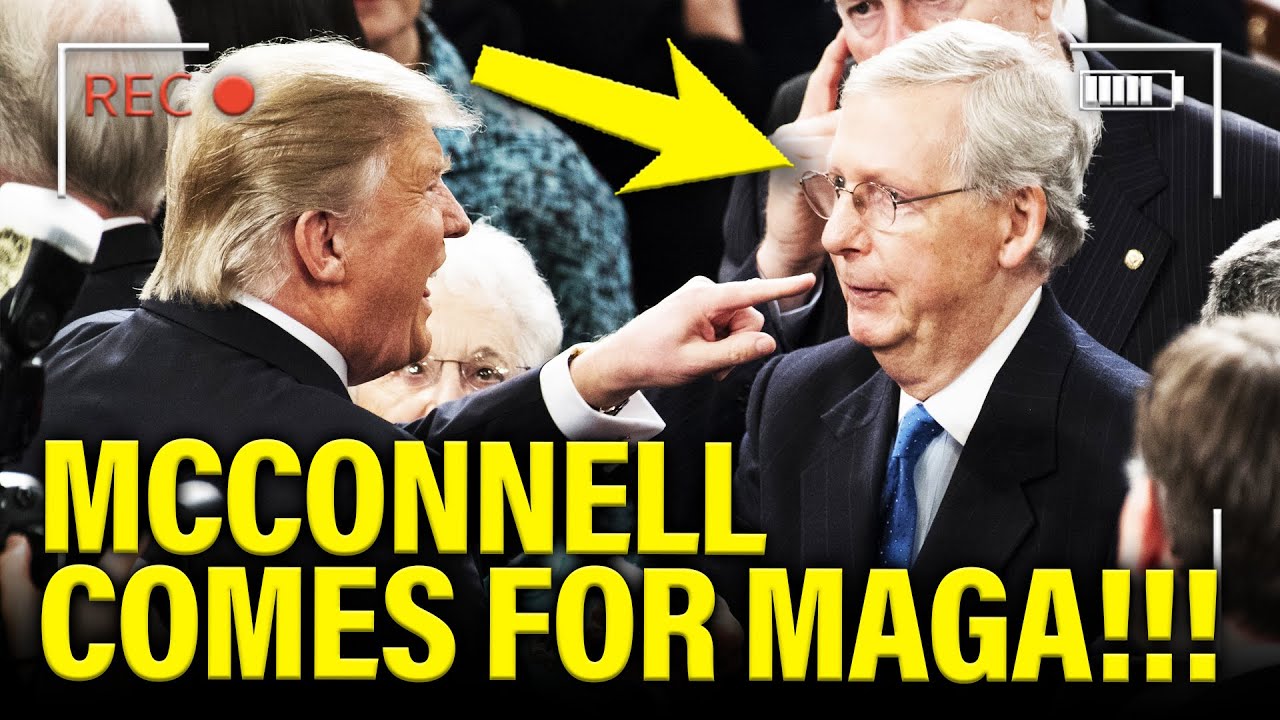
The long, uneasy relationship between outgoing Senate Republican leader Mitch McConnell and former President Donald Trump has never fit neatly into the categories of loyalty or opposition. It has instead existed in a tense middle ground—marked by personal disdain, political convenience, and moments of sharp hypocrisy.
That dynamic was on display once again this week when McConnell delivered a speech at the Ronald Reagan Presidential Library that many observers interpreted as a pointed rebuke of Trump’s isolationist foreign policy, even though the former president was never mentioned by name.
Speaking at the annual Reagan National Defense Forum, McConnell invoked the legacy of Ronald Reagan and warned that influential voices within the Republican Party were abandoning America’s role as a global leader. “It is increasingly fashionable to suggest that the sort of global leadership he modeled is no longer America’s place,” McConnell said, referring to Reagan. Then came the unmistakable line: “America will not be made great again by those who are content to manage our decline.”
The phrase was a thinly veiled paraphrase of Trump’s signature campaign slogan—and a clear shot at the former president’s worldview.

A Familiar Pattern: Criticism Without Consequences
McConnell’s remarks were greeted with a standing ovation from a room full of traditional, defense-oriented Republicans. But they also highlighted the paradox that has defined his relationship with Trump for nearly a decade.
McConnell has never hidden his personal distaste for Trump. Their animosity intensified after Trump repeatedly attacked McConnell’s wife, Elaine Chao, using racially charged language during his presidency. The attacks were widely condemned, including by some Republicans, but McConnell largely stayed silent.
Yet when it mattered most—when Trump faced impeachment after January 6, 2021—McConnell ultimately chose party unity over accountability.
At the time, Trump had already left office. Conviction in the Senate would have required only a handful of additional Republican votes and would have barred Trump from holding future federal office. McConnell voted to acquit, arguing that the Senate lacked jurisdiction over a former president and suggesting instead that the Justice Department should handle any criminal accountability.
That referral never materialized into meaningful support from McConnell. And Trump remained politically viable.
The episode cemented McConnell’s reputation as a leader willing to criticize Trump rhetorically while protecting him institutionally.
Foreign Policy as the Latest Fault Line
McConnell’s Reagan Library speech suggested that foreign policy—particularly Trump’s skepticism toward NATO and support for pulling back from Ukraine—may be the next battleground between Trump and the party’s old guard.
“At both ends of our politics, a dangerous fiction is taking hold that America’s primacy and the fruits of our leadership are self-sustaining,” McConnell warned. He emphasized the importance of alliances in NATO and the Indo-Pacific, pushing back against voices that question America’s central role in global security.
The subtext was clear. Trump has repeatedly criticized NATO, suggested the U.S. might not defend allies who fail to meet spending targets, and has spoken admiringly of authoritarian leaders such as Vladimir Putin. Those positions stand in direct contrast to the hawkish, alliance-based worldview McConnell has championed for decades.
Whether McConnell—or any Republican leader—will meaningfully oppose Trump on these issues remains an open question. As the old political adage goes: Democrats fall in love; Republicans fall in line.
A Judiciary Dispute Exposes Deep Hypocrisy
McConnell’s credibility took another hit this month when he sharply criticized two Democratic-appointed federal judges who reversed earlier plans to retire after Trump’s re-election victory.
The judges, concerned that their successors would be appointed by Trump, chose to remain on the bench rather than take senior status. McConnell condemned the decision as “open partisanship,” arguing that it undermined the integrity of the judiciary and warranted scrutiny by the incoming administration.
“It’s hard to conclude that this is anything other than open partisanship,” McConnell said on the Senate floor, accusing the judges of placing a “political finger on the scale.”
The criticism landed with a thud.
McConnell is, after all, the architect of the modern politicized judiciary. In 2016, after the death of Supreme Court Justice Antonin Scalia, McConnell refused to allow President Barack Obama to nominate a replacement, arguing that the decision should be left to voters in the upcoming election. The nominee, Merrick Garland, was widely viewed as a moderate and had bipartisan support.
Four years later, when Justice Ruth Bader Ginsburg died just weeks before the 2020 election, McConnell abandoned that principle entirely, rushing Amy Coney Barrett’s confirmation through the Senate in record time.
The rule, it turned out, applied only when convenient.
Today’s 6–3 conservative majority on the Supreme Court—and recent rulings expanding presidential immunity and rolling back decades of precedent—are widely viewed as McConnell’s enduring legacy.
Against that backdrop, his outrage over judges declining to retire rings hollow to many observers.
The Final Act of a Contradictory Career
As McConnell prepares to step back from leadership, he finds himself in a familiar position: warning against Trump’s influence while having done more than almost any Republican to enable it.
He helped shield Trump from conviction. He reshaped the judiciary in ways that strengthened Trump’s power. And he now criticizes the very politicization he proudly engineered.
The question facing Republicans is not whether McConnell understands the risks Trump poses to democratic institutions. His speeches suggest that he does. The question is whether that understanding ever translates into action when it matters.
For now, McConnell’s legacy remains one of contradiction—a man who saw the danger, named it aloud, and then repeatedly stepped aside.
Whether history remembers him as a guardian of institutions or their most effective underminer may depend less on his speeches than on the moments when he chose not to act.






