Canada’s Prime Minister Mark Carney Signals a New Global Fault Line at Davos
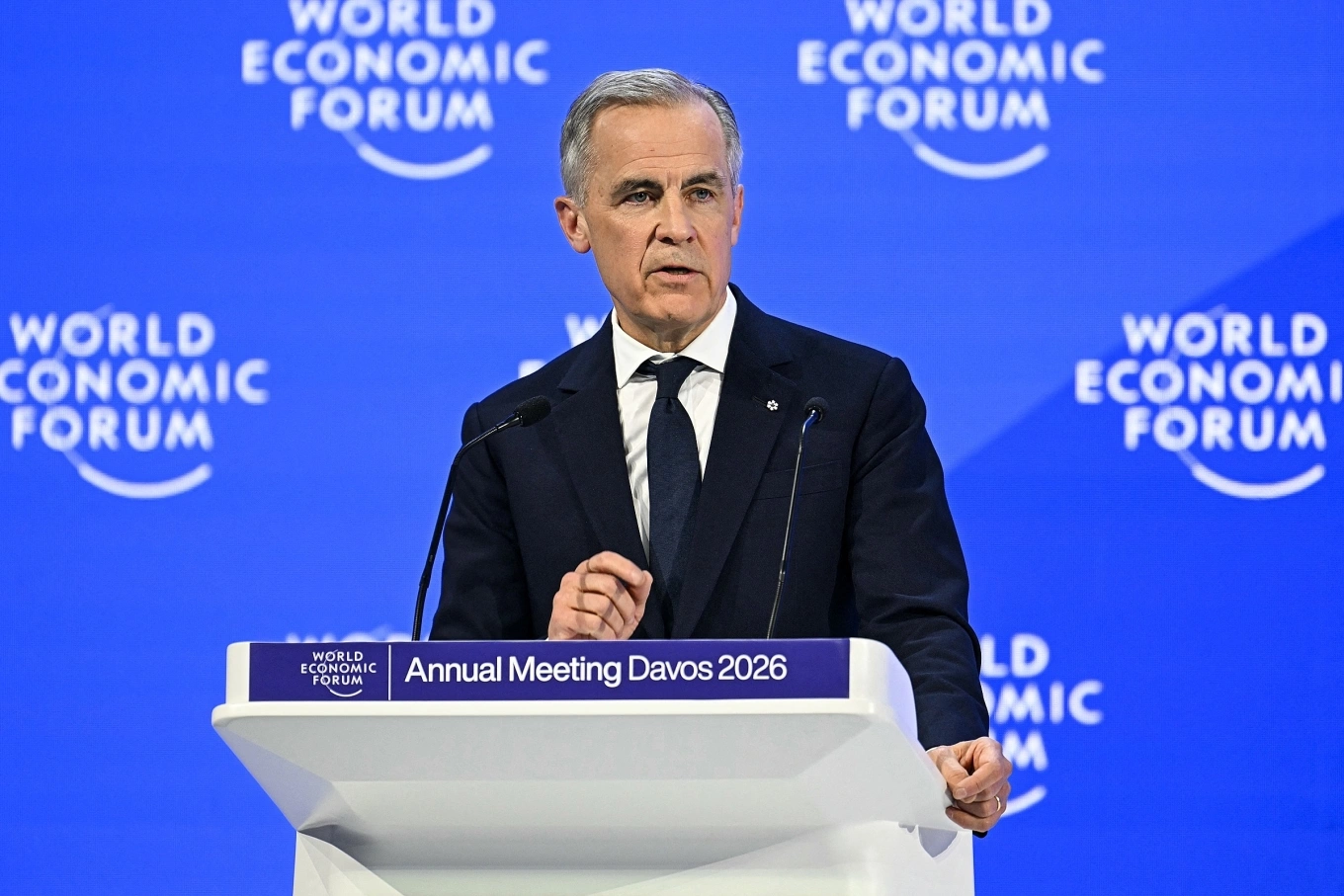
DAVOS, Switzerland — In a speech that rippled far beyond the Alpine corridors of the World Economic Forum, Canada’s Prime Minister, Mark Carney, delivered one of the clearest and most consequential rebukes yet of the United States’ current posture on the world stage — and, in doing so, signaled how profoundly the global order may be shifting.
Speaking before an audience of political leaders, executives, and diplomats in Davos, Mr. Carney declared Canada’s unequivocal support for the sovereignty of Greenland and Denmark in the face of U.S. pressure, reaffirmed Canada’s commitment to NATO’s collective defense clause, and warned that the era of unquestioned American leadership had fractured into something more unstable, transactional, and dangerous.
“This bargain no longer works,” Mr. Carney said, referring to the postwar rules-based international system long underwritten by American power. “We are in the midst of a rupture, not a transition.”
The remarks, which quickly spread across American social media platforms and were dissected by analysts on cable news and financial television, were striking not merely for their content but for their source. Canada, a country that has historically calibrated its diplomacy to avoid open confrontation with Washington, appeared to be doing precisely that — calmly, deliberately, and without apology.
Standing With Greenland — And Against Washington
At the heart of Mr. Carney’s speech was a direct response to recent U.S. rhetoric suggesting possible coercive measures — including tariffs and security pressure — related to Greenland, the autonomous Danish territory of immense strategic value in the Arctic.
Canada, Mr. Carney said, “stands firmly with Greenland and Denmark” and “fully supports their unique right to determine Greenland’s future.” He added that Canada’s commitment to NATO’s Article 5 — the principle that an attack on one member is an attack on all — was “unwavering,” a statement that carried an unmistakable implication: if the United States were to act militarily against Greenland, Canada would side with Denmark.
That assertion reverberated through diplomatic circles. On American political forums and X (formerly Twitter), the speech was described by commentators as “historic,” “extraordinary,” and “a wake-up call.” Even some traditionally Atlanticist analysts noted that Canada had crossed a rhetorical threshold rarely breached by close allies.
A Broader Indictment of American Power
Yet the speech was about far more than Greenland.
Mr. Carney offered a sweeping critique of what he described as the weaponization of globalization by great powers — most pointedly the United States — through tariffs, financial infrastructure, and supply chains used as tools of coercion rather than cooperation.
“For decades, countries like Canada prospered under what we called the rules-based international order,” he said. “We knew the story was partially false. But American hegemony provided public goods — open sea lanes, a stable financial system, collective security.”

That implicit bargain, Mr. Carney argued, has now collapsed.
Analysts on Bloomberg Television and foreign-policy commentators on Substack quickly noted the significance of the language. Mr. Carney did not frame the problem as a temporary deviation or a partisan anomaly. Instead, he portrayed the rupture as structural — a breakdown that middle powers could no longer afford to ignore or paper over with diplomatic ritual.
“Living Within a Lie”
One of the most widely shared segments of the speech invoked the late Czech dissident Václav Havel and his essay The Power of the Powerless. Mr. Carney described the metaphor of the shopkeeper who displays a political slogan he does not believe, not out of conviction but out of fear and convenience.
“For decades,” Mr. Carney said, “we placed the sign in the window. We participated in the rituals.”
That era, he argued, is over.
The passage resonated widely online, particularly among policy professionals and academics, many of whom saw it as a rare moment of moral clarity in a forum often criticized for platitudes. Several prominent American commentators noted that Mr. Carney’s language echoed criticisms long voiced by smaller nations — but rarely by a G7 leader speaking so plainly.
The Middle Powers’ Dilemma
A central theme of the address was the emerging role of so-called middle powers — countries like Canada, Finland, South Korea, and Australia — caught between rival great powers yet unwilling to accept subordination.
“When we negotiate bilaterally with a hegemon,” Mr. Carney said, “we negotiate from weakness. This is not sovereignty. It is the performance of sovereignty while accepting subordination.”
Instead, he outlined a strategy of “variable geometry”: flexible coalitions built issue by issue, from Arctic security to artificial intelligence governance to critical minerals supply chains. Canada, he said, is pursuing deeper partnerships with the European Union, Asia-Pacific economies, and energy and defense alliances beyond the traditional U.S.-centric framework.
In recent months, Canada has announced new trade and security agreements across multiple continents, accelerated defense spending, and moved to eliminate internal trade barriers — steps analysts say reflect an effort to reduce dependence on any single partner.
Reaction in the United States
Official reaction from Washington was muted, but the speech dominated discussion in American political media. Some conservative commentators dismissed it as overreach, while others warned that alienating allies risked accelerating the very fragmentation Mr. Carney described.
On mainstream networks, former diplomats acknowledged that the remarks reflected anxieties shared quietly by many allied capitals. “What’s new,” one former U.S. official said on CNN, “is that they’re saying it out loud — and at Davos.”
Markets, for their part, appeared less rattled than attentive. Financial analysts noted that Mr. Carney’s emphasis on stability, rule consistency, and diversified trade was likely to appeal to investors wary of geopolitical volatility.
A Signal, Not a Speech
By the end of his address, Mr. Carney was explicit: nostalgia for the old order, he said, is not a strategy.
“We know the old order is not coming back,” he told the audience. “From the fracture, we can build something stronger, more just.”
Whether that vision proves achievable remains uncertain. But what was unmistakable in Davos was that a line had been drawn — not in anger or spectacle, but with deliberate clarity.
For a country long defined by its quiet diplomacy, Canada had chosen to speak plainly. And in doing so, Prime Minister Mark Carney made clear that the global realignment many have sensed in private is now being articulated, openly, on the world stage.






