Jimmy Kimmel’s Surgical Roast of J.D. Vance Triggers a Trump Meltdown—and a Larger Question About Power
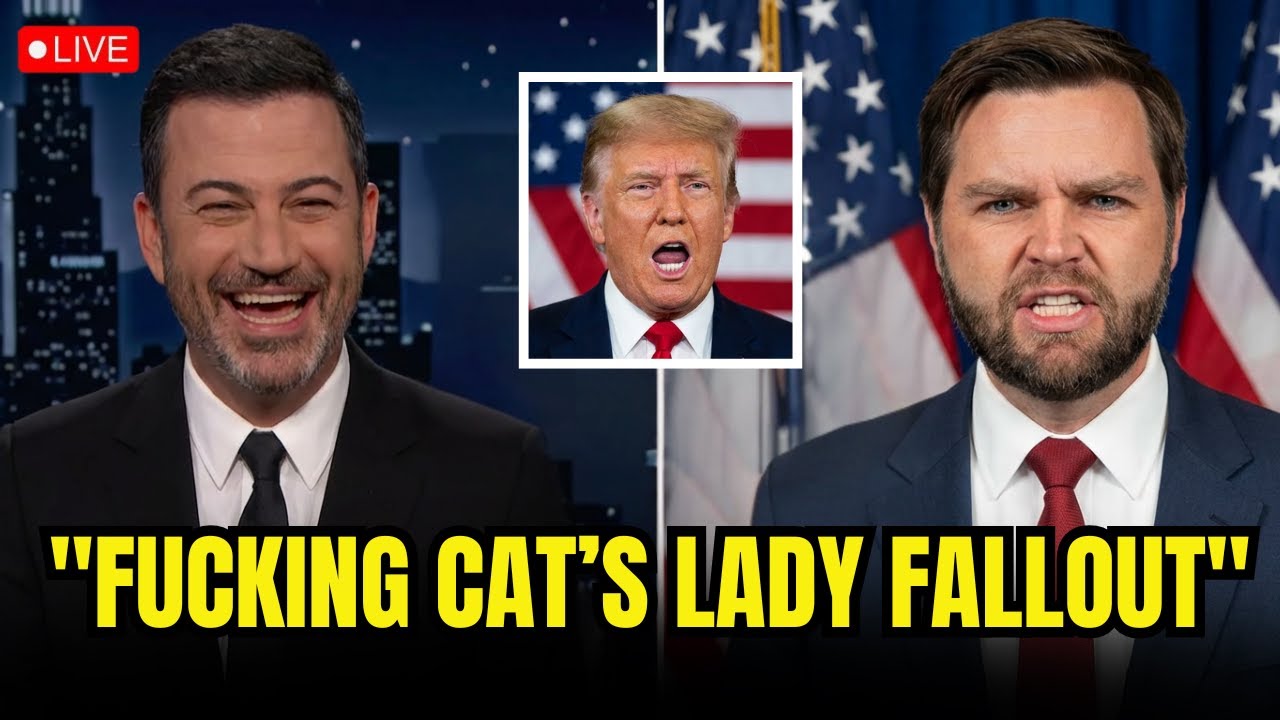
What began as a familiar late-night monologue took an unexpected turn when Jimmy Kimmel decided to do something almost radical in modern political discourse: present evidence in order. No shouting. No viral jump cuts. Just a timeline. By the end of the segment, the audience was laughing—but the political fallout suggested something far more serious had landed.
Kimmel opened by acknowledging an uncomfortable truth. Many Americans, he said, still do not know J.D. Vance all that well. Rather than rush to punchlines, he framed the moment as an introduction. On the screen behind him appeared a simple title: “J.D. Vance: Three Moments.” What followed was not a roast in the traditional sense, but a quiet dismantling of political inconsistency, delivered with the restraint of a courtroom presentation rather than a comedy club rant.
The first clip showed Vance in a polished interview, speaking gently about working families, dignity, and economic fairness. The tone was calm, reassuring, almost therapeutic. The audience responded politely. Then came the second clip: Vance at a rally, sharper and combative, relishing confrontation and dismissing critics with rhetorical swagger. The mood in the room shifted. The third clip completed the arc—Vance insisting that he had always been consistent, that critics were misquoting or misunderstanding him.
Kimmel didn’t interrupt the footage. He let it sit. Then, stepping aside like a teacher reviewing a lesson plan, he delivered the line that reframed the entire segment: “I’m not even roasting him yet. I’m just showing you the before-and-after photo.” The laugh that followed was not cruel. It was recognition.
What made the segment resonate was its precision. Kimmel acknowledged that politicians can evolve. People change. Ideas sharpen. But, he added, “when you evolve three times in one month, that’s not growth—that’s a costume change.” The joke landed because it wasn’t really a joke. It was a diagnosis of political performance in the age of audience targeting, where language shifts depending on who is watching.
Only then did Kimmel begin to roast, and even that was restrained. He mimicked the two versions of Vance—the thoughtful senator voice and the perpetual fighter persona—without venom. The humor worked because it was familiar. As Kimmel put it, this was the coworker who tells the boss one thing and the break room another, then acts shocked when the email thread exists.
The cleanest moment of the night came not with an insult, but a question. “If nothing changes,” Kimmel asked calmly, “why does the wording change every time the audience changes?” The room responded with a low, collective murmur—the sound of a point landing too cleanly to laugh off.
Within hours, the segment exploded online. Clips spread across platforms, not just among late-night comedy fans but among politically neutral viewers replaying the footage for clarity rather than outrage. And then, inevitably, Donald Trump weighed in.
Trump’s response followed a familiar script. He blasted Kimmel as a disgrace, labeled late-night television propaganda, and praised Vance as a great American under attack by a “failing comedian.” He invoked ratings. He repeated the words “fake” and “sad.” What he did not do was address the timeline.
That absence became the story. Kimmel hadn’t accused Vance of anything new. He hadn’t relied on anonymous sources or speculative claims. He had simply shown clips, in sequence. Trump’s response did not correct the record, offer additional context, or dispute the authenticity of the footage. It attempted to overwhelm the moment with volume.
The following night, Kimmel returned with a printout of Trump’s rant, holding it up like a homework assignment. “Thank you for watching,” he said, drawing laughter from the crowd. Then he offered a challenge: if the clips were misleading, post the full context. “That ends this in ten seconds,” he said. “But notice what didn’t happen. No correction. Just more yelling.”
Kimmel laid out what he called the signs you cannot handle the receipts: attack the person holding them, change the subject, demand everyone stop looking. The audience laughed again, but the humor carried an edge. “When you react louder than the evidence,” Kimmel said, “you’re telling people the evidence matters.”
In the end, the segment did not destroy J.D. Vance or Donald Trump. It did something subtler and, perhaps, more dangerous. It forced a question into the open—about consistency, accountability, and whether political power today is built on conviction or adaptation to the room.
For a few minutes on late-night television, the crowd went quiet. And in that silence, a simple truth became hard to ignore: sometimes the most effective critique is not outrage, but order.






