Canada Turns West, and Washington Feels the Chill
By late January 2026, a quiet but consequential shift was underway in North American energy markets — one that is now reverberating through household utility bills, factory balance sheets, and the geopolitical assumptions that have underpinned U.S.-Canadian relations for decades.
For much of the modern era, Canada has been the United States’ most dependable energy partner. Canadian oil heats American homes, fuels American cars, and powers American industry. Canadian natural gas, cheap and abundant, has long flowed south through a dense web of pipelines, cushioning U.S. markets against price spikes and supply disruptions.
That assumption — that Canada would always be there — is now being tested.
Over the past year, Canadian natural gas exports to the United States have fallen sharply, by roughly 40 percent according to industry data circulated by energy analysts and highlighted across financial media and energy-focused social platforms. In January 2025, Canada was sending roughly nine billion cubic feet of gas per day across the border. By mid-January 2026, that figure had fallen to about 5.4 billion.
This is not a weather-driven fluctuation. It is the result of policy, infrastructure and geopolitics colliding.
A Tariff Shock and an Unexpected Response
The trigger dates back to August 2025, when President Trump imposed sweeping tariffs of up to 35 percent on Canadian goods, citing national security concerns under emergency economic powers. The move was framed by the White House as leverage — a way to force concessions on trade, border security and energy terms.
In Ottawa, however, the reaction was not capitulation.
Prime Minister Mark Carney, a former central banker with deep credibility in global markets, responded with a strategy that has since reshaped Canada’s economic trajectory: diversification at scale. Publicly, Carney spoke of “reducing vulnerability.” Privately, according to analysts and former officials, the message was starker — Canada could no longer afford to be structurally dependent on a single, unpredictable customer.
Energy sat at the center of that recalculation.
LNG Changes the Math
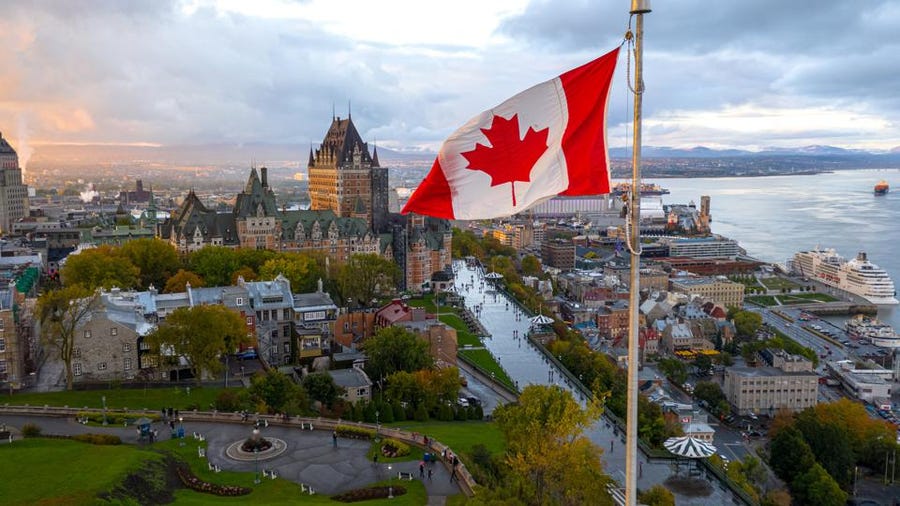
For years, Canada’s natural gas industry had been constrained by geography. Pipelines ran south, not west. Producers had little choice but to sell into North American markets at North American prices.
That changed with the opening of LNG Canada, a $40 billion liquefied natural gas terminal on British Columbia’s coast, backed by Shell and major Asian partners. The facility shipped its first cargoes to South Korea in early January 2026, marking Canada’s entry into the global LNG trade.
The economics are stark. Asian buyers, particularly Japan and South Korea, are paying 30 to 40 percent more for LNG than prevailing North American prices. For Canadian producers, the choice is obvious.
Gas that once flowed south to Michigan and Ohio now flows west to the Pacific.
And more is coming. Ottawa has approved a second wave of major projects — including the Ksi Lisims LNG terminal and associated pipelines — bringing total announced energy and infrastructure investment to roughly $116 billion. These are not short-term hedges. They are long-lived assets designed to operate for decades.
The Impact at Home
For American consumers, the consequences are already becoming visible.
The Energy Information Administration has projected that U.S. natural gas prices will average close to $4 per million British thermal units in 2026, nearly double 2024 levels. While multiple factors are at play — rising LNG exports from the Gulf Coast, surging demand from data centers and artificial intelligence infrastructure — analysts increasingly point to declining Canadian imports as a key source of pressure.
Nearly half of American homes rely on natural gas for heating. In colder states across the Midwest and Northeast, higher prices translate directly into higher winter bills. Energy economists estimate that some households could see heating costs rise by 25 to 30 percent compared with two years ago.
Manufacturers are feeling the squeeze even more acutely. Natural gas is not just fuel; it is a feedstock for chemicals, fertilizers, plastics and steel. On social media platforms like X and LinkedIn, executives from energy-intensive industries have warned that sustained price increases could force production cuts and layoffs, particularly among smaller firms with thin margins.
A Strategic Realignment
Beyond economics, the shift carries profound geopolitical implications.
Canada has long been viewed in Washington as a “safe” supplier — politically aligned, geographically proximate, and deeply integrated into U.S. markets. That reliability was assumed, not negotiated.
Now, Canada has options.
Asian governments, still wary after Russia’s weaponization of energy supplies, are eager for long-term contracts with stable producers. Canadian LNG, marketed as among the lowest-emissions in the world, fits neatly into their decarbonization strategies. Long-term supply agreements, some reportedly stretching 15 to 20 years, are being finalized now.
Once signed, those volumes will not easily return to North American markets.
Trade diversification is extending beyond energy. Ottawa and Beijing have quietly reset parts of their economic relationship, reducing tariffs on Canadian agricultural exports while easing restrictions on Chinese electric vehicles. Europe, meanwhile, has deepened energy cooperation with Canada, particularly around hydrogen and critical minerals.
The message is consistent: Canada is hedging against U.S. unpredictability.
Politics and Irony

The irony is difficult to miss.
President Trump’s tariff strategy was designed to strengthen American leverage. Instead, it appears to have accelerated the erosion of it. Even if tariffs were lifted tomorrow, the infrastructure and contracts underpinning Canada’s pivot would remain.
Some Republicans have begun to voice concern. Senator Lisa Murkowski of Alaska warned publicly in December that “we cannot tariff our way to energy security,” a sentiment echoed quietly by governors in gas-dependent states, according to people familiar with the discussions.
Business groups have been more explicit. In December, hundreds of American trade associations signed a joint letter urging stability ahead of the 2026 review of the U.S.-Mexico-Canada Agreement, warning that uncertainty was driving investment away from North America.
A New Energy Reality
None of this means the United States lacks energy. American production remains enormous, and LNG exports from Texas and Louisiana are booming. But energy security is not just about resources; it is about reliable relationships.
For decades, Washington assumed Ottawa needed U.S. markets more than the U.S. needed Canadian supply. That assumption is no longer safe.
Canada is not abandoning the United States. But it is no longer organizing its economy around American needs. The balance has shifted — quietly, structurally, and perhaps permanently.
As one widely shared post by a veteran energy analyst put it: “This isn’t Canada punishing the U.S. It’s Canada discovering it doesn’t have to choose.”
For American consumers and policymakers, that discovery is already proving expensive.






