Canada’s Fighter Jet Dilemma: Sovereignty, Cost and the Price of Alliance

For more than a decade, Canada’s effort to replace its aging fighter fleet has been framed as a technical procurement question. How many aircraft? Which platform? At what cost? Yet what began as a routine military modernization has quietly evolved into one of the most consequential sovereignty debates in modern Canadian history—one that now forces Ottawa to reconsider not just what it flies, but how much control it truly holds over its own defense.
At the center of the controversy stands the F-35A Lightning II, the fifth-generation stealth fighter produced by Lockheed Martin and championed by Washington as the backbone of allied air power. After years of political turmoil and repeated reviews, Canada formally selected the F-35 in 2023, committing to purchase 88 aircraft. Deliveries were set to begin in 2026, with full operational capability expected by 2032.
For a moment, the saga appeared settled.
It did not last.
In June 2025, Canada’s auditor general released a report that stunned both Parliament and the defense establishment. The program’s projected cost had surged from an initial estimate of 19 billion Canadian dollars to at least 27.7 billion, with the possibility of reaching 33 billion once infrastructure upgrades, weapons integration, training pipelines and long-term sustainment were fully accounted for—a cost increase of roughly 75 percent.
The report echoed criticisms long voiced by defense economists and watchdog groups, many of whom argued on platforms like X and in U.S.-based outlets such as Defense News that early F-35 estimates across partner nations consistently understated lifetime costs. What was harder to ignore was the timing. The cost shock landed amid renewed political turbulence in the Canada–U.S. relationship.
Donald Trump, serving a second presidential term, had announced plans to impose 25 percent tariffs on Canadian goods, while reviving rhetoric that questioned Canada’s economic independence and even its political future. Though widely dismissed as provocation, the message resonated deeply in Ottawa. Defense analysts at U.S. think tanks such as Brookings and the Atlantic Council noted that alliance politics, once assumed to be stable, had entered a more transactional phase.
Against this backdrop, Canada made an unexpected move.

In August 2025, Ottawa signed a defense and aerospace cooperation agreement with Sweden focused on Arctic security. Almost immediately, Saab—the Swedish defense firm behind the Gripen E fighter—advanced a proposal that reframed the debate. Rather than a simple aircraft sale, Saab offered a sweeping industrial partnership: final assembly in Canada, broad technology transfer, domestic control over maintenance and upgrades, and the creation of as many as 12,600 aerospace jobs.
Bombardier, Canada’s aerospace flagship, was positioned as a central partner.
The proposal electrified political discourse. Supporters saw an opportunity to reclaim industrial autonomy and reduce long-term dependence on the United States. Critics warned of diplomatic fallout and operational compromise. American defense commentators on social media were blunt. Some framed the move as a test of alliance discipline; others saw it as an inevitable response to ballooning costs and political leverage.
In March 2025, the debate crossed a threshold. Defense Minister Bill Blair announced that Canada would formally re-examine its F-35 commitment, reopening consideration of the Gripen E, which had previously competed in the 2021 procurement process.
In Washington, the reaction was immediate and uneasy. Lockheed Martin executives, Pentagon officials and congressional defense hawks had long viewed Canada’s participation as a given. The possibility that a cornerstone NATO partner might partially walk away from the F-35 program was no longer theoretical.
The reasons behind Canada’s hesitation are threefold: economics, politics and technology.
The financial case is the most visible. As the auditor general made clear, the F-35 is not merely an aircraft but a decades-long ecosystem of obligations. Sustainment costs alone are projected to dominate defense budgets well into the 2050s. Analysts writing in Politico and Breaking Defense have noted that for mid-sized air forces, these costs can crowd out spending on personnel, infrastructure and other capabilities.
Politics compounds the concern. The F-35’s operational viability depends on continuous software updates, mission data files and logistics systems controlled by the United States. While the Pentagon has repeatedly denied the existence of a so-called “kill switch,” the underlying reality is uncontested: without U.S.-managed updates, the aircraft’s effectiveness degrades over time.

On defense podcasts popular among U.S. veterans and analysts, this has become a recurring theme. Control over software, they argue, is control over combat power. Only Israel, under a unique security arrangement, has independent access to key elements of the F-35’s software architecture.
Saab’s pitch exploits this anxiety. The Gripen E, while less stealthy and technologically complex, offers full national control over upgrades and modifications. Its operating cost—estimated at around $8,000 per flight hour—stands in stark contrast to estimates of $35,000 to $47,000 for the F-35. Designed to operate from short runways and dispersed locations, including highways, the Gripen aligns naturally with Canada’s Arctic geography.
Yet the trade-offs are real.
A leaked technical evaluation from the 2021 competition resurfaced in late 2025, reigniting controversy. The F-35 scored near-perfect marks for mission effectiveness and upgrade potential, while the Gripen lagged significantly. Senior Royal Canadian Air Force leaders publicly warned that substituting capability with affordability could undermine deterrence in high-intensity conflict.
American military commentators echoed that concern. On X, former U.S. Air Force officers argued that air combat is increasingly defined by sensor fusion and network dominance—areas where the F-35 remains unmatched.
Even the industrial argument contains a paradox. The Gripen’s engine, the General Electric F414, is manufactured in the United States. Export licenses remain subject to American approval, underscoring the reality that complete autonomy is illusory. As several U.S. analysts have pointed out, leverage exists not only in hardware but in intelligence sharing, NORAD cooperation and trade policy.
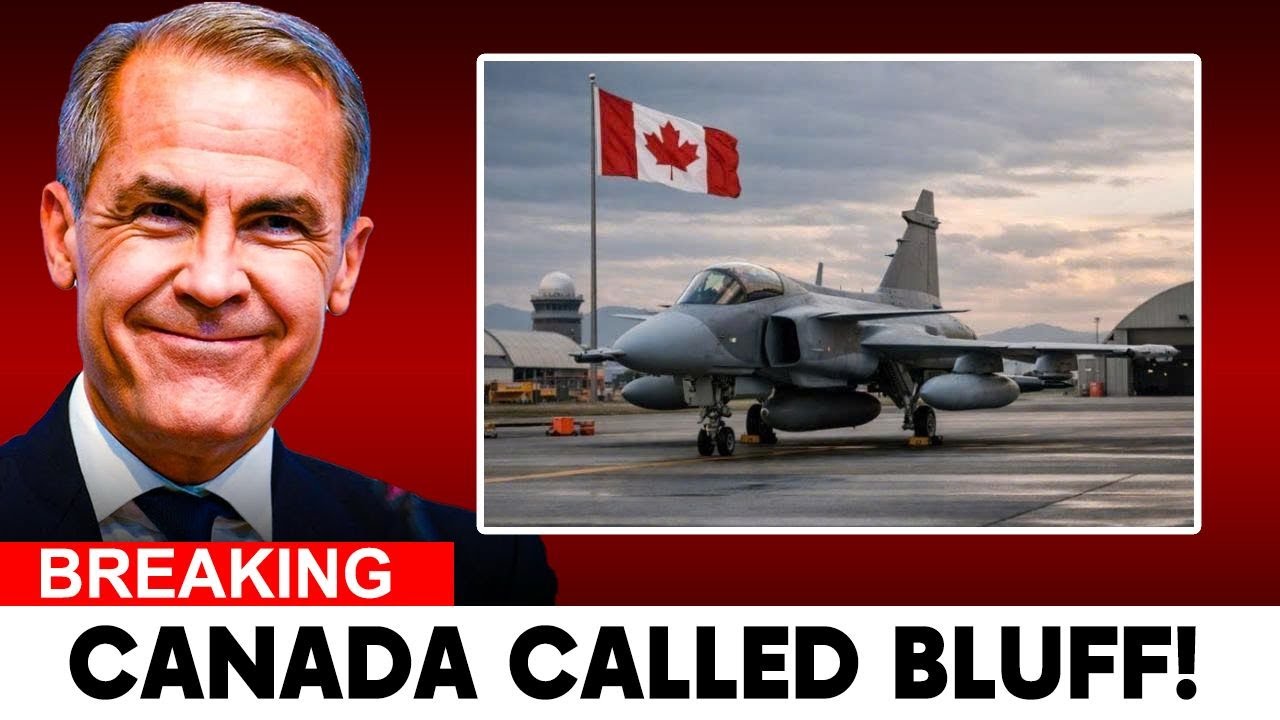
In response, Saab floated a compromise: Canada would accept delivery of the first 16 F-35s, honoring existing commitments, while replacing the remaining 72 aircraft with Gripen variants assembled domestically. The hybrid approach aims to preserve alliance credibility while anchoring industrial capacity at home.
The risks are substantial. Operating two fighter platforms would increase logistical complexity, training costs and operational friction. In a crisis, inconsistency can be fatal.
By early 2026, Ottawa’s language had grown cautious. Full withdrawal from the F-35 remains unlikely. But alternatives are no longer unthinkable.
What this debate ultimately reveals is not indecision, but transition. Canada is confronting a reality increasingly discussed in American strategic circles: modern defense is as much about control of data and supply chains as it is about firepower. Choosing the F-35 means embracing unparalleled capability—along with constraints that quietly redefine ownership. Choosing the Gripen signals a bid for autonomy, at the cost of diplomatic and operational risk.
Prime Minister Mark Carney has already committed to the first 16 F-35s. The fate of the remaining 72 will shape not only the Royal Canadian Air Force, but Canada’s understanding of sovereignty in an era where security and dependence are inseparable.
The decision, once framed as technical, has become existential.






